1 / 5
17th-Century Silver Candle Snuffers
Candle Snuffers or Scissors
William Bainbridge
Circa 1685
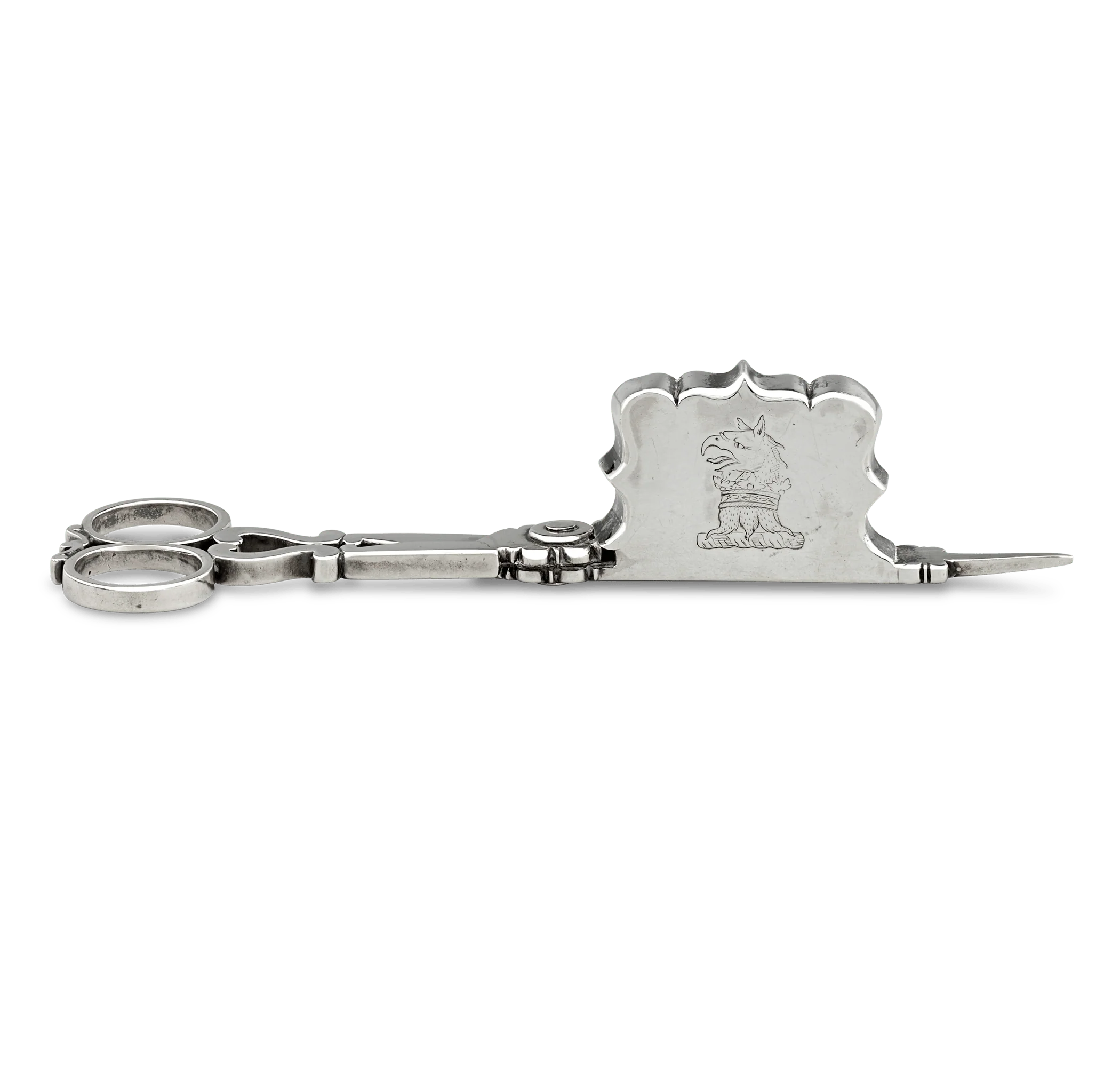
This remarkable pair of 17th-century English candle scissors and snuffers exemplifies an elegant solution to a common candle maintenance challenge of the era. As beeswax was very expensive, everyday candles were typically made from tallow, a material prone to uneven burning. The wicks, crafted from tightly braided fibers, didn’t burn away, growing longer as the candle melted. These wicks would often curl back into the flame, extinguishing it. This required frequent trimming to maintain a steady light.
Candle scissors like these served to trim the wick, ensuring a steadier, more even burn. The small box attached to one of the blades collected trimmed wick remnants, while the longer blade’s pointed end was designed to skillfully uncurl the wick and remove charred portions. Additionally, these scissors could be used to snuff out the flame, functioning as candle snuffers. While most candle scissors were crafted from iron, brass or steel, more upscale households favored ornamental versions made of silver, such as this elegant pair. Surviving examples of 17th-century silver are extremely uncommon today, as much was melted down for materials.
This rare example, stamped six times with the initials "WB," is attributed to William Bainbridge or Bambridge. Other candle scissors bearing this "WB" mark survive from the reign of James II. The scissor's compartment is elegantly engraved with a griffin’s head erased, a heraldic crest linking it to the noble Watson family, Earls of Rockingham—a lineage that dates back to the late 15th century and became extinct in 1746. Additionally, these scissors were a part of the prestigious Red McCombs collection, which has been highly publicized and studied.
6 1/2" high x 2 1/4" wide x 1 1/2" deep
Provenance:
Private collection of the Watson family, Rockingham
M.S. Rau, New Orleans
Red McCombs Collection, Texas
M.S. Rau, New Orleans
William Bainbridge
Circa 1685
This remarkable pair of 17th-century English candle scissors and snuffers exemplifies an elegant solution to a common candle maintenance challenge of the era. As beeswax was very expensive, everyday candles were typically made from tallow, a material prone to uneven burning. The wicks, crafted from tightly braided fibers, didn’t burn away, growing longer as the candle melted. These wicks would often curl back into the flame, extinguishing it. This required frequent trimming to maintain a steady light.
Candle scissors like these served to trim the wick, ensuring a steadier, more even burn. The small box attached to one of the blades collected trimmed wick remnants, while the longer blade’s pointed end was designed to skillfully uncurl the wick and remove charred portions. Additionally, these scissors could be used to snuff out the flame, functioning as candle snuffers. While most candle scissors were crafted from iron, brass or steel, more upscale households favored ornamental versions made of silver, such as this elegant pair. Surviving examples of 17th-century silver are extremely uncommon today, as much was melted down for materials.
This rare example, stamped six times with the initials "WB," is attributed to William Bainbridge or Bambridge. Other candle scissors bearing this "WB" mark survive from the reign of James II. The scissor's compartment is elegantly engraved with a griffin’s head erased, a heraldic crest linking it to the noble Watson family, Earls of Rockingham—a lineage that dates back to the late 15th century and became extinct in 1746. Additionally, these scissors were a part of the prestigious Red McCombs collection, which has been highly publicized and studied.
6 1/2" high x 2 1/4" wide x 1 1/2" deep
Provenance:
Private collection of the Watson family, Rockingham
M.S. Rau, New Orleans
Red McCombs Collection, Texas
M.S. Rau, New Orleans
Candle Snuffers or Scissors
William Bainbridge
Circa 1685
This remarkable pair of 17th-century English candle scissors and snuffers exemplifies an elegant solution to a common candle maintenance challenge of the era. As beeswax was very expensive, everyday candles were typically made from tallow, a material prone to uneven burning. The wicks, crafted from tightly braided fibers, didn’t burn away, growing longer as the candle melted. These wicks would often curl back into the flame, extinguishing it. This required frequent trimming to maintain a steady light.
Candle scissors like these served to trim the wick, ensuring a steadier, more even burn. The small box attached to one of the blades collected trimmed wick remnants, while the longer blade’s pointed end was designed to skillfully uncurl the wick and remove charred portions. Additionally, these scissors could be used to snuff out the flame, functioning as candle snuffers. While most candle scissors were crafted from iron, brass or steel, more upscale households favored ornamental versions made of silver, such as this elegant pair. Surviving examples of 17th-century silver are extremely uncommon today, as much was melted down for materials.
This rare example, stamped six times with the initials "WB," is attributed to William Bainbridge or Bambridge. Other candle scissors bearing this "WB" mark survive from the reign of James II. The scissor's compartment is elegantly engraved with a griffin’s head erased, a heraldic crest linking it to the noble Watson family, Earls of Rockingham—a lineage that dates back to the late 15th century and became extinct in 1746. Additionally, these scissors were a part of the prestigious Red McCombs collection, which has been highly publicized and studied.
6 1/2" high x 2 1/4" wide x 1 1/2" deep
Provenance:
Private collection of the Watson family, Rockingham
M.S. Rau, New Orleans
Red McCombs Collection, Texas
M.S. Rau, New Orleans
William Bainbridge
Circa 1685
This remarkable pair of 17th-century English candle scissors and snuffers exemplifies an elegant solution to a common candle maintenance challenge of the era. As beeswax was very expensive, everyday candles were typically made from tallow, a material prone to uneven burning. The wicks, crafted from tightly braided fibers, didn’t burn away, growing longer as the candle melted. These wicks would often curl back into the flame, extinguishing it. This required frequent trimming to maintain a steady light.
Candle scissors like these served to trim the wick, ensuring a steadier, more even burn. The small box attached to one of the blades collected trimmed wick remnants, while the longer blade’s pointed end was designed to skillfully uncurl the wick and remove charred portions. Additionally, these scissors could be used to snuff out the flame, functioning as candle snuffers. While most candle scissors were crafted from iron, brass or steel, more upscale households favored ornamental versions made of silver, such as this elegant pair. Surviving examples of 17th-century silver are extremely uncommon today, as much was melted down for materials.
This rare example, stamped six times with the initials "WB," is attributed to William Bainbridge or Bambridge. Other candle scissors bearing this "WB" mark survive from the reign of James II. The scissor's compartment is elegantly engraved with a griffin’s head erased, a heraldic crest linking it to the noble Watson family, Earls of Rockingham—a lineage that dates back to the late 15th century and became extinct in 1746. Additionally, these scissors were a part of the prestigious Red McCombs collection, which has been highly publicized and studied.
6 1/2" high x 2 1/4" wide x 1 1/2" deep
Provenance:
Private collection of the Watson family, Rockingham
M.S. Rau, New Orleans
Red McCombs Collection, Texas
M.S. Rau, New Orleans
$1,575.00
Original: $4,500.00
-65%17th-Century Silver Candle Snuffers—
$4,500.00
$1,575.00Description
Candle Snuffers or Scissors
William Bainbridge
Circa 1685
This remarkable pair of 17th-century English candle scissors and snuffers exemplifies an elegant solution to a common candle maintenance challenge of the era. As beeswax was very expensive, everyday candles were typically made from tallow, a material prone to uneven burning. The wicks, crafted from tightly braided fibers, didn’t burn away, growing longer as the candle melted. These wicks would often curl back into the flame, extinguishing it. This required frequent trimming to maintain a steady light.
Candle scissors like these served to trim the wick, ensuring a steadier, more even burn. The small box attached to one of the blades collected trimmed wick remnants, while the longer blade’s pointed end was designed to skillfully uncurl the wick and remove charred portions. Additionally, these scissors could be used to snuff out the flame, functioning as candle snuffers. While most candle scissors were crafted from iron, brass or steel, more upscale households favored ornamental versions made of silver, such as this elegant pair. Surviving examples of 17th-century silver are extremely uncommon today, as much was melted down for materials.
This rare example, stamped six times with the initials "WB," is attributed to William Bainbridge or Bambridge. Other candle scissors bearing this "WB" mark survive from the reign of James II. The scissor's compartment is elegantly engraved with a griffin’s head erased, a heraldic crest linking it to the noble Watson family, Earls of Rockingham—a lineage that dates back to the late 15th century and became extinct in 1746. Additionally, these scissors were a part of the prestigious Red McCombs collection, which has been highly publicized and studied.
6 1/2" high x 2 1/4" wide x 1 1/2" deep
Provenance:
Private collection of the Watson family, Rockingham
M.S. Rau, New Orleans
Red McCombs Collection, Texas
M.S. Rau, New Orleans
William Bainbridge
Circa 1685
This remarkable pair of 17th-century English candle scissors and snuffers exemplifies an elegant solution to a common candle maintenance challenge of the era. As beeswax was very expensive, everyday candles were typically made from tallow, a material prone to uneven burning. The wicks, crafted from tightly braided fibers, didn’t burn away, growing longer as the candle melted. These wicks would often curl back into the flame, extinguishing it. This required frequent trimming to maintain a steady light.
Candle scissors like these served to trim the wick, ensuring a steadier, more even burn. The small box attached to one of the blades collected trimmed wick remnants, while the longer blade’s pointed end was designed to skillfully uncurl the wick and remove charred portions. Additionally, these scissors could be used to snuff out the flame, functioning as candle snuffers. While most candle scissors were crafted from iron, brass or steel, more upscale households favored ornamental versions made of silver, such as this elegant pair. Surviving examples of 17th-century silver are extremely uncommon today, as much was melted down for materials.
This rare example, stamped six times with the initials "WB," is attributed to William Bainbridge or Bambridge. Other candle scissors bearing this "WB" mark survive from the reign of James II. The scissor's compartment is elegantly engraved with a griffin’s head erased, a heraldic crest linking it to the noble Watson family, Earls of Rockingham—a lineage that dates back to the late 15th century and became extinct in 1746. Additionally, these scissors were a part of the prestigious Red McCombs collection, which has been highly publicized and studied.
6 1/2" high x 2 1/4" wide x 1 1/2" deep
Provenance:
Private collection of the Watson family, Rockingham
M.S. Rau, New Orleans
Red McCombs Collection, Texas
M.S. Rau, New Orleans