1 / 6
+1
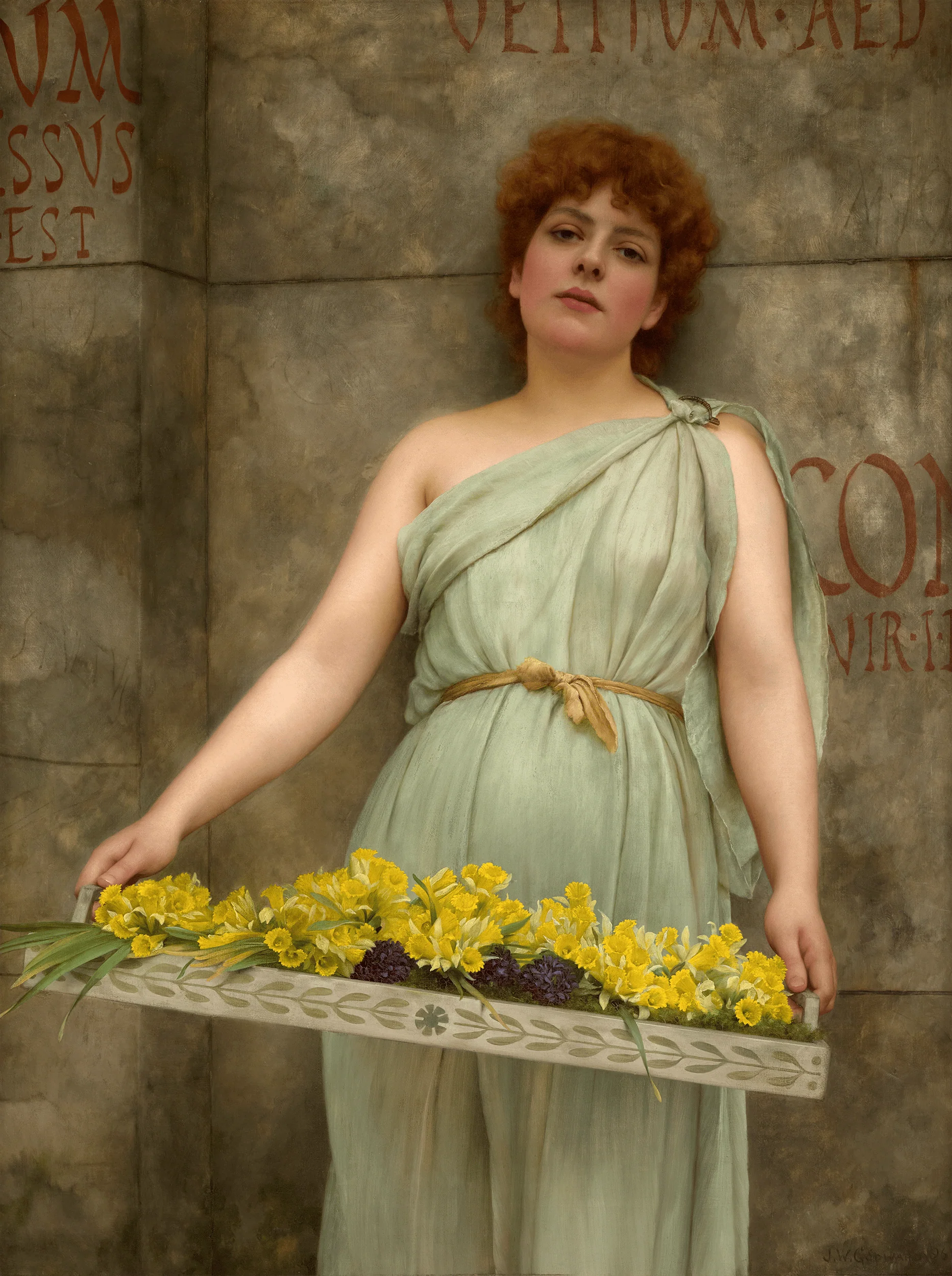
A Flower Seller by John William Godward
John William Godward
1861-1922 | British
A Flower Seller
Signed and dated lower right "J.W. Godward 96"
Oil on canvas
This stunning painting by John William Godward is a monumental masterpiece of the artist's oeuvre. Celebrated as one of the most important Neoclassical painters at the turn of the century, Godward's career was devoted to a style of Classicism known as the "Marble School," which rendered Greco-Roman beauties in their exquisite architectural settings.
A large-scale masterwork, A Flower Seller was exhibited at the prestigious Royal Academy in 1896, the most important venue for artists of the 19th century, where only the best works were shown. Here, the flower seller boldly engages the viewer with her mesmerizing gaze, and her rosy cheeks and glowing skin exude an ethereal beauty. Godward displays his extraordinary talent for rendering every surface with incredible realism, immersing his viewers in the allure of this bygone era. Of Godward's compelling oeuvre, esteemed art historian Vern Grosvenor Swanson wrote, “He sought to portray peace, feminine charm and ideal perfection by marvelously painted and composed classical pictures of beautiful women in halcyon marble environments.”
Raised in Wimbledon, England, Godward debuted at London’s Royal Academy exhibition in 1887. By the subsequent decade, the burgeoning artist was on a steady ascent to artistic success. Having fallen under the influence of British Neoclassical Revivalists Sir Lawrence Alma-Tadema, Lord Frederic Leighton, and Sir Edward John Poynter, Godward quickly rivaled their style. The sensuality and mystery of Godward’s maidens, combined with his impressive backdrops, attracted fans across Europe and sent Godward on a rapid ascent to artistic stardom.
In 1889, he was elected to the Royal Society of British Artists. Ten years later, Godward debuted at the Parisian Salon of 1899, where again he was heaped with praise. He moved to Rome in 1912 to surround himself with the physical remnants of the classical world, and there he stayed for the major part of his remaining career. Today, his works belong to prestigious collections worldwide, including the Getty Museum and the Manchester Art Gallery.
Dated 1896
Canvas: 47 1/2” high x 35 1/2” wide (120.65 x 90.17 cm)
Frame: 55 1/2” high x 43 1/2” wide x 7 3/4” deep (140.97 x 110.49 x 12.07 cm)
Provenance:
Messrs. Thomas McClean, London, May 2, 1896
Private collection
M.S. Rau, New Orleans
Literature:
H.G. Blackburn, Academy Notes, 1896
Vern Grosvenor Swanson, John William Godward: The Eclipse of Classicism, London, 1998, p. 194, no. 5, illustrated
Exhibited:
Royal Academy of Art, Summer Exhibition, London, 1896, no. 597
1861-1922 | British
A Flower Seller
Signed and dated lower right "J.W. Godward 96"
Oil on canvas
This stunning painting by John William Godward is a monumental masterpiece of the artist's oeuvre. Celebrated as one of the most important Neoclassical painters at the turn of the century, Godward's career was devoted to a style of Classicism known as the "Marble School," which rendered Greco-Roman beauties in their exquisite architectural settings.
A large-scale masterwork, A Flower Seller was exhibited at the prestigious Royal Academy in 1896, the most important venue for artists of the 19th century, where only the best works were shown. Here, the flower seller boldly engages the viewer with her mesmerizing gaze, and her rosy cheeks and glowing skin exude an ethereal beauty. Godward displays his extraordinary talent for rendering every surface with incredible realism, immersing his viewers in the allure of this bygone era. Of Godward's compelling oeuvre, esteemed art historian Vern Grosvenor Swanson wrote, “He sought to portray peace, feminine charm and ideal perfection by marvelously painted and composed classical pictures of beautiful women in halcyon marble environments.”
Raised in Wimbledon, England, Godward debuted at London’s Royal Academy exhibition in 1887. By the subsequent decade, the burgeoning artist was on a steady ascent to artistic success. Having fallen under the influence of British Neoclassical Revivalists Sir Lawrence Alma-Tadema, Lord Frederic Leighton, and Sir Edward John Poynter, Godward quickly rivaled their style. The sensuality and mystery of Godward’s maidens, combined with his impressive backdrops, attracted fans across Europe and sent Godward on a rapid ascent to artistic stardom.
In 1889, he was elected to the Royal Society of British Artists. Ten years later, Godward debuted at the Parisian Salon of 1899, where again he was heaped with praise. He moved to Rome in 1912 to surround himself with the physical remnants of the classical world, and there he stayed for the major part of his remaining career. Today, his works belong to prestigious collections worldwide, including the Getty Museum and the Manchester Art Gallery.
Dated 1896
Canvas: 47 1/2” high x 35 1/2” wide (120.65 x 90.17 cm)
Frame: 55 1/2” high x 43 1/2” wide x 7 3/4” deep (140.97 x 110.49 x 12.07 cm)
Provenance:
Messrs. Thomas McClean, London, May 2, 1896
Private collection
M.S. Rau, New Orleans
Literature:
H.G. Blackburn, Academy Notes, 1896
Vern Grosvenor Swanson, John William Godward: The Eclipse of Classicism, London, 1998, p. 194, no. 5, illustrated
Exhibited:
Royal Academy of Art, Summer Exhibition, London, 1896, no. 597
John William Godward
1861-1922 | British
A Flower Seller
Signed and dated lower right "J.W. Godward 96"
Oil on canvas
This stunning painting by John William Godward is a monumental masterpiece of the artist's oeuvre. Celebrated as one of the most important Neoclassical painters at the turn of the century, Godward's career was devoted to a style of Classicism known as the "Marble School," which rendered Greco-Roman beauties in their exquisite architectural settings.
A large-scale masterwork, A Flower Seller was exhibited at the prestigious Royal Academy in 1896, the most important venue for artists of the 19th century, where only the best works were shown. Here, the flower seller boldly engages the viewer with her mesmerizing gaze, and her rosy cheeks and glowing skin exude an ethereal beauty. Godward displays his extraordinary talent for rendering every surface with incredible realism, immersing his viewers in the allure of this bygone era. Of Godward's compelling oeuvre, esteemed art historian Vern Grosvenor Swanson wrote, “He sought to portray peace, feminine charm and ideal perfection by marvelously painted and composed classical pictures of beautiful women in halcyon marble environments.”
Raised in Wimbledon, England, Godward debuted at London’s Royal Academy exhibition in 1887. By the subsequent decade, the burgeoning artist was on a steady ascent to artistic success. Having fallen under the influence of British Neoclassical Revivalists Sir Lawrence Alma-Tadema, Lord Frederic Leighton, and Sir Edward John Poynter, Godward quickly rivaled their style. The sensuality and mystery of Godward’s maidens, combined with his impressive backdrops, attracted fans across Europe and sent Godward on a rapid ascent to artistic stardom.
In 1889, he was elected to the Royal Society of British Artists. Ten years later, Godward debuted at the Parisian Salon of 1899, where again he was heaped with praise. He moved to Rome in 1912 to surround himself with the physical remnants of the classical world, and there he stayed for the major part of his remaining career. Today, his works belong to prestigious collections worldwide, including the Getty Museum and the Manchester Art Gallery.
Dated 1896
Canvas: 47 1/2” high x 35 1/2” wide (120.65 x 90.17 cm)
Frame: 55 1/2” high x 43 1/2” wide x 7 3/4” deep (140.97 x 110.49 x 12.07 cm)
Provenance:
Messrs. Thomas McClean, London, May 2, 1896
Private collection
M.S. Rau, New Orleans
Literature:
H.G. Blackburn, Academy Notes, 1896
Vern Grosvenor Swanson, John William Godward: The Eclipse of Classicism, London, 1998, p. 194, no. 5, illustrated
Exhibited:
Royal Academy of Art, Summer Exhibition, London, 1896, no. 597
1861-1922 | British
A Flower Seller
Signed and dated lower right "J.W. Godward 96"
Oil on canvas
This stunning painting by John William Godward is a monumental masterpiece of the artist's oeuvre. Celebrated as one of the most important Neoclassical painters at the turn of the century, Godward's career was devoted to a style of Classicism known as the "Marble School," which rendered Greco-Roman beauties in their exquisite architectural settings.
A large-scale masterwork, A Flower Seller was exhibited at the prestigious Royal Academy in 1896, the most important venue for artists of the 19th century, where only the best works were shown. Here, the flower seller boldly engages the viewer with her mesmerizing gaze, and her rosy cheeks and glowing skin exude an ethereal beauty. Godward displays his extraordinary talent for rendering every surface with incredible realism, immersing his viewers in the allure of this bygone era. Of Godward's compelling oeuvre, esteemed art historian Vern Grosvenor Swanson wrote, “He sought to portray peace, feminine charm and ideal perfection by marvelously painted and composed classical pictures of beautiful women in halcyon marble environments.”
Raised in Wimbledon, England, Godward debuted at London’s Royal Academy exhibition in 1887. By the subsequent decade, the burgeoning artist was on a steady ascent to artistic success. Having fallen under the influence of British Neoclassical Revivalists Sir Lawrence Alma-Tadema, Lord Frederic Leighton, and Sir Edward John Poynter, Godward quickly rivaled their style. The sensuality and mystery of Godward’s maidens, combined with his impressive backdrops, attracted fans across Europe and sent Godward on a rapid ascent to artistic stardom.
In 1889, he was elected to the Royal Society of British Artists. Ten years later, Godward debuted at the Parisian Salon of 1899, where again he was heaped with praise. He moved to Rome in 1912 to surround himself with the physical remnants of the classical world, and there he stayed for the major part of his remaining career. Today, his works belong to prestigious collections worldwide, including the Getty Museum and the Manchester Art Gallery.
Dated 1896
Canvas: 47 1/2” high x 35 1/2” wide (120.65 x 90.17 cm)
Frame: 55 1/2” high x 43 1/2” wide x 7 3/4” deep (140.97 x 110.49 x 12.07 cm)
Provenance:
Messrs. Thomas McClean, London, May 2, 1896
Private collection
M.S. Rau, New Orleans
Literature:
H.G. Blackburn, Academy Notes, 1896
Vern Grosvenor Swanson, John William Godward: The Eclipse of Classicism, London, 1998, p. 194, no. 5, illustrated
Exhibited:
Royal Academy of Art, Summer Exhibition, London, 1896, no. 597
$309,750.00
Original: $885,000.00
-65%A Flower Seller by John William Godward—
$885,000.00
$309,750.00Description
John William Godward
1861-1922 | British
A Flower Seller
Signed and dated lower right "J.W. Godward 96"
Oil on canvas
This stunning painting by John William Godward is a monumental masterpiece of the artist's oeuvre. Celebrated as one of the most important Neoclassical painters at the turn of the century, Godward's career was devoted to a style of Classicism known as the "Marble School," which rendered Greco-Roman beauties in their exquisite architectural settings.
A large-scale masterwork, A Flower Seller was exhibited at the prestigious Royal Academy in 1896, the most important venue for artists of the 19th century, where only the best works were shown. Here, the flower seller boldly engages the viewer with her mesmerizing gaze, and her rosy cheeks and glowing skin exude an ethereal beauty. Godward displays his extraordinary talent for rendering every surface with incredible realism, immersing his viewers in the allure of this bygone era. Of Godward's compelling oeuvre, esteemed art historian Vern Grosvenor Swanson wrote, “He sought to portray peace, feminine charm and ideal perfection by marvelously painted and composed classical pictures of beautiful women in halcyon marble environments.”
Raised in Wimbledon, England, Godward debuted at London’s Royal Academy exhibition in 1887. By the subsequent decade, the burgeoning artist was on a steady ascent to artistic success. Having fallen under the influence of British Neoclassical Revivalists Sir Lawrence Alma-Tadema, Lord Frederic Leighton, and Sir Edward John Poynter, Godward quickly rivaled their style. The sensuality and mystery of Godward’s maidens, combined with his impressive backdrops, attracted fans across Europe and sent Godward on a rapid ascent to artistic stardom.
In 1889, he was elected to the Royal Society of British Artists. Ten years later, Godward debuted at the Parisian Salon of 1899, where again he was heaped with praise. He moved to Rome in 1912 to surround himself with the physical remnants of the classical world, and there he stayed for the major part of his remaining career. Today, his works belong to prestigious collections worldwide, including the Getty Museum and the Manchester Art Gallery.
Dated 1896
Canvas: 47 1/2” high x 35 1/2” wide (120.65 x 90.17 cm)
Frame: 55 1/2” high x 43 1/2” wide x 7 3/4” deep (140.97 x 110.49 x 12.07 cm)
Provenance:
Messrs. Thomas McClean, London, May 2, 1896
Private collection
M.S. Rau, New Orleans
Literature:
H.G. Blackburn, Academy Notes, 1896
Vern Grosvenor Swanson, John William Godward: The Eclipse of Classicism, London, 1998, p. 194, no. 5, illustrated
Exhibited:
Royal Academy of Art, Summer Exhibition, London, 1896, no. 597
1861-1922 | British
A Flower Seller
Signed and dated lower right "J.W. Godward 96"
Oil on canvas
This stunning painting by John William Godward is a monumental masterpiece of the artist's oeuvre. Celebrated as one of the most important Neoclassical painters at the turn of the century, Godward's career was devoted to a style of Classicism known as the "Marble School," which rendered Greco-Roman beauties in their exquisite architectural settings.
A large-scale masterwork, A Flower Seller was exhibited at the prestigious Royal Academy in 1896, the most important venue for artists of the 19th century, where only the best works were shown. Here, the flower seller boldly engages the viewer with her mesmerizing gaze, and her rosy cheeks and glowing skin exude an ethereal beauty. Godward displays his extraordinary talent for rendering every surface with incredible realism, immersing his viewers in the allure of this bygone era. Of Godward's compelling oeuvre, esteemed art historian Vern Grosvenor Swanson wrote, “He sought to portray peace, feminine charm and ideal perfection by marvelously painted and composed classical pictures of beautiful women in halcyon marble environments.”
Raised in Wimbledon, England, Godward debuted at London’s Royal Academy exhibition in 1887. By the subsequent decade, the burgeoning artist was on a steady ascent to artistic success. Having fallen under the influence of British Neoclassical Revivalists Sir Lawrence Alma-Tadema, Lord Frederic Leighton, and Sir Edward John Poynter, Godward quickly rivaled their style. The sensuality and mystery of Godward’s maidens, combined with his impressive backdrops, attracted fans across Europe and sent Godward on a rapid ascent to artistic stardom.
In 1889, he was elected to the Royal Society of British Artists. Ten years later, Godward debuted at the Parisian Salon of 1899, where again he was heaped with praise. He moved to Rome in 1912 to surround himself with the physical remnants of the classical world, and there he stayed for the major part of his remaining career. Today, his works belong to prestigious collections worldwide, including the Getty Museum and the Manchester Art Gallery.
Dated 1896
Canvas: 47 1/2” high x 35 1/2” wide (120.65 x 90.17 cm)
Frame: 55 1/2” high x 43 1/2” wide x 7 3/4” deep (140.97 x 110.49 x 12.07 cm)
Provenance:
Messrs. Thomas McClean, London, May 2, 1896
Private collection
M.S. Rau, New Orleans
Literature:
H.G. Blackburn, Academy Notes, 1896
Vern Grosvenor Swanson, John William Godward: The Eclipse of Classicism, London, 1998, p. 194, no. 5, illustrated
Exhibited:
Royal Academy of Art, Summer Exhibition, London, 1896, no. 597