1 / 6
+1
Allegory of Peace by Albert-Ernest Carrier-Belleuse
Albert-Ernest Carrier-Belleuse
1824–1887 | French
Allégorie de la Paix
(Allegory of Peace)
Signed “Carrier-Belleuse” White marble
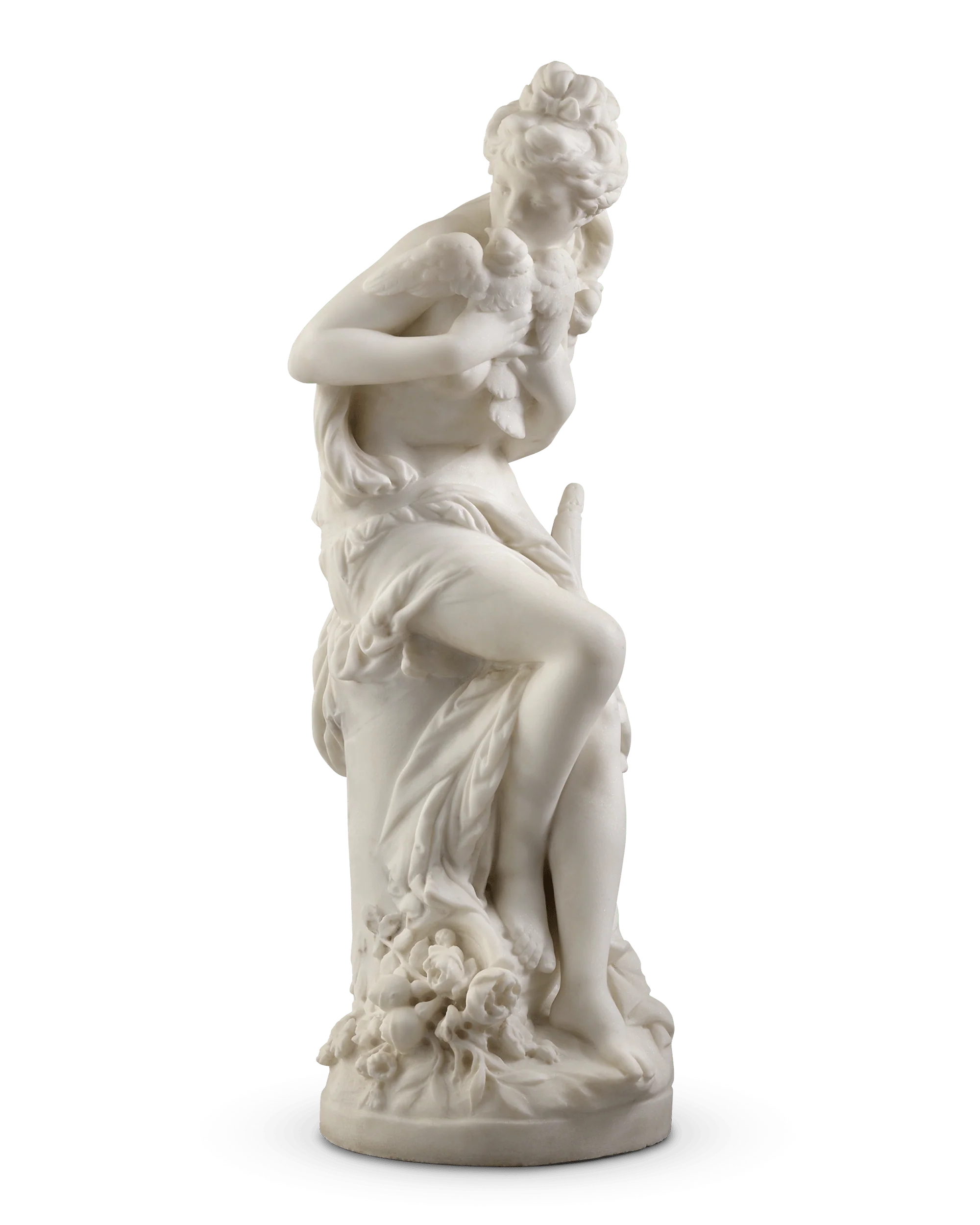
A vision of serenity and grace, Allégorie de la Paix (Allegory of Peace) by Albert-Ernest Carrier-Belleuse captures an elegant female figure holding two doves. Carved in luminous white marble, the classical figure’s flowing drapery and gentle posture reflect the elegance of antiquity. Her downward gaze and serene expression imbue the composition with quiet strength, while the soft detailing reveals Carrier-Belleuse’s exceptional skill and sensitivity.
Albert-Ernest Carrier-Belleuse was one of the most influential French sculptors of the 19th century. A founding member of the Société Nationale des Beaux-Arts and an officer of the Légion d’honneur, he was celebrated throughout Europe for his expressive, elegant style. He served as artistic director at the Sèvres porcelain manufactory and mentored a young Auguste Rodin, who later credited Carrier-Belleuse with shaping his early sculptural language.
A favorite of the Parisian public, Carrier-Belleuse enjoyed immense popularity. As noted in the catalogue of the 1878 Universal Exhibition, “Even the English come from London to ask him to work for them.” Today, his works are held in major museum collections around the world, including the Metropolitan Museum of Art.
Carved after 1868
23 5/8" high x 8" wide x 9" deep
1824–1887 | French
Allégorie de la Paix
(Allegory of Peace)
Signed “Carrier-Belleuse” White marble
A vision of serenity and grace, Allégorie de la Paix (Allegory of Peace) by Albert-Ernest Carrier-Belleuse captures an elegant female figure holding two doves. Carved in luminous white marble, the classical figure’s flowing drapery and gentle posture reflect the elegance of antiquity. Her downward gaze and serene expression imbue the composition with quiet strength, while the soft detailing reveals Carrier-Belleuse’s exceptional skill and sensitivity.
Albert-Ernest Carrier-Belleuse was one of the most influential French sculptors of the 19th century. A founding member of the Société Nationale des Beaux-Arts and an officer of the Légion d’honneur, he was celebrated throughout Europe for his expressive, elegant style. He served as artistic director at the Sèvres porcelain manufactory and mentored a young Auguste Rodin, who later credited Carrier-Belleuse with shaping his early sculptural language.
A favorite of the Parisian public, Carrier-Belleuse enjoyed immense popularity. As noted in the catalogue of the 1878 Universal Exhibition, “Even the English come from London to ask him to work for them.” Today, his works are held in major museum collections around the world, including the Metropolitan Museum of Art.
Carved after 1868
23 5/8" high x 8" wide x 9" deep
Albert-Ernest Carrier-Belleuse
1824–1887 | French
Allégorie de la Paix
(Allegory of Peace)
Signed “Carrier-Belleuse” White marble
A vision of serenity and grace, Allégorie de la Paix (Allegory of Peace) by Albert-Ernest Carrier-Belleuse captures an elegant female figure holding two doves. Carved in luminous white marble, the classical figure’s flowing drapery and gentle posture reflect the elegance of antiquity. Her downward gaze and serene expression imbue the composition with quiet strength, while the soft detailing reveals Carrier-Belleuse’s exceptional skill and sensitivity.
Albert-Ernest Carrier-Belleuse was one of the most influential French sculptors of the 19th century. A founding member of the Société Nationale des Beaux-Arts and an officer of the Légion d’honneur, he was celebrated throughout Europe for his expressive, elegant style. He served as artistic director at the Sèvres porcelain manufactory and mentored a young Auguste Rodin, who later credited Carrier-Belleuse with shaping his early sculptural language.
A favorite of the Parisian public, Carrier-Belleuse enjoyed immense popularity. As noted in the catalogue of the 1878 Universal Exhibition, “Even the English come from London to ask him to work for them.” Today, his works are held in major museum collections around the world, including the Metropolitan Museum of Art.
Carved after 1868
23 5/8" high x 8" wide x 9" deep
1824–1887 | French
Allégorie de la Paix
(Allegory of Peace)
Signed “Carrier-Belleuse” White marble
A vision of serenity and grace, Allégorie de la Paix (Allegory of Peace) by Albert-Ernest Carrier-Belleuse captures an elegant female figure holding two doves. Carved in luminous white marble, the classical figure’s flowing drapery and gentle posture reflect the elegance of antiquity. Her downward gaze and serene expression imbue the composition with quiet strength, while the soft detailing reveals Carrier-Belleuse’s exceptional skill and sensitivity.
Albert-Ernest Carrier-Belleuse was one of the most influential French sculptors of the 19th century. A founding member of the Société Nationale des Beaux-Arts and an officer of the Légion d’honneur, he was celebrated throughout Europe for his expressive, elegant style. He served as artistic director at the Sèvres porcelain manufactory and mentored a young Auguste Rodin, who later credited Carrier-Belleuse with shaping his early sculptural language.
A favorite of the Parisian public, Carrier-Belleuse enjoyed immense popularity. As noted in the catalogue of the 1878 Universal Exhibition, “Even the English come from London to ask him to work for them.” Today, his works are held in major museum collections around the world, including the Metropolitan Museum of Art.
Carved after 1868
23 5/8" high x 8" wide x 9" deep
$3,447.50
Original: $9,850.00
-65%Allegory of Peace by Albert-Ernest Carrier-Belleuse—
$9,850.00
$3,447.50Description
Albert-Ernest Carrier-Belleuse
1824–1887 | French
Allégorie de la Paix
(Allegory of Peace)
Signed “Carrier-Belleuse” White marble
A vision of serenity and grace, Allégorie de la Paix (Allegory of Peace) by Albert-Ernest Carrier-Belleuse captures an elegant female figure holding two doves. Carved in luminous white marble, the classical figure’s flowing drapery and gentle posture reflect the elegance of antiquity. Her downward gaze and serene expression imbue the composition with quiet strength, while the soft detailing reveals Carrier-Belleuse’s exceptional skill and sensitivity.
Albert-Ernest Carrier-Belleuse was one of the most influential French sculptors of the 19th century. A founding member of the Société Nationale des Beaux-Arts and an officer of the Légion d’honneur, he was celebrated throughout Europe for his expressive, elegant style. He served as artistic director at the Sèvres porcelain manufactory and mentored a young Auguste Rodin, who later credited Carrier-Belleuse with shaping his early sculptural language.
A favorite of the Parisian public, Carrier-Belleuse enjoyed immense popularity. As noted in the catalogue of the 1878 Universal Exhibition, “Even the English come from London to ask him to work for them.” Today, his works are held in major museum collections around the world, including the Metropolitan Museum of Art.
Carved after 1868
23 5/8" high x 8" wide x 9" deep
1824–1887 | French
Allégorie de la Paix
(Allegory of Peace)
Signed “Carrier-Belleuse” White marble
A vision of serenity and grace, Allégorie de la Paix (Allegory of Peace) by Albert-Ernest Carrier-Belleuse captures an elegant female figure holding two doves. Carved in luminous white marble, the classical figure’s flowing drapery and gentle posture reflect the elegance of antiquity. Her downward gaze and serene expression imbue the composition with quiet strength, while the soft detailing reveals Carrier-Belleuse’s exceptional skill and sensitivity.
Albert-Ernest Carrier-Belleuse was one of the most influential French sculptors of the 19th century. A founding member of the Société Nationale des Beaux-Arts and an officer of the Légion d’honneur, he was celebrated throughout Europe for his expressive, elegant style. He served as artistic director at the Sèvres porcelain manufactory and mentored a young Auguste Rodin, who later credited Carrier-Belleuse with shaping his early sculptural language.
A favorite of the Parisian public, Carrier-Belleuse enjoyed immense popularity. As noted in the catalogue of the 1878 Universal Exhibition, “Even the English come from London to ask him to work for them.” Today, his works are held in major museum collections around the world, including the Metropolitan Museum of Art.
Carved after 1868
23 5/8" high x 8" wide x 9" deep