
1 / 7
+2
Ancient Roman Stele Relief Fragment
Ancient Roman Stele Relief Fragment
Circa 1st Century BCE–1st Century CE
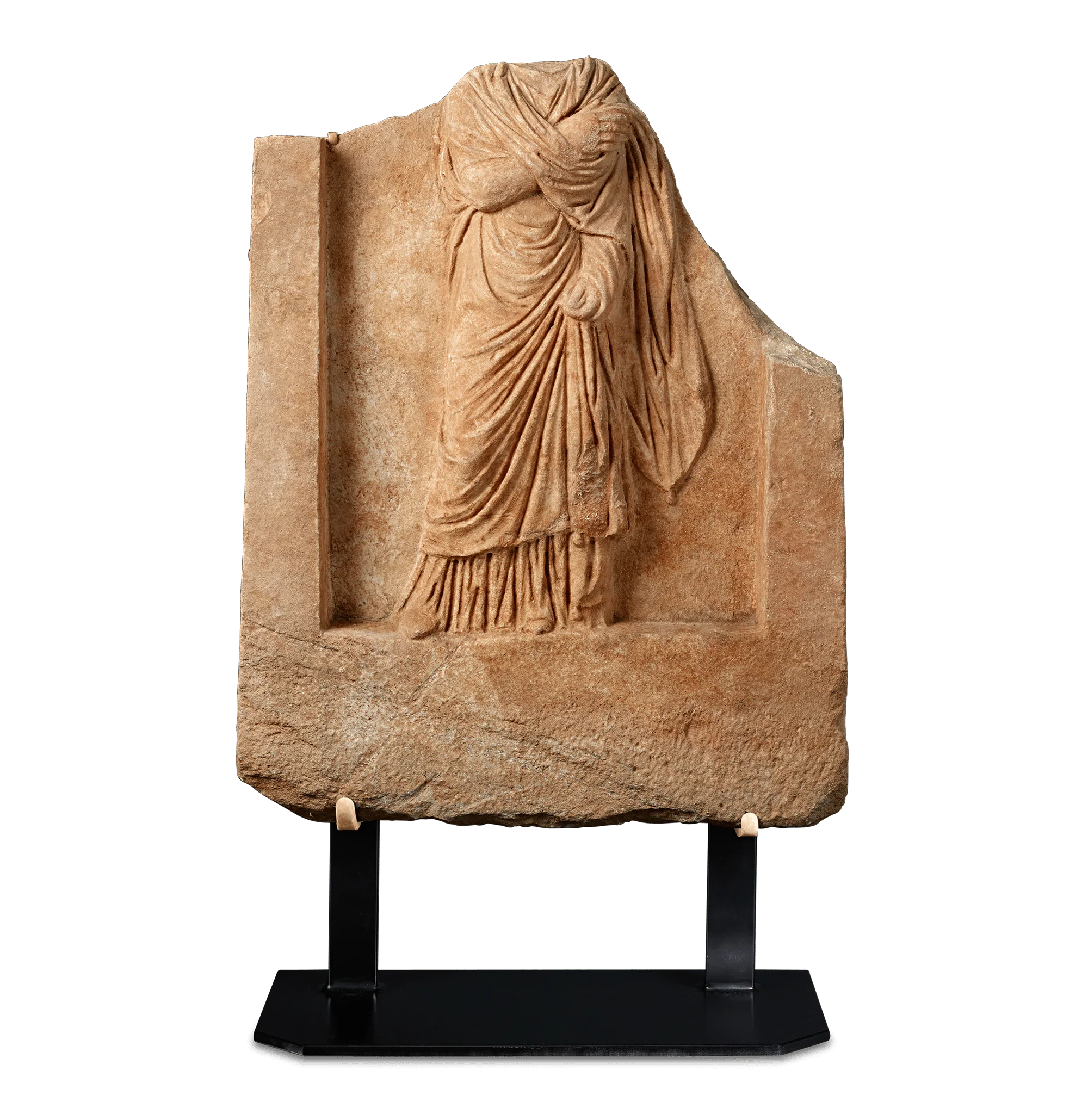
This rare marble stele relief fragment is a remarkable artifact of ancient history. Dating to the 1st century BCE–1st century CE, it offers a direct connection to the grandeur of Ancient Rome. Carved in fine white marble, possibly of Greek origin, this fragment exemplifies the Roman refinement of Classical Greek ideals.
A stele is a carved stone slab used in antiquity, typically as a commemorative monument, often decorated with relief figures or inscriptions. The quality and refined execution of this example suggest that it once belonged to an individual of considerable social standing.
The female figure is shown mid-motion, with her right hand gracefully crossing the body to her left shoulder, suggestive of adjusting or clasping a himation cloak. Her left arm extends downward, grasping the drapery in a composed gesture. The stele fragment retains the full expressive power of Roman classicism seen in the fluid contrapposto stance and elegant drapery lines that emphasize movement and femininity.
A statue in a similar pose, The Small Herculaneum Woman, housed in the Skulpturensammlung of the Staatliche Kunstsammlungen in Dresden, Germany, dates to the 1st century BCE. Unearthed in 1711 at the ancient city of Herculaneum, it represents one of the earliest significant discoveries at the site. Similar stylistic choices can also be found in a pentelic marble stele from the Archaeological Museum in Elefsina.
On stand: 37 1/2 high x 23 1/2" wide x 12" deep
Provenance:
Private collection, New York
M.S. Rau, New Orleans
Circa 1st Century BCE–1st Century CE
This rare marble stele relief fragment is a remarkable artifact of ancient history. Dating to the 1st century BCE–1st century CE, it offers a direct connection to the grandeur of Ancient Rome. Carved in fine white marble, possibly of Greek origin, this fragment exemplifies the Roman refinement of Classical Greek ideals.
A stele is a carved stone slab used in antiquity, typically as a commemorative monument, often decorated with relief figures or inscriptions. The quality and refined execution of this example suggest that it once belonged to an individual of considerable social standing.
The female figure is shown mid-motion, with her right hand gracefully crossing the body to her left shoulder, suggestive of adjusting or clasping a himation cloak. Her left arm extends downward, grasping the drapery in a composed gesture. The stele fragment retains the full expressive power of Roman classicism seen in the fluid contrapposto stance and elegant drapery lines that emphasize movement and femininity.
A statue in a similar pose, The Small Herculaneum Woman, housed in the Skulpturensammlung of the Staatliche Kunstsammlungen in Dresden, Germany, dates to the 1st century BCE. Unearthed in 1711 at the ancient city of Herculaneum, it represents one of the earliest significant discoveries at the site. Similar stylistic choices can also be found in a pentelic marble stele from the Archaeological Museum in Elefsina.
On stand: 37 1/2 high x 23 1/2" wide x 12" deep
Provenance:
Private collection, New York
M.S. Rau, New Orleans
Ancient Roman Stele Relief Fragment
Circa 1st Century BCE–1st Century CE
This rare marble stele relief fragment is a remarkable artifact of ancient history. Dating to the 1st century BCE–1st century CE, it offers a direct connection to the grandeur of Ancient Rome. Carved in fine white marble, possibly of Greek origin, this fragment exemplifies the Roman refinement of Classical Greek ideals.
A stele is a carved stone slab used in antiquity, typically as a commemorative monument, often decorated with relief figures or inscriptions. The quality and refined execution of this example suggest that it once belonged to an individual of considerable social standing.
The female figure is shown mid-motion, with her right hand gracefully crossing the body to her left shoulder, suggestive of adjusting or clasping a himation cloak. Her left arm extends downward, grasping the drapery in a composed gesture. The stele fragment retains the full expressive power of Roman classicism seen in the fluid contrapposto stance and elegant drapery lines that emphasize movement and femininity.
A statue in a similar pose, The Small Herculaneum Woman, housed in the Skulpturensammlung of the Staatliche Kunstsammlungen in Dresden, Germany, dates to the 1st century BCE. Unearthed in 1711 at the ancient city of Herculaneum, it represents one of the earliest significant discoveries at the site. Similar stylistic choices can also be found in a pentelic marble stele from the Archaeological Museum in Elefsina.
On stand: 37 1/2 high x 23 1/2" wide x 12" deep
Provenance:
Private collection, New York
M.S. Rau, New Orleans
Circa 1st Century BCE–1st Century CE
This rare marble stele relief fragment is a remarkable artifact of ancient history. Dating to the 1st century BCE–1st century CE, it offers a direct connection to the grandeur of Ancient Rome. Carved in fine white marble, possibly of Greek origin, this fragment exemplifies the Roman refinement of Classical Greek ideals.
A stele is a carved stone slab used in antiquity, typically as a commemorative monument, often decorated with relief figures or inscriptions. The quality and refined execution of this example suggest that it once belonged to an individual of considerable social standing.
The female figure is shown mid-motion, with her right hand gracefully crossing the body to her left shoulder, suggestive of adjusting or clasping a himation cloak. Her left arm extends downward, grasping the drapery in a composed gesture. The stele fragment retains the full expressive power of Roman classicism seen in the fluid contrapposto stance and elegant drapery lines that emphasize movement and femininity.
A statue in a similar pose, The Small Herculaneum Woman, housed in the Skulpturensammlung of the Staatliche Kunstsammlungen in Dresden, Germany, dates to the 1st century BCE. Unearthed in 1711 at the ancient city of Herculaneum, it represents one of the earliest significant discoveries at the site. Similar stylistic choices can also be found in a pentelic marble stele from the Archaeological Museum in Elefsina.
On stand: 37 1/2 high x 23 1/2" wide x 12" deep
Provenance:
Private collection, New York
M.S. Rau, New Orleans
$26,075.00
Original: $74,500.00
-65%Ancient Roman Stele Relief Fragment—
$74,500.00
$26,075.00Description
Ancient Roman Stele Relief Fragment
Circa 1st Century BCE–1st Century CE
This rare marble stele relief fragment is a remarkable artifact of ancient history. Dating to the 1st century BCE–1st century CE, it offers a direct connection to the grandeur of Ancient Rome. Carved in fine white marble, possibly of Greek origin, this fragment exemplifies the Roman refinement of Classical Greek ideals.
A stele is a carved stone slab used in antiquity, typically as a commemorative monument, often decorated with relief figures or inscriptions. The quality and refined execution of this example suggest that it once belonged to an individual of considerable social standing.
The female figure is shown mid-motion, with her right hand gracefully crossing the body to her left shoulder, suggestive of adjusting or clasping a himation cloak. Her left arm extends downward, grasping the drapery in a composed gesture. The stele fragment retains the full expressive power of Roman classicism seen in the fluid contrapposto stance and elegant drapery lines that emphasize movement and femininity.
A statue in a similar pose, The Small Herculaneum Woman, housed in the Skulpturensammlung of the Staatliche Kunstsammlungen in Dresden, Germany, dates to the 1st century BCE. Unearthed in 1711 at the ancient city of Herculaneum, it represents one of the earliest significant discoveries at the site. Similar stylistic choices can also be found in a pentelic marble stele from the Archaeological Museum in Elefsina.
On stand: 37 1/2 high x 23 1/2" wide x 12" deep
Provenance:
Private collection, New York
M.S. Rau, New Orleans
Circa 1st Century BCE–1st Century CE
This rare marble stele relief fragment is a remarkable artifact of ancient history. Dating to the 1st century BCE–1st century CE, it offers a direct connection to the grandeur of Ancient Rome. Carved in fine white marble, possibly of Greek origin, this fragment exemplifies the Roman refinement of Classical Greek ideals.
A stele is a carved stone slab used in antiquity, typically as a commemorative monument, often decorated with relief figures or inscriptions. The quality and refined execution of this example suggest that it once belonged to an individual of considerable social standing.
The female figure is shown mid-motion, with her right hand gracefully crossing the body to her left shoulder, suggestive of adjusting or clasping a himation cloak. Her left arm extends downward, grasping the drapery in a composed gesture. The stele fragment retains the full expressive power of Roman classicism seen in the fluid contrapposto stance and elegant drapery lines that emphasize movement and femininity.
A statue in a similar pose, The Small Herculaneum Woman, housed in the Skulpturensammlung of the Staatliche Kunstsammlungen in Dresden, Germany, dates to the 1st century BCE. Unearthed in 1711 at the ancient city of Herculaneum, it represents one of the earliest significant discoveries at the site. Similar stylistic choices can also be found in a pentelic marble stele from the Archaeological Museum in Elefsina.
On stand: 37 1/2 high x 23 1/2" wide x 12" deep
Provenance:
Private collection, New York
M.S. Rau, New Orleans