
1 / 6
+1
Cleopatra by Julius Kronberg
Julius Kronberg
1850-1921 | Swedish
Cleopatra
Oil on canvas
Signed and dated “Julius Kronberg Roma. 1883” (lower right)
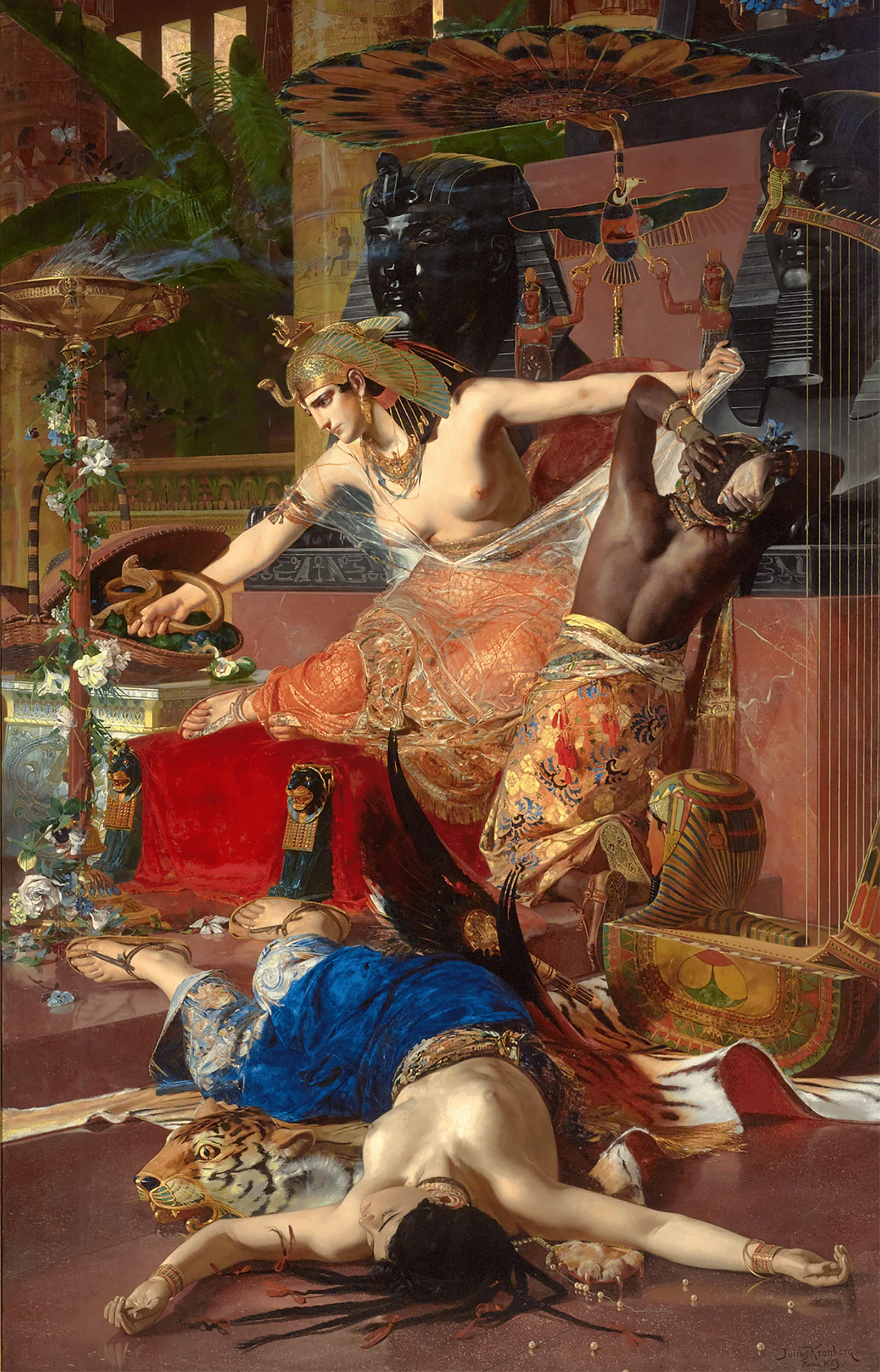
Painted for and until recently housed in Sweden’s famed Tistad Castle, this historical genre masterpiece by Swedish Academic painter Julius Kronberg is monumental in both size and importance. The awe-inspiring work vividly brings to life the final moments of Queen Cleopatra VII of Egypt (69-30 B.C.E.), one of the most myth-enshrouded figures in history. Measuring over 11 feet high, it is a tour de force of the Academic style; its sheer size, along with its vibrancy and wealth of fascinating details, place it at the pinnacle of Academic art.
The subject of Cleopatra’s death was a popular one in the realm of art history, having been captured by the likes of Guido Reni, Jean-Baptiste Regnault, German von Bohn, and Hans Makart. Yet, when compared to all of these, Kronberg’s Cleopatra far exceeds them all in terms of drama and his extraordinary sense of detail. The artist took his inspiration from Shakespeare’s tragedy Antony and Cleopatra, which had been published in Sweden for the first time in 1825.
In the tragic final act, Cleopatra mourns her lover Antony’s death, while also refusing to surrender to Octavian, who wishes to take her to Rome as a prisoner of war. Rather than become a spectacle of Rome, she resolves to commit suicide with her handmaidens, Charmian and Iras. Kronberg brilliantly captures the moment in which, after her handmaiden Iras has already died, Cleopatra reaches for a poisonous asp to press to her own breast. Her handmaiden Charmian kneels with her back to the viewer, but the brokenhearted anguish of her stance makes clear her despair in the face of what she is witnessing. Cleopatra herself comes across as strong and resolute in spite of the task ahead of her.
When confronted with the work, viewers cannot help but be awed by the scene. Kronberg’s composition overflows with Oriental objects in a grand, Egyptian-influenced interior. Reproduced in rich detail with astounding accuracy, they reveal Kronberg’s dedication to careful research and superior draftsmanship.
To achieve such accuracy, two smaller versions of the work were produced, one on cardboard and the other a small color sketch in oil. Kronberg also produced two three-dimensional studies of Cleopatra and her handmaidens in wax, to ensure he would achieve exactly the correct proportions of the bodies’ postures. The two painted studies can be viewed today in Julius Kronberg's studio at Skansen in Stockholm, where they form part of the Nordic Museum collection.
Kronberg created very few stand-alone paintings during his career, and most can be found in Sweden’s museums, including the Hallwyl Museum (Stockholm), Nationalmuseum (Stockholm) and Gothenburg Art Museum. He was more often commissioned for large-scale murals and ceiling paintings, including those in Stockholm Palace and Stockholm’s Royal Dramatic Theatre. In high demand in his day, the vast majority of Kronberg’s compositions were privately commissioned by wealthy Swedish private clients. Cleopatra is one such example, having been commissioned in 1879 by Count Fredrik Wachtmeister. Painted specifically for the Wachtmeister family’s Tistad Castle, it remained there for over 130 years, only recently appearing on the market. The work is one of Kronberg’s very few masterpieces, and is perhaps the greatest Academic painting not presently found in a museum.
Dated 1883
Canvas: 131 1/2" high x 83 1/2" wide (334.01 x 212.09 cm)
Frame: 141 3/4" high x 94" wide x 3 1/2" deep (360.05 x 238.76 x 8.89 cm)
View the Dossier
Provenance:
Count Fredrik Wachtmeister, Tistad Castle, Nyköping
By descent to Count Nils Wachtmeister, Tistad Castle, Nyköping
Thence by descent within the Wachtmeister family
M.S. Rau, New Orleans
Private collection, Minnesota
M.S. Rau, New Orleans
Exhibited:
Copenhagen, Nordic Exhibition, 1888
Stockholm, Blanchs konstsalong, Julius Kronberg – Måleriets triumfator (year unknown, source: T. Björk, p. 109)
Stockholm, Liljevalchs konsthall, Julius Kronberg, Memorial Exhibition, 1923, cat. no. 84
Literature:
Små konstböcker no 11, Julius Kronberg, Gleerupska universitetsbokhandeln, Lund (year unknown), p. 11 (illustrated)
Sigurd Müller, Finsk Tidskrift för Vitterhet, Vetenskap, Konst och Politik, vol. XVIII, 1885, p. 76
G. Nordensvan, Och Svenska Konstnärer, Stockholm, 1892, pp. 558-559 (illustrated)
Swedish Life in Town and Country, New York and London, 1904, p. 172
R. Muther, The History of Modern Painting, London, 1907, p. 196
K. Asplund, Julius Kronbergs atelier och efterlämnade arbeten, Stockholm, 1922, p. 15-16
K. Asplund, Julius Kronberg, Liljevalchs catalogue no. 43, Stockholm, 1923, p. 14, no. 84
B.G. Söderberg, Slott och herresäten i Sverige, Södermanland, band II, Malmö, 1968, p. 236 (illustrated)
T. Björk, Julius Kronberg – Måleriets triumfator, Stockholm, 2016, pp. 107-110 (illustrated)
1850-1921 | Swedish
Cleopatra
Oil on canvas
Signed and dated “Julius Kronberg Roma. 1883” (lower right)
Painted for and until recently housed in Sweden’s famed Tistad Castle, this historical genre masterpiece by Swedish Academic painter Julius Kronberg is monumental in both size and importance. The awe-inspiring work vividly brings to life the final moments of Queen Cleopatra VII of Egypt (69-30 B.C.E.), one of the most myth-enshrouded figures in history. Measuring over 11 feet high, it is a tour de force of the Academic style; its sheer size, along with its vibrancy and wealth of fascinating details, place it at the pinnacle of Academic art.
The subject of Cleopatra’s death was a popular one in the realm of art history, having been captured by the likes of Guido Reni, Jean-Baptiste Regnault, German von Bohn, and Hans Makart. Yet, when compared to all of these, Kronberg’s Cleopatra far exceeds them all in terms of drama and his extraordinary sense of detail. The artist took his inspiration from Shakespeare’s tragedy Antony and Cleopatra, which had been published in Sweden for the first time in 1825.
In the tragic final act, Cleopatra mourns her lover Antony’s death, while also refusing to surrender to Octavian, who wishes to take her to Rome as a prisoner of war. Rather than become a spectacle of Rome, she resolves to commit suicide with her handmaidens, Charmian and Iras. Kronberg brilliantly captures the moment in which, after her handmaiden Iras has already died, Cleopatra reaches for a poisonous asp to press to her own breast. Her handmaiden Charmian kneels with her back to the viewer, but the brokenhearted anguish of her stance makes clear her despair in the face of what she is witnessing. Cleopatra herself comes across as strong and resolute in spite of the task ahead of her.
When confronted with the work, viewers cannot help but be awed by the scene. Kronberg’s composition overflows with Oriental objects in a grand, Egyptian-influenced interior. Reproduced in rich detail with astounding accuracy, they reveal Kronberg’s dedication to careful research and superior draftsmanship.
To achieve such accuracy, two smaller versions of the work were produced, one on cardboard and the other a small color sketch in oil. Kronberg also produced two three-dimensional studies of Cleopatra and her handmaidens in wax, to ensure he would achieve exactly the correct proportions of the bodies’ postures. The two painted studies can be viewed today in Julius Kronberg's studio at Skansen in Stockholm, where they form part of the Nordic Museum collection.
Kronberg created very few stand-alone paintings during his career, and most can be found in Sweden’s museums, including the Hallwyl Museum (Stockholm), Nationalmuseum (Stockholm) and Gothenburg Art Museum. He was more often commissioned for large-scale murals and ceiling paintings, including those in Stockholm Palace and Stockholm’s Royal Dramatic Theatre. In high demand in his day, the vast majority of Kronberg’s compositions were privately commissioned by wealthy Swedish private clients. Cleopatra is one such example, having been commissioned in 1879 by Count Fredrik Wachtmeister. Painted specifically for the Wachtmeister family’s Tistad Castle, it remained there for over 130 years, only recently appearing on the market. The work is one of Kronberg’s very few masterpieces, and is perhaps the greatest Academic painting not presently found in a museum.
Dated 1883
Canvas: 131 1/2" high x 83 1/2" wide (334.01 x 212.09 cm)
Frame: 141 3/4" high x 94" wide x 3 1/2" deep (360.05 x 238.76 x 8.89 cm)
View the Dossier
Provenance:
Count Fredrik Wachtmeister, Tistad Castle, Nyköping
By descent to Count Nils Wachtmeister, Tistad Castle, Nyköping
Thence by descent within the Wachtmeister family
M.S. Rau, New Orleans
Private collection, Minnesota
M.S. Rau, New Orleans
Exhibited:
Copenhagen, Nordic Exhibition, 1888
Stockholm, Blanchs konstsalong, Julius Kronberg – Måleriets triumfator (year unknown, source: T. Björk, p. 109)
Stockholm, Liljevalchs konsthall, Julius Kronberg, Memorial Exhibition, 1923, cat. no. 84
Literature:
Små konstböcker no 11, Julius Kronberg, Gleerupska universitetsbokhandeln, Lund (year unknown), p. 11 (illustrated)
Sigurd Müller, Finsk Tidskrift för Vitterhet, Vetenskap, Konst och Politik, vol. XVIII, 1885, p. 76
G. Nordensvan, Och Svenska Konstnärer, Stockholm, 1892, pp. 558-559 (illustrated)
Swedish Life in Town and Country, New York and London, 1904, p. 172
R. Muther, The History of Modern Painting, London, 1907, p. 196
K. Asplund, Julius Kronbergs atelier och efterlämnade arbeten, Stockholm, 1922, p. 15-16
K. Asplund, Julius Kronberg, Liljevalchs catalogue no. 43, Stockholm, 1923, p. 14, no. 84
B.G. Söderberg, Slott och herresäten i Sverige, Södermanland, band II, Malmö, 1968, p. 236 (illustrated)
T. Björk, Julius Kronberg – Måleriets triumfator, Stockholm, 2016, pp. 107-110 (illustrated)
Julius Kronberg
1850-1921 | Swedish
Cleopatra
Oil on canvas
Signed and dated “Julius Kronberg Roma. 1883” (lower right)
Painted for and until recently housed in Sweden’s famed Tistad Castle, this historical genre masterpiece by Swedish Academic painter Julius Kronberg is monumental in both size and importance. The awe-inspiring work vividly brings to life the final moments of Queen Cleopatra VII of Egypt (69-30 B.C.E.), one of the most myth-enshrouded figures in history. Measuring over 11 feet high, it is a tour de force of the Academic style; its sheer size, along with its vibrancy and wealth of fascinating details, place it at the pinnacle of Academic art.
The subject of Cleopatra’s death was a popular one in the realm of art history, having been captured by the likes of Guido Reni, Jean-Baptiste Regnault, German von Bohn, and Hans Makart. Yet, when compared to all of these, Kronberg’s Cleopatra far exceeds them all in terms of drama and his extraordinary sense of detail. The artist took his inspiration from Shakespeare’s tragedy Antony and Cleopatra, which had been published in Sweden for the first time in 1825.
In the tragic final act, Cleopatra mourns her lover Antony’s death, while also refusing to surrender to Octavian, who wishes to take her to Rome as a prisoner of war. Rather than become a spectacle of Rome, she resolves to commit suicide with her handmaidens, Charmian and Iras. Kronberg brilliantly captures the moment in which, after her handmaiden Iras has already died, Cleopatra reaches for a poisonous asp to press to her own breast. Her handmaiden Charmian kneels with her back to the viewer, but the brokenhearted anguish of her stance makes clear her despair in the face of what she is witnessing. Cleopatra herself comes across as strong and resolute in spite of the task ahead of her.
When confronted with the work, viewers cannot help but be awed by the scene. Kronberg’s composition overflows with Oriental objects in a grand, Egyptian-influenced interior. Reproduced in rich detail with astounding accuracy, they reveal Kronberg’s dedication to careful research and superior draftsmanship.
To achieve such accuracy, two smaller versions of the work were produced, one on cardboard and the other a small color sketch in oil. Kronberg also produced two three-dimensional studies of Cleopatra and her handmaidens in wax, to ensure he would achieve exactly the correct proportions of the bodies’ postures. The two painted studies can be viewed today in Julius Kronberg's studio at Skansen in Stockholm, where they form part of the Nordic Museum collection.
Kronberg created very few stand-alone paintings during his career, and most can be found in Sweden’s museums, including the Hallwyl Museum (Stockholm), Nationalmuseum (Stockholm) and Gothenburg Art Museum. He was more often commissioned for large-scale murals and ceiling paintings, including those in Stockholm Palace and Stockholm’s Royal Dramatic Theatre. In high demand in his day, the vast majority of Kronberg’s compositions were privately commissioned by wealthy Swedish private clients. Cleopatra is one such example, having been commissioned in 1879 by Count Fredrik Wachtmeister. Painted specifically for the Wachtmeister family’s Tistad Castle, it remained there for over 130 years, only recently appearing on the market. The work is one of Kronberg’s very few masterpieces, and is perhaps the greatest Academic painting not presently found in a museum.
Dated 1883
Canvas: 131 1/2" high x 83 1/2" wide (334.01 x 212.09 cm)
Frame: 141 3/4" high x 94" wide x 3 1/2" deep (360.05 x 238.76 x 8.89 cm)
View the Dossier
Provenance:
Count Fredrik Wachtmeister, Tistad Castle, Nyköping
By descent to Count Nils Wachtmeister, Tistad Castle, Nyköping
Thence by descent within the Wachtmeister family
M.S. Rau, New Orleans
Private collection, Minnesota
M.S. Rau, New Orleans
Exhibited:
Copenhagen, Nordic Exhibition, 1888
Stockholm, Blanchs konstsalong, Julius Kronberg – Måleriets triumfator (year unknown, source: T. Björk, p. 109)
Stockholm, Liljevalchs konsthall, Julius Kronberg, Memorial Exhibition, 1923, cat. no. 84
Literature:
Små konstböcker no 11, Julius Kronberg, Gleerupska universitetsbokhandeln, Lund (year unknown), p. 11 (illustrated)
Sigurd Müller, Finsk Tidskrift för Vitterhet, Vetenskap, Konst och Politik, vol. XVIII, 1885, p. 76
G. Nordensvan, Och Svenska Konstnärer, Stockholm, 1892, pp. 558-559 (illustrated)
Swedish Life in Town and Country, New York and London, 1904, p. 172
R. Muther, The History of Modern Painting, London, 1907, p. 196
K. Asplund, Julius Kronbergs atelier och efterlämnade arbeten, Stockholm, 1922, p. 15-16
K. Asplund, Julius Kronberg, Liljevalchs catalogue no. 43, Stockholm, 1923, p. 14, no. 84
B.G. Söderberg, Slott och herresäten i Sverige, Södermanland, band II, Malmö, 1968, p. 236 (illustrated)
T. Björk, Julius Kronberg – Måleriets triumfator, Stockholm, 2016, pp. 107-110 (illustrated)
1850-1921 | Swedish
Cleopatra
Oil on canvas
Signed and dated “Julius Kronberg Roma. 1883” (lower right)
Painted for and until recently housed in Sweden’s famed Tistad Castle, this historical genre masterpiece by Swedish Academic painter Julius Kronberg is monumental in both size and importance. The awe-inspiring work vividly brings to life the final moments of Queen Cleopatra VII of Egypt (69-30 B.C.E.), one of the most myth-enshrouded figures in history. Measuring over 11 feet high, it is a tour de force of the Academic style; its sheer size, along with its vibrancy and wealth of fascinating details, place it at the pinnacle of Academic art.
The subject of Cleopatra’s death was a popular one in the realm of art history, having been captured by the likes of Guido Reni, Jean-Baptiste Regnault, German von Bohn, and Hans Makart. Yet, when compared to all of these, Kronberg’s Cleopatra far exceeds them all in terms of drama and his extraordinary sense of detail. The artist took his inspiration from Shakespeare’s tragedy Antony and Cleopatra, which had been published in Sweden for the first time in 1825.
In the tragic final act, Cleopatra mourns her lover Antony’s death, while also refusing to surrender to Octavian, who wishes to take her to Rome as a prisoner of war. Rather than become a spectacle of Rome, she resolves to commit suicide with her handmaidens, Charmian and Iras. Kronberg brilliantly captures the moment in which, after her handmaiden Iras has already died, Cleopatra reaches for a poisonous asp to press to her own breast. Her handmaiden Charmian kneels with her back to the viewer, but the brokenhearted anguish of her stance makes clear her despair in the face of what she is witnessing. Cleopatra herself comes across as strong and resolute in spite of the task ahead of her.
When confronted with the work, viewers cannot help but be awed by the scene. Kronberg’s composition overflows with Oriental objects in a grand, Egyptian-influenced interior. Reproduced in rich detail with astounding accuracy, they reveal Kronberg’s dedication to careful research and superior draftsmanship.
To achieve such accuracy, two smaller versions of the work were produced, one on cardboard and the other a small color sketch in oil. Kronberg also produced two three-dimensional studies of Cleopatra and her handmaidens in wax, to ensure he would achieve exactly the correct proportions of the bodies’ postures. The two painted studies can be viewed today in Julius Kronberg's studio at Skansen in Stockholm, where they form part of the Nordic Museum collection.
Kronberg created very few stand-alone paintings during his career, and most can be found in Sweden’s museums, including the Hallwyl Museum (Stockholm), Nationalmuseum (Stockholm) and Gothenburg Art Museum. He was more often commissioned for large-scale murals and ceiling paintings, including those in Stockholm Palace and Stockholm’s Royal Dramatic Theatre. In high demand in his day, the vast majority of Kronberg’s compositions were privately commissioned by wealthy Swedish private clients. Cleopatra is one such example, having been commissioned in 1879 by Count Fredrik Wachtmeister. Painted specifically for the Wachtmeister family’s Tistad Castle, it remained there for over 130 years, only recently appearing on the market. The work is one of Kronberg’s very few masterpieces, and is perhaps the greatest Academic painting not presently found in a museum.
Dated 1883
Canvas: 131 1/2" high x 83 1/2" wide (334.01 x 212.09 cm)
Frame: 141 3/4" high x 94" wide x 3 1/2" deep (360.05 x 238.76 x 8.89 cm)
View the Dossier
Provenance:
Count Fredrik Wachtmeister, Tistad Castle, Nyköping
By descent to Count Nils Wachtmeister, Tistad Castle, Nyköping
Thence by descent within the Wachtmeister family
M.S. Rau, New Orleans
Private collection, Minnesota
M.S. Rau, New Orleans
Exhibited:
Copenhagen, Nordic Exhibition, 1888
Stockholm, Blanchs konstsalong, Julius Kronberg – Måleriets triumfator (year unknown, source: T. Björk, p. 109)
Stockholm, Liljevalchs konsthall, Julius Kronberg, Memorial Exhibition, 1923, cat. no. 84
Literature:
Små konstböcker no 11, Julius Kronberg, Gleerupska universitetsbokhandeln, Lund (year unknown), p. 11 (illustrated)
Sigurd Müller, Finsk Tidskrift för Vitterhet, Vetenskap, Konst och Politik, vol. XVIII, 1885, p. 76
G. Nordensvan, Och Svenska Konstnärer, Stockholm, 1892, pp. 558-559 (illustrated)
Swedish Life in Town and Country, New York and London, 1904, p. 172
R. Muther, The History of Modern Painting, London, 1907, p. 196
K. Asplund, Julius Kronbergs atelier och efterlämnade arbeten, Stockholm, 1922, p. 15-16
K. Asplund, Julius Kronberg, Liljevalchs catalogue no. 43, Stockholm, 1923, p. 14, no. 84
B.G. Söderberg, Slott och herresäten i Sverige, Södermanland, band II, Malmö, 1968, p. 236 (illustrated)
T. Björk, Julius Kronberg – Måleriets triumfator, Stockholm, 2016, pp. 107-110 (illustrated)
$1,032,500.00
Original: $2,950,000.00
-65%Cleopatra by Julius Kronberg—
$2,950,000.00
$1,032,500.00Description
Julius Kronberg
1850-1921 | Swedish
Cleopatra
Oil on canvas
Signed and dated “Julius Kronberg Roma. 1883” (lower right)
Painted for and until recently housed in Sweden’s famed Tistad Castle, this historical genre masterpiece by Swedish Academic painter Julius Kronberg is monumental in both size and importance. The awe-inspiring work vividly brings to life the final moments of Queen Cleopatra VII of Egypt (69-30 B.C.E.), one of the most myth-enshrouded figures in history. Measuring over 11 feet high, it is a tour de force of the Academic style; its sheer size, along with its vibrancy and wealth of fascinating details, place it at the pinnacle of Academic art.
The subject of Cleopatra’s death was a popular one in the realm of art history, having been captured by the likes of Guido Reni, Jean-Baptiste Regnault, German von Bohn, and Hans Makart. Yet, when compared to all of these, Kronberg’s Cleopatra far exceeds them all in terms of drama and his extraordinary sense of detail. The artist took his inspiration from Shakespeare’s tragedy Antony and Cleopatra, which had been published in Sweden for the first time in 1825.
In the tragic final act, Cleopatra mourns her lover Antony’s death, while also refusing to surrender to Octavian, who wishes to take her to Rome as a prisoner of war. Rather than become a spectacle of Rome, she resolves to commit suicide with her handmaidens, Charmian and Iras. Kronberg brilliantly captures the moment in which, after her handmaiden Iras has already died, Cleopatra reaches for a poisonous asp to press to her own breast. Her handmaiden Charmian kneels with her back to the viewer, but the brokenhearted anguish of her stance makes clear her despair in the face of what she is witnessing. Cleopatra herself comes across as strong and resolute in spite of the task ahead of her.
When confronted with the work, viewers cannot help but be awed by the scene. Kronberg’s composition overflows with Oriental objects in a grand, Egyptian-influenced interior. Reproduced in rich detail with astounding accuracy, they reveal Kronberg’s dedication to careful research and superior draftsmanship.
To achieve such accuracy, two smaller versions of the work were produced, one on cardboard and the other a small color sketch in oil. Kronberg also produced two three-dimensional studies of Cleopatra and her handmaidens in wax, to ensure he would achieve exactly the correct proportions of the bodies’ postures. The two painted studies can be viewed today in Julius Kronberg's studio at Skansen in Stockholm, where they form part of the Nordic Museum collection.
Kronberg created very few stand-alone paintings during his career, and most can be found in Sweden’s museums, including the Hallwyl Museum (Stockholm), Nationalmuseum (Stockholm) and Gothenburg Art Museum. He was more often commissioned for large-scale murals and ceiling paintings, including those in Stockholm Palace and Stockholm’s Royal Dramatic Theatre. In high demand in his day, the vast majority of Kronberg’s compositions were privately commissioned by wealthy Swedish private clients. Cleopatra is one such example, having been commissioned in 1879 by Count Fredrik Wachtmeister. Painted specifically for the Wachtmeister family’s Tistad Castle, it remained there for over 130 years, only recently appearing on the market. The work is one of Kronberg’s very few masterpieces, and is perhaps the greatest Academic painting not presently found in a museum.
Dated 1883
Canvas: 131 1/2" high x 83 1/2" wide (334.01 x 212.09 cm)
Frame: 141 3/4" high x 94" wide x 3 1/2" deep (360.05 x 238.76 x 8.89 cm)
View the Dossier
Provenance:
Count Fredrik Wachtmeister, Tistad Castle, Nyköping
By descent to Count Nils Wachtmeister, Tistad Castle, Nyköping
Thence by descent within the Wachtmeister family
M.S. Rau, New Orleans
Private collection, Minnesota
M.S. Rau, New Orleans
Exhibited:
Copenhagen, Nordic Exhibition, 1888
Stockholm, Blanchs konstsalong, Julius Kronberg – Måleriets triumfator (year unknown, source: T. Björk, p. 109)
Stockholm, Liljevalchs konsthall, Julius Kronberg, Memorial Exhibition, 1923, cat. no. 84
Literature:
Små konstböcker no 11, Julius Kronberg, Gleerupska universitetsbokhandeln, Lund (year unknown), p. 11 (illustrated)
Sigurd Müller, Finsk Tidskrift för Vitterhet, Vetenskap, Konst och Politik, vol. XVIII, 1885, p. 76
G. Nordensvan, Och Svenska Konstnärer, Stockholm, 1892, pp. 558-559 (illustrated)
Swedish Life in Town and Country, New York and London, 1904, p. 172
R. Muther, The History of Modern Painting, London, 1907, p. 196
K. Asplund, Julius Kronbergs atelier och efterlämnade arbeten, Stockholm, 1922, p. 15-16
K. Asplund, Julius Kronberg, Liljevalchs catalogue no. 43, Stockholm, 1923, p. 14, no. 84
B.G. Söderberg, Slott och herresäten i Sverige, Södermanland, band II, Malmö, 1968, p. 236 (illustrated)
T. Björk, Julius Kronberg – Måleriets triumfator, Stockholm, 2016, pp. 107-110 (illustrated)
1850-1921 | Swedish
Cleopatra
Oil on canvas
Signed and dated “Julius Kronberg Roma. 1883” (lower right)
Painted for and until recently housed in Sweden’s famed Tistad Castle, this historical genre masterpiece by Swedish Academic painter Julius Kronberg is monumental in both size and importance. The awe-inspiring work vividly brings to life the final moments of Queen Cleopatra VII of Egypt (69-30 B.C.E.), one of the most myth-enshrouded figures in history. Measuring over 11 feet high, it is a tour de force of the Academic style; its sheer size, along with its vibrancy and wealth of fascinating details, place it at the pinnacle of Academic art.
The subject of Cleopatra’s death was a popular one in the realm of art history, having been captured by the likes of Guido Reni, Jean-Baptiste Regnault, German von Bohn, and Hans Makart. Yet, when compared to all of these, Kronberg’s Cleopatra far exceeds them all in terms of drama and his extraordinary sense of detail. The artist took his inspiration from Shakespeare’s tragedy Antony and Cleopatra, which had been published in Sweden for the first time in 1825.
In the tragic final act, Cleopatra mourns her lover Antony’s death, while also refusing to surrender to Octavian, who wishes to take her to Rome as a prisoner of war. Rather than become a spectacle of Rome, she resolves to commit suicide with her handmaidens, Charmian and Iras. Kronberg brilliantly captures the moment in which, after her handmaiden Iras has already died, Cleopatra reaches for a poisonous asp to press to her own breast. Her handmaiden Charmian kneels with her back to the viewer, but the brokenhearted anguish of her stance makes clear her despair in the face of what she is witnessing. Cleopatra herself comes across as strong and resolute in spite of the task ahead of her.
When confronted with the work, viewers cannot help but be awed by the scene. Kronberg’s composition overflows with Oriental objects in a grand, Egyptian-influenced interior. Reproduced in rich detail with astounding accuracy, they reveal Kronberg’s dedication to careful research and superior draftsmanship.
To achieve such accuracy, two smaller versions of the work were produced, one on cardboard and the other a small color sketch in oil. Kronberg also produced two three-dimensional studies of Cleopatra and her handmaidens in wax, to ensure he would achieve exactly the correct proportions of the bodies’ postures. The two painted studies can be viewed today in Julius Kronberg's studio at Skansen in Stockholm, where they form part of the Nordic Museum collection.
Kronberg created very few stand-alone paintings during his career, and most can be found in Sweden’s museums, including the Hallwyl Museum (Stockholm), Nationalmuseum (Stockholm) and Gothenburg Art Museum. He was more often commissioned for large-scale murals and ceiling paintings, including those in Stockholm Palace and Stockholm’s Royal Dramatic Theatre. In high demand in his day, the vast majority of Kronberg’s compositions were privately commissioned by wealthy Swedish private clients. Cleopatra is one such example, having been commissioned in 1879 by Count Fredrik Wachtmeister. Painted specifically for the Wachtmeister family’s Tistad Castle, it remained there for over 130 years, only recently appearing on the market. The work is one of Kronberg’s very few masterpieces, and is perhaps the greatest Academic painting not presently found in a museum.
Dated 1883
Canvas: 131 1/2" high x 83 1/2" wide (334.01 x 212.09 cm)
Frame: 141 3/4" high x 94" wide x 3 1/2" deep (360.05 x 238.76 x 8.89 cm)
View the Dossier
Provenance:
Count Fredrik Wachtmeister, Tistad Castle, Nyköping
By descent to Count Nils Wachtmeister, Tistad Castle, Nyköping
Thence by descent within the Wachtmeister family
M.S. Rau, New Orleans
Private collection, Minnesota
M.S. Rau, New Orleans
Exhibited:
Copenhagen, Nordic Exhibition, 1888
Stockholm, Blanchs konstsalong, Julius Kronberg – Måleriets triumfator (year unknown, source: T. Björk, p. 109)
Stockholm, Liljevalchs konsthall, Julius Kronberg, Memorial Exhibition, 1923, cat. no. 84
Literature:
Små konstböcker no 11, Julius Kronberg, Gleerupska universitetsbokhandeln, Lund (year unknown), p. 11 (illustrated)
Sigurd Müller, Finsk Tidskrift för Vitterhet, Vetenskap, Konst och Politik, vol. XVIII, 1885, p. 76
G. Nordensvan, Och Svenska Konstnärer, Stockholm, 1892, pp. 558-559 (illustrated)
Swedish Life in Town and Country, New York and London, 1904, p. 172
R. Muther, The History of Modern Painting, London, 1907, p. 196
K. Asplund, Julius Kronbergs atelier och efterlämnade arbeten, Stockholm, 1922, p. 15-16
K. Asplund, Julius Kronberg, Liljevalchs catalogue no. 43, Stockholm, 1923, p. 14, no. 84
B.G. Söderberg, Slott och herresäten i Sverige, Södermanland, band II, Malmö, 1968, p. 236 (illustrated)
T. Björk, Julius Kronberg – Måleriets triumfator, Stockholm, 2016, pp. 107-110 (illustrated)