
1 / 9
+4
Empire Tekmessa and Eurysakes Mantel Clock
Empire Mythological Mantel Clock
Deschamps à Paris
Circa 1810
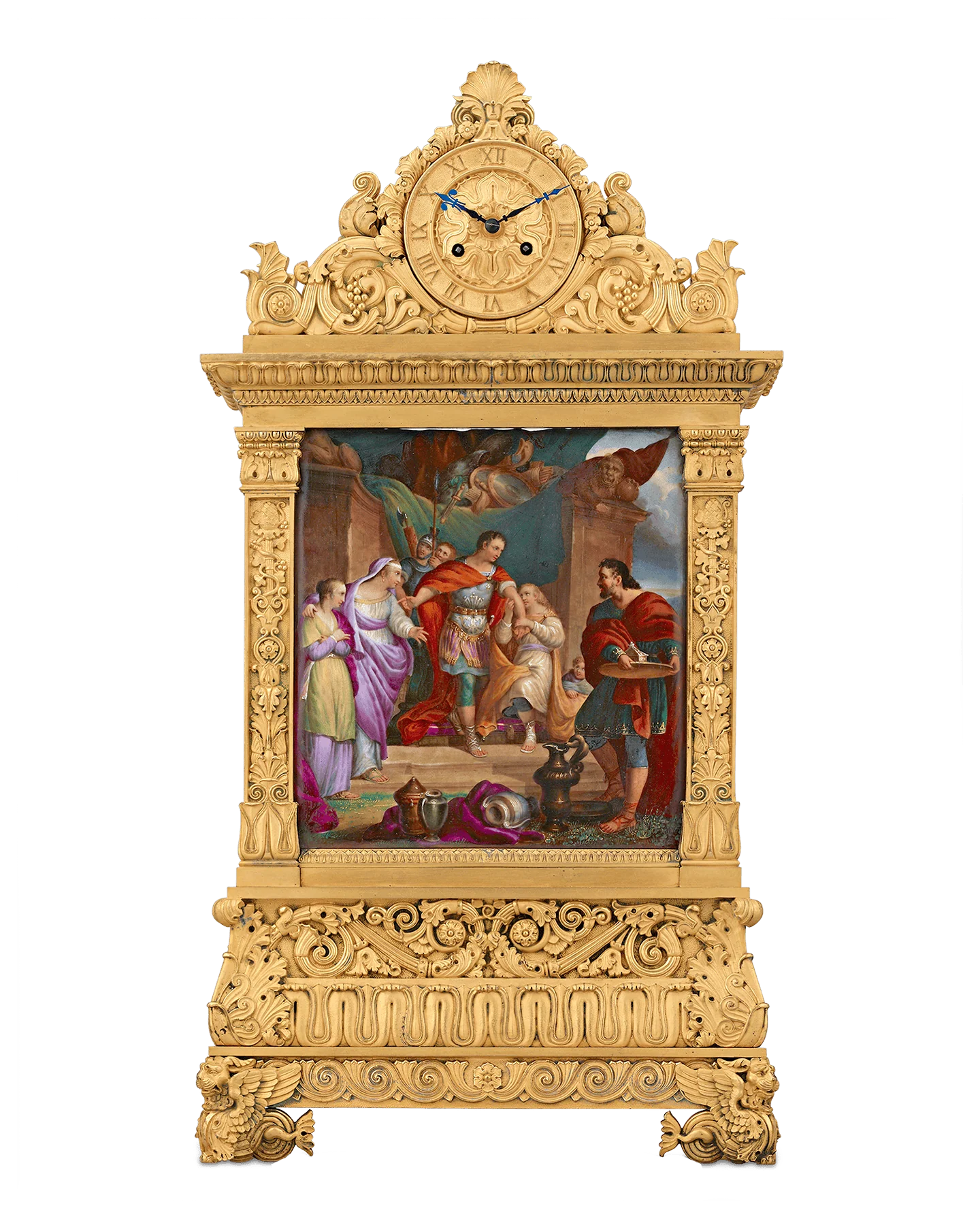
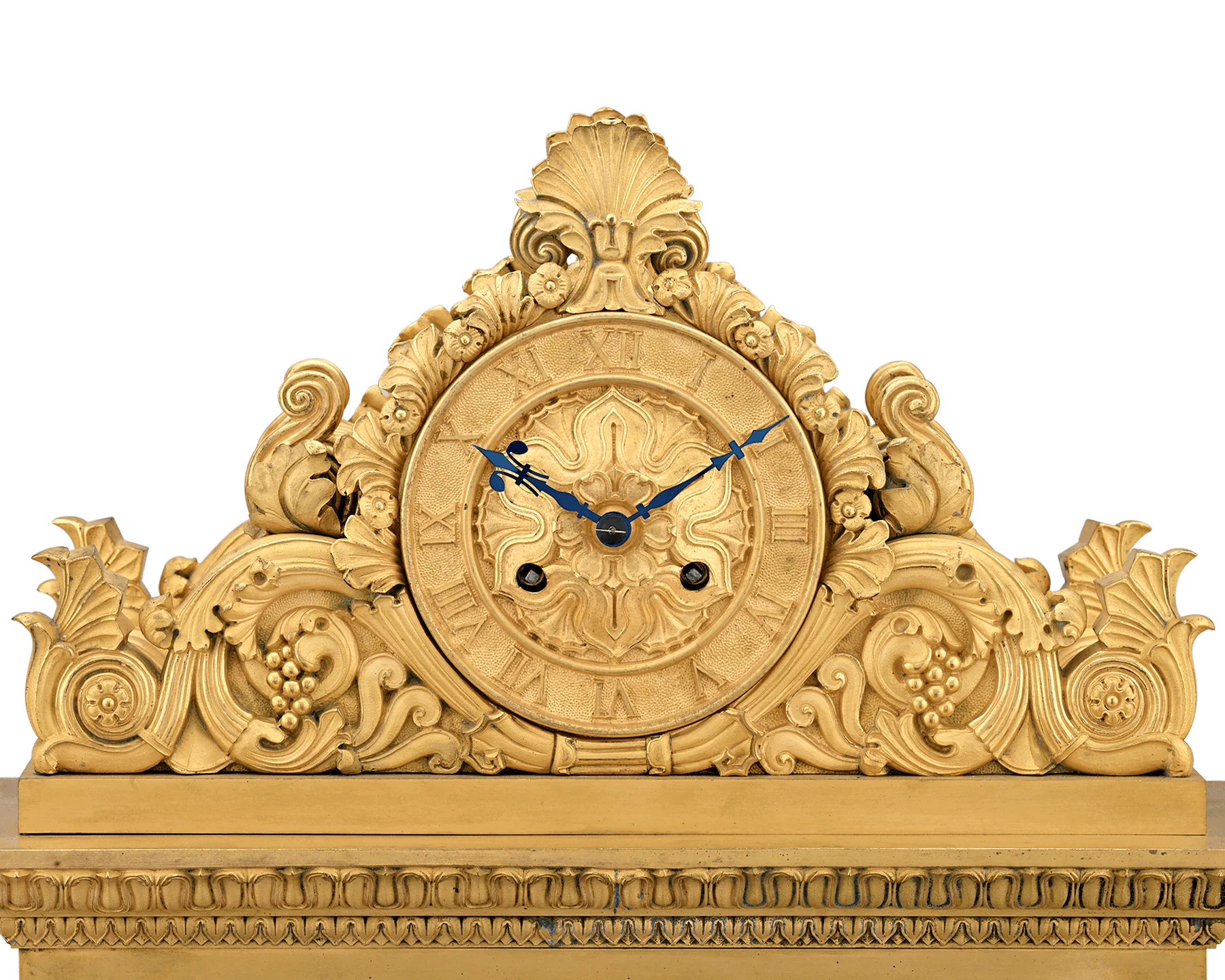
A refined expression of Neoclassical elegance, this Empire mantel clock reflects the early 19th-century fascination with classical antiquity, rendered in finely cast mercury-gilded bronze. Signed Deschamps à Paris, the work unites sculptural narrative and horological precision, depicting the myth of Tekmessa, Ajax and their son Eurysakes.
Tekmessa is shown seated on an upholstered chair raised on claw feet, presenting the shield of Ajax to her son Eurysakes, who stands attentively beside her. Neoclassical tables frame the central figures, while the rectangular base is decorated with finely chased relief scenes from the story of Ajax, extending the narrative across the composition. The case is executed in mercury-gilded bronze, a traditional fire-gilding technique valued for its rich, luminous finish and no longer practiced today due to the hazardous nature of its production process.
Rooted in Greek mythology and later dramatized by Sophocles, the story of Ajax, Tekmessa and Eurysakes reflects themes of honor, fate and legacy. Ajax, one of the great heroes of the Trojan War, descends into despair following the loss of Achilles’ arms, ultimately taking his own life. His son Eurysakes, named for his father’s legendary shield, is raised by Tekmessa and later brought to Salamis, where he is said to become king. In the early 19th century, such classical narratives were frequently revived in the decorative arts, serving as vehicles for moral reflection and artistic refinement within the Empire aesthetic.
21 1/2" high x 18" wide x 6" deep
Deschamps à Paris
Circa 1810
A refined expression of Neoclassical elegance, this Empire mantel clock reflects the early 19th-century fascination with classical antiquity, rendered in finely cast mercury-gilded bronze. Signed Deschamps à Paris, the work unites sculptural narrative and horological precision, depicting the myth of Tekmessa, Ajax and their son Eurysakes.
Tekmessa is shown seated on an upholstered chair raised on claw feet, presenting the shield of Ajax to her son Eurysakes, who stands attentively beside her. Neoclassical tables frame the central figures, while the rectangular base is decorated with finely chased relief scenes from the story of Ajax, extending the narrative across the composition. The case is executed in mercury-gilded bronze, a traditional fire-gilding technique valued for its rich, luminous finish and no longer practiced today due to the hazardous nature of its production process.
Rooted in Greek mythology and later dramatized by Sophocles, the story of Ajax, Tekmessa and Eurysakes reflects themes of honor, fate and legacy. Ajax, one of the great heroes of the Trojan War, descends into despair following the loss of Achilles’ arms, ultimately taking his own life. His son Eurysakes, named for his father’s legendary shield, is raised by Tekmessa and later brought to Salamis, where he is said to become king. In the early 19th century, such classical narratives were frequently revived in the decorative arts, serving as vehicles for moral reflection and artistic refinement within the Empire aesthetic.
21 1/2" high x 18" wide x 6" deep
Empire Mythological Mantel Clock
Deschamps à Paris
Circa 1810
A refined expression of Neoclassical elegance, this Empire mantel clock reflects the early 19th-century fascination with classical antiquity, rendered in finely cast mercury-gilded bronze. Signed Deschamps à Paris, the work unites sculptural narrative and horological precision, depicting the myth of Tekmessa, Ajax and their son Eurysakes.
Tekmessa is shown seated on an upholstered chair raised on claw feet, presenting the shield of Ajax to her son Eurysakes, who stands attentively beside her. Neoclassical tables frame the central figures, while the rectangular base is decorated with finely chased relief scenes from the story of Ajax, extending the narrative across the composition. The case is executed in mercury-gilded bronze, a traditional fire-gilding technique valued for its rich, luminous finish and no longer practiced today due to the hazardous nature of its production process.
Rooted in Greek mythology and later dramatized by Sophocles, the story of Ajax, Tekmessa and Eurysakes reflects themes of honor, fate and legacy. Ajax, one of the great heroes of the Trojan War, descends into despair following the loss of Achilles’ arms, ultimately taking his own life. His son Eurysakes, named for his father’s legendary shield, is raised by Tekmessa and later brought to Salamis, where he is said to become king. In the early 19th century, such classical narratives were frequently revived in the decorative arts, serving as vehicles for moral reflection and artistic refinement within the Empire aesthetic.
21 1/2" high x 18" wide x 6" deep
Deschamps à Paris
Circa 1810
A refined expression of Neoclassical elegance, this Empire mantel clock reflects the early 19th-century fascination with classical antiquity, rendered in finely cast mercury-gilded bronze. Signed Deschamps à Paris, the work unites sculptural narrative and horological precision, depicting the myth of Tekmessa, Ajax and their son Eurysakes.
Tekmessa is shown seated on an upholstered chair raised on claw feet, presenting the shield of Ajax to her son Eurysakes, who stands attentively beside her. Neoclassical tables frame the central figures, while the rectangular base is decorated with finely chased relief scenes from the story of Ajax, extending the narrative across the composition. The case is executed in mercury-gilded bronze, a traditional fire-gilding technique valued for its rich, luminous finish and no longer practiced today due to the hazardous nature of its production process.
Rooted in Greek mythology and later dramatized by Sophocles, the story of Ajax, Tekmessa and Eurysakes reflects themes of honor, fate and legacy. Ajax, one of the great heroes of the Trojan War, descends into despair following the loss of Achilles’ arms, ultimately taking his own life. His son Eurysakes, named for his father’s legendary shield, is raised by Tekmessa and later brought to Salamis, where he is said to become king. In the early 19th century, such classical narratives were frequently revived in the decorative arts, serving as vehicles for moral reflection and artistic refinement within the Empire aesthetic.
21 1/2" high x 18" wide x 6" deep
$8,575.00
Original: $24,500.00
-65%Empire Tekmessa and Eurysakes Mantel Clock—
$24,500.00
$8,575.00Description
Empire Mythological Mantel Clock
Deschamps à Paris
Circa 1810
A refined expression of Neoclassical elegance, this Empire mantel clock reflects the early 19th-century fascination with classical antiquity, rendered in finely cast mercury-gilded bronze. Signed Deschamps à Paris, the work unites sculptural narrative and horological precision, depicting the myth of Tekmessa, Ajax and their son Eurysakes.
Tekmessa is shown seated on an upholstered chair raised on claw feet, presenting the shield of Ajax to her son Eurysakes, who stands attentively beside her. Neoclassical tables frame the central figures, while the rectangular base is decorated with finely chased relief scenes from the story of Ajax, extending the narrative across the composition. The case is executed in mercury-gilded bronze, a traditional fire-gilding technique valued for its rich, luminous finish and no longer practiced today due to the hazardous nature of its production process.
Rooted in Greek mythology and later dramatized by Sophocles, the story of Ajax, Tekmessa and Eurysakes reflects themes of honor, fate and legacy. Ajax, one of the great heroes of the Trojan War, descends into despair following the loss of Achilles’ arms, ultimately taking his own life. His son Eurysakes, named for his father’s legendary shield, is raised by Tekmessa and later brought to Salamis, where he is said to become king. In the early 19th century, such classical narratives were frequently revived in the decorative arts, serving as vehicles for moral reflection and artistic refinement within the Empire aesthetic.
21 1/2" high x 18" wide x 6" deep
Deschamps à Paris
Circa 1810
A refined expression of Neoclassical elegance, this Empire mantel clock reflects the early 19th-century fascination with classical antiquity, rendered in finely cast mercury-gilded bronze. Signed Deschamps à Paris, the work unites sculptural narrative and horological precision, depicting the myth of Tekmessa, Ajax and their son Eurysakes.
Tekmessa is shown seated on an upholstered chair raised on claw feet, presenting the shield of Ajax to her son Eurysakes, who stands attentively beside her. Neoclassical tables frame the central figures, while the rectangular base is decorated with finely chased relief scenes from the story of Ajax, extending the narrative across the composition. The case is executed in mercury-gilded bronze, a traditional fire-gilding technique valued for its rich, luminous finish and no longer practiced today due to the hazardous nature of its production process.
Rooted in Greek mythology and later dramatized by Sophocles, the story of Ajax, Tekmessa and Eurysakes reflects themes of honor, fate and legacy. Ajax, one of the great heroes of the Trojan War, descends into despair following the loss of Achilles’ arms, ultimately taking his own life. His son Eurysakes, named for his father’s legendary shield, is raised by Tekmessa and later brought to Salamis, where he is said to become king. In the early 19th century, such classical narratives were frequently revived in the decorative arts, serving as vehicles for moral reflection and artistic refinement within the Empire aesthetic.
21 1/2" high x 18" wide x 6" deep