1 / 3
Etude de décor, Don Pasquale Scene II by Erté
Erté (Romain de Tirtoff)
1892-1990 | Russian-French
Etude de décor, Don Pasquale by Erté
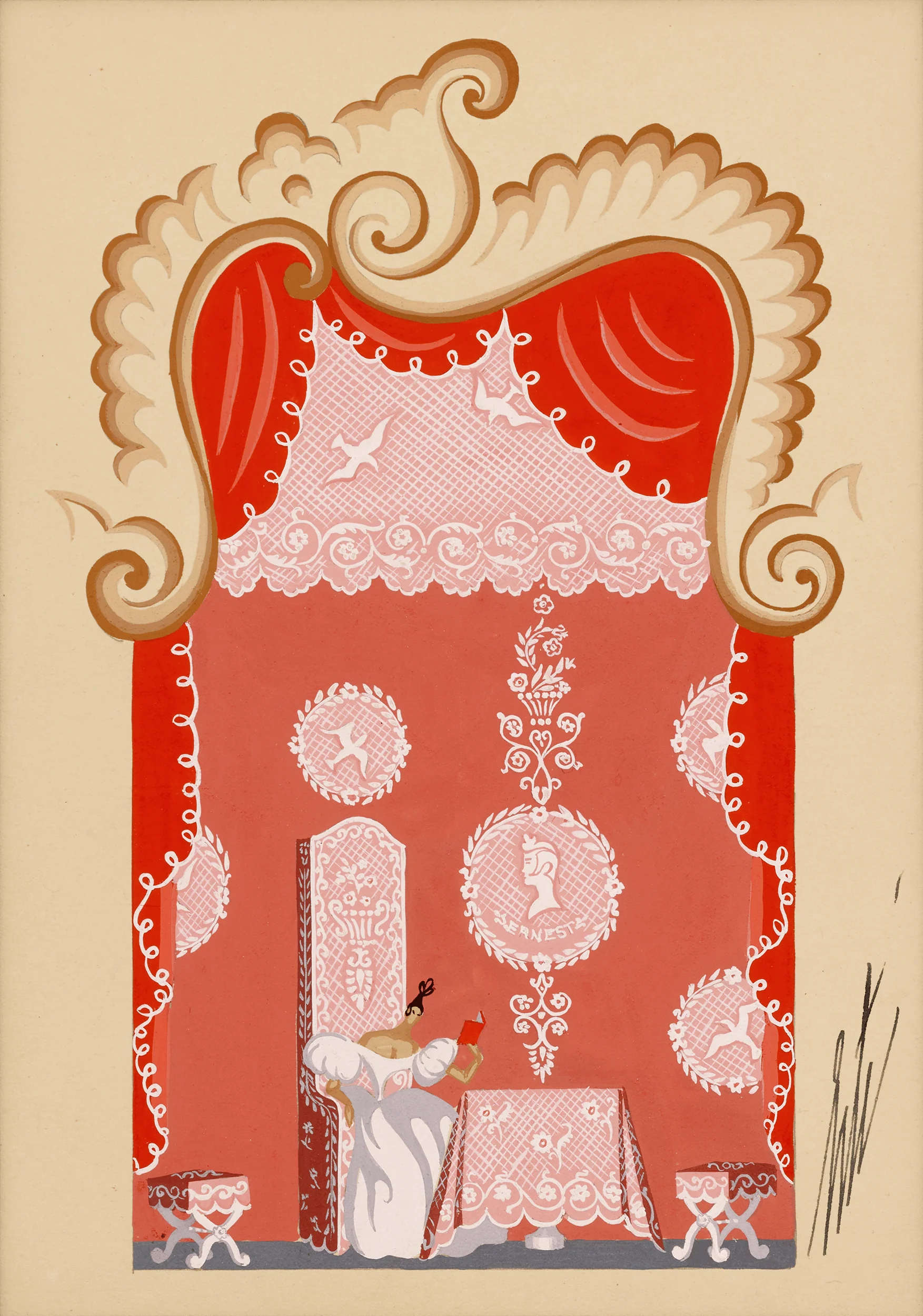
Signed “Erté”(lower right)
Inscribed "No. 7216 / Don Pasquale / 2e tableau" (en verso)
Gouache on paper
In this set design, Erté breathes new life into the classic Italian opera Don Pasquale. Created for scene II, the tableau captures the moment Norina, the production's main character, is deeply immersed in a romantic novel. Her friend, Dr. Malatesta, is about to enter with a devious scheme that serves as the impetus for the unfolding drama. Norina's room, a vision of romantic elegance, is adorned with lace, artworks and a delicate canopy. The ambiance is further enhanced by Norina herself, gracefully attired in a luxurious, flowing white gown.
In this famed Italian comical opera, Pasquale, an elderly bachelor, aims to marry to disinherit his defiant nephew, Ernesto. Dr. Malatesta, their mutual friend, orchestrates a ruse: he introduces Pasquale to Sofronia, who is actually Ernesto's lover, Norina, in disguise. After a fake marriage, Norina, as Sofronia, becomes a demanding wife, driving Pasquale to despair. As tensions rise, Malatesta reveals the deception, teaching Pasquale about the pitfalls of old men marrying young women. Pasquale blesses Ernesto and Norina's union, concluding the opera with a lesson on the dangers of vanity-driven marriages. This timeless plot, accompanied by Erté's modern Art Deco set designs, would have created a riveting performance, enjoyed by the artist's fashionable 20th century audience.
Russian-French visionary Romain de Tirtoff (1892-1990), popularly known as Erté, began his artistic journey in the culturally rich city of St. Petersburg, where he developed an early fondness for ballet and theatrical performances. He moved to Paris in 1912 to study architecture, and quickly found his creative niche in crafting fantastical costumes for the city’s bustling nightlife. Erté‘s expertise, refined under the guidance of the famed Paul Poiret, captured the attention of Harper’s Bazaar, marking the beginning of a significant partnership that spanned from 1915 to 1936. The artist also designed sets for notable cinematic masterpieces including Ben Hur and La Bohème, and created sets and costumes for cabarets, operas and other performances at the Folies-Bergères, Bal Tabarin, the Théâtre du Bataclan and Le Casino de Paris. Often remembered as the “Father of Art Deco,” Erté was a trailblazer whose colorful creations shaped the groundbreaking Art Deco era more than any other, leaving an indelible mark on the history of art and design. His artworks reside in prestigious museum collections worldwide, including the Metropolitan Museum of Art in New York, the Victoria & Albert Museum in London and the Los Angeles County Museum of Art.
Circa 1943
Paper: 9 1/2” high by 7” wide
Frame: 15 1/4” high by 12 1/2” wide by 3/4" deep
Exhibitions:
M.S. Rau, New Orleans, Erté and the Era of Art Deco, October 14, 2023 - January 3, 2024
Provenance:
Private collection, Serge Leeman, Paris
Private collection, Paris
M.S. Rau, New Orleans
1892-1990 | Russian-French
Etude de décor, Don Pasquale by Erté
Signed “Erté”(lower right)
Inscribed "No. 7216 / Don Pasquale / 2e tableau" (en verso)
Gouache on paper
In this set design, Erté breathes new life into the classic Italian opera Don Pasquale. Created for scene II, the tableau captures the moment Norina, the production's main character, is deeply immersed in a romantic novel. Her friend, Dr. Malatesta, is about to enter with a devious scheme that serves as the impetus for the unfolding drama. Norina's room, a vision of romantic elegance, is adorned with lace, artworks and a delicate canopy. The ambiance is further enhanced by Norina herself, gracefully attired in a luxurious, flowing white gown.
In this famed Italian comical opera, Pasquale, an elderly bachelor, aims to marry to disinherit his defiant nephew, Ernesto. Dr. Malatesta, their mutual friend, orchestrates a ruse: he introduces Pasquale to Sofronia, who is actually Ernesto's lover, Norina, in disguise. After a fake marriage, Norina, as Sofronia, becomes a demanding wife, driving Pasquale to despair. As tensions rise, Malatesta reveals the deception, teaching Pasquale about the pitfalls of old men marrying young women. Pasquale blesses Ernesto and Norina's union, concluding the opera with a lesson on the dangers of vanity-driven marriages. This timeless plot, accompanied by Erté's modern Art Deco set designs, would have created a riveting performance, enjoyed by the artist's fashionable 20th century audience.
Russian-French visionary Romain de Tirtoff (1892-1990), popularly known as Erté, began his artistic journey in the culturally rich city of St. Petersburg, where he developed an early fondness for ballet and theatrical performances. He moved to Paris in 1912 to study architecture, and quickly found his creative niche in crafting fantastical costumes for the city’s bustling nightlife. Erté‘s expertise, refined under the guidance of the famed Paul Poiret, captured the attention of Harper’s Bazaar, marking the beginning of a significant partnership that spanned from 1915 to 1936. The artist also designed sets for notable cinematic masterpieces including Ben Hur and La Bohème, and created sets and costumes for cabarets, operas and other performances at the Folies-Bergères, Bal Tabarin, the Théâtre du Bataclan and Le Casino de Paris. Often remembered as the “Father of Art Deco,” Erté was a trailblazer whose colorful creations shaped the groundbreaking Art Deco era more than any other, leaving an indelible mark on the history of art and design. His artworks reside in prestigious museum collections worldwide, including the Metropolitan Museum of Art in New York, the Victoria & Albert Museum in London and the Los Angeles County Museum of Art.
Circa 1943
Paper: 9 1/2” high by 7” wide
Frame: 15 1/4” high by 12 1/2” wide by 3/4" deep
Exhibitions:
M.S. Rau, New Orleans, Erté and the Era of Art Deco, October 14, 2023 - January 3, 2024
Provenance:
Private collection, Serge Leeman, Paris
Private collection, Paris
M.S. Rau, New Orleans
Erté (Romain de Tirtoff)
1892-1990 | Russian-French
Etude de décor, Don Pasquale by Erté
Signed “Erté”(lower right)
Inscribed "No. 7216 / Don Pasquale / 2e tableau" (en verso)
Gouache on paper
In this set design, Erté breathes new life into the classic Italian opera Don Pasquale. Created for scene II, the tableau captures the moment Norina, the production's main character, is deeply immersed in a romantic novel. Her friend, Dr. Malatesta, is about to enter with a devious scheme that serves as the impetus for the unfolding drama. Norina's room, a vision of romantic elegance, is adorned with lace, artworks and a delicate canopy. The ambiance is further enhanced by Norina herself, gracefully attired in a luxurious, flowing white gown.
In this famed Italian comical opera, Pasquale, an elderly bachelor, aims to marry to disinherit his defiant nephew, Ernesto. Dr. Malatesta, their mutual friend, orchestrates a ruse: he introduces Pasquale to Sofronia, who is actually Ernesto's lover, Norina, in disguise. After a fake marriage, Norina, as Sofronia, becomes a demanding wife, driving Pasquale to despair. As tensions rise, Malatesta reveals the deception, teaching Pasquale about the pitfalls of old men marrying young women. Pasquale blesses Ernesto and Norina's union, concluding the opera with a lesson on the dangers of vanity-driven marriages. This timeless plot, accompanied by Erté's modern Art Deco set designs, would have created a riveting performance, enjoyed by the artist's fashionable 20th century audience.
Russian-French visionary Romain de Tirtoff (1892-1990), popularly known as Erté, began his artistic journey in the culturally rich city of St. Petersburg, where he developed an early fondness for ballet and theatrical performances. He moved to Paris in 1912 to study architecture, and quickly found his creative niche in crafting fantastical costumes for the city’s bustling nightlife. Erté‘s expertise, refined under the guidance of the famed Paul Poiret, captured the attention of Harper’s Bazaar, marking the beginning of a significant partnership that spanned from 1915 to 1936. The artist also designed sets for notable cinematic masterpieces including Ben Hur and La Bohème, and created sets and costumes for cabarets, operas and other performances at the Folies-Bergères, Bal Tabarin, the Théâtre du Bataclan and Le Casino de Paris. Often remembered as the “Father of Art Deco,” Erté was a trailblazer whose colorful creations shaped the groundbreaking Art Deco era more than any other, leaving an indelible mark on the history of art and design. His artworks reside in prestigious museum collections worldwide, including the Metropolitan Museum of Art in New York, the Victoria & Albert Museum in London and the Los Angeles County Museum of Art.
Circa 1943
Paper: 9 1/2” high by 7” wide
Frame: 15 1/4” high by 12 1/2” wide by 3/4" deep
Exhibitions:
M.S. Rau, New Orleans, Erté and the Era of Art Deco, October 14, 2023 - January 3, 2024
Provenance:
Private collection, Serge Leeman, Paris
Private collection, Paris
M.S. Rau, New Orleans
1892-1990 | Russian-French
Etude de décor, Don Pasquale by Erté
Signed “Erté”(lower right)
Inscribed "No. 7216 / Don Pasquale / 2e tableau" (en verso)
Gouache on paper
In this set design, Erté breathes new life into the classic Italian opera Don Pasquale. Created for scene II, the tableau captures the moment Norina, the production's main character, is deeply immersed in a romantic novel. Her friend, Dr. Malatesta, is about to enter with a devious scheme that serves as the impetus for the unfolding drama. Norina's room, a vision of romantic elegance, is adorned with lace, artworks and a delicate canopy. The ambiance is further enhanced by Norina herself, gracefully attired in a luxurious, flowing white gown.
In this famed Italian comical opera, Pasquale, an elderly bachelor, aims to marry to disinherit his defiant nephew, Ernesto. Dr. Malatesta, their mutual friend, orchestrates a ruse: he introduces Pasquale to Sofronia, who is actually Ernesto's lover, Norina, in disguise. After a fake marriage, Norina, as Sofronia, becomes a demanding wife, driving Pasquale to despair. As tensions rise, Malatesta reveals the deception, teaching Pasquale about the pitfalls of old men marrying young women. Pasquale blesses Ernesto and Norina's union, concluding the opera with a lesson on the dangers of vanity-driven marriages. This timeless plot, accompanied by Erté's modern Art Deco set designs, would have created a riveting performance, enjoyed by the artist's fashionable 20th century audience.
Russian-French visionary Romain de Tirtoff (1892-1990), popularly known as Erté, began his artistic journey in the culturally rich city of St. Petersburg, where he developed an early fondness for ballet and theatrical performances. He moved to Paris in 1912 to study architecture, and quickly found his creative niche in crafting fantastical costumes for the city’s bustling nightlife. Erté‘s expertise, refined under the guidance of the famed Paul Poiret, captured the attention of Harper’s Bazaar, marking the beginning of a significant partnership that spanned from 1915 to 1936. The artist also designed sets for notable cinematic masterpieces including Ben Hur and La Bohème, and created sets and costumes for cabarets, operas and other performances at the Folies-Bergères, Bal Tabarin, the Théâtre du Bataclan and Le Casino de Paris. Often remembered as the “Father of Art Deco,” Erté was a trailblazer whose colorful creations shaped the groundbreaking Art Deco era more than any other, leaving an indelible mark on the history of art and design. His artworks reside in prestigious museum collections worldwide, including the Metropolitan Museum of Art in New York, the Victoria & Albert Museum in London and the Los Angeles County Museum of Art.
Circa 1943
Paper: 9 1/2” high by 7” wide
Frame: 15 1/4” high by 12 1/2” wide by 3/4" deep
Exhibitions:
M.S. Rau, New Orleans, Erté and the Era of Art Deco, October 14, 2023 - January 3, 2024
Provenance:
Private collection, Serge Leeman, Paris
Private collection, Paris
M.S. Rau, New Orleans
$12,500.00
Etude de décor, Don Pasquale Scene II by Erté—
$12,500.00
Description
Erté (Romain de Tirtoff)
1892-1990 | Russian-French
Etude de décor, Don Pasquale by Erté
Signed “Erté”(lower right)
Inscribed "No. 7216 / Don Pasquale / 2e tableau" (en verso)
Gouache on paper
In this set design, Erté breathes new life into the classic Italian opera Don Pasquale. Created for scene II, the tableau captures the moment Norina, the production's main character, is deeply immersed in a romantic novel. Her friend, Dr. Malatesta, is about to enter with a devious scheme that serves as the impetus for the unfolding drama. Norina's room, a vision of romantic elegance, is adorned with lace, artworks and a delicate canopy. The ambiance is further enhanced by Norina herself, gracefully attired in a luxurious, flowing white gown.
In this famed Italian comical opera, Pasquale, an elderly bachelor, aims to marry to disinherit his defiant nephew, Ernesto. Dr. Malatesta, their mutual friend, orchestrates a ruse: he introduces Pasquale to Sofronia, who is actually Ernesto's lover, Norina, in disguise. After a fake marriage, Norina, as Sofronia, becomes a demanding wife, driving Pasquale to despair. As tensions rise, Malatesta reveals the deception, teaching Pasquale about the pitfalls of old men marrying young women. Pasquale blesses Ernesto and Norina's union, concluding the opera with a lesson on the dangers of vanity-driven marriages. This timeless plot, accompanied by Erté's modern Art Deco set designs, would have created a riveting performance, enjoyed by the artist's fashionable 20th century audience.
Russian-French visionary Romain de Tirtoff (1892-1990), popularly known as Erté, began his artistic journey in the culturally rich city of St. Petersburg, where he developed an early fondness for ballet and theatrical performances. He moved to Paris in 1912 to study architecture, and quickly found his creative niche in crafting fantastical costumes for the city’s bustling nightlife. Erté‘s expertise, refined under the guidance of the famed Paul Poiret, captured the attention of Harper’s Bazaar, marking the beginning of a significant partnership that spanned from 1915 to 1936. The artist also designed sets for notable cinematic masterpieces including Ben Hur and La Bohème, and created sets and costumes for cabarets, operas and other performances at the Folies-Bergères, Bal Tabarin, the Théâtre du Bataclan and Le Casino de Paris. Often remembered as the “Father of Art Deco,” Erté was a trailblazer whose colorful creations shaped the groundbreaking Art Deco era more than any other, leaving an indelible mark on the history of art and design. His artworks reside in prestigious museum collections worldwide, including the Metropolitan Museum of Art in New York, the Victoria & Albert Museum in London and the Los Angeles County Museum of Art.
Circa 1943
Paper: 9 1/2” high by 7” wide
Frame: 15 1/4” high by 12 1/2” wide by 3/4" deep
Exhibitions:
M.S. Rau, New Orleans, Erté and the Era of Art Deco, October 14, 2023 - January 3, 2024
Provenance:
Private collection, Serge Leeman, Paris
Private collection, Paris
M.S. Rau, New Orleans
1892-1990 | Russian-French
Etude de décor, Don Pasquale by Erté
Signed “Erté”(lower right)
Inscribed "No. 7216 / Don Pasquale / 2e tableau" (en verso)
Gouache on paper
In this set design, Erté breathes new life into the classic Italian opera Don Pasquale. Created for scene II, the tableau captures the moment Norina, the production's main character, is deeply immersed in a romantic novel. Her friend, Dr. Malatesta, is about to enter with a devious scheme that serves as the impetus for the unfolding drama. Norina's room, a vision of romantic elegance, is adorned with lace, artworks and a delicate canopy. The ambiance is further enhanced by Norina herself, gracefully attired in a luxurious, flowing white gown.
In this famed Italian comical opera, Pasquale, an elderly bachelor, aims to marry to disinherit his defiant nephew, Ernesto. Dr. Malatesta, their mutual friend, orchestrates a ruse: he introduces Pasquale to Sofronia, who is actually Ernesto's lover, Norina, in disguise. After a fake marriage, Norina, as Sofronia, becomes a demanding wife, driving Pasquale to despair. As tensions rise, Malatesta reveals the deception, teaching Pasquale about the pitfalls of old men marrying young women. Pasquale blesses Ernesto and Norina's union, concluding the opera with a lesson on the dangers of vanity-driven marriages. This timeless plot, accompanied by Erté's modern Art Deco set designs, would have created a riveting performance, enjoyed by the artist's fashionable 20th century audience.
Russian-French visionary Romain de Tirtoff (1892-1990), popularly known as Erté, began his artistic journey in the culturally rich city of St. Petersburg, where he developed an early fondness for ballet and theatrical performances. He moved to Paris in 1912 to study architecture, and quickly found his creative niche in crafting fantastical costumes for the city’s bustling nightlife. Erté‘s expertise, refined under the guidance of the famed Paul Poiret, captured the attention of Harper’s Bazaar, marking the beginning of a significant partnership that spanned from 1915 to 1936. The artist also designed sets for notable cinematic masterpieces including Ben Hur and La Bohème, and created sets and costumes for cabarets, operas and other performances at the Folies-Bergères, Bal Tabarin, the Théâtre du Bataclan and Le Casino de Paris. Often remembered as the “Father of Art Deco,” Erté was a trailblazer whose colorful creations shaped the groundbreaking Art Deco era more than any other, leaving an indelible mark on the history of art and design. His artworks reside in prestigious museum collections worldwide, including the Metropolitan Museum of Art in New York, the Victoria & Albert Museum in London and the Los Angeles County Museum of Art.
Circa 1943
Paper: 9 1/2” high by 7” wide
Frame: 15 1/4” high by 12 1/2” wide by 3/4" deep
Exhibitions:
M.S. Rau, New Orleans, Erté and the Era of Art Deco, October 14, 2023 - January 3, 2024
Provenance:
Private collection, Serge Leeman, Paris
Private collection, Paris
M.S. Rau, New Orleans