
1 / 9
+4
Four Silver Sauceboats by Edward Farrell
Sauceboats, Set of 4
Edward Farrell
Hallmarked London, 1821
These sauceboats are a fine example of Edward Farrell's craftsmanship, reflecting his distinctive style and attention to detail. Drawing inspiration from 17th-century Dutch interiors, Farrell took a unique approach by decorating functional items such as sauceboats with intricate scenes depicting taverns, farmhouses and animals. Each sauceboat features two scenes, one on each side. Each sauceboat remains unique in its overall composition.
The scenes depicted are rich in narrative detail. In one, men are shown feasting and drinking, enjoying the lively music of a fiddler. Another scene captures a peasant playing the hornpipe, entertaining a solitary onlooker. These lively vignettes bring a sense of rustic charm and storytelling to the sauceboats, a hallmark of Farrell’s work.
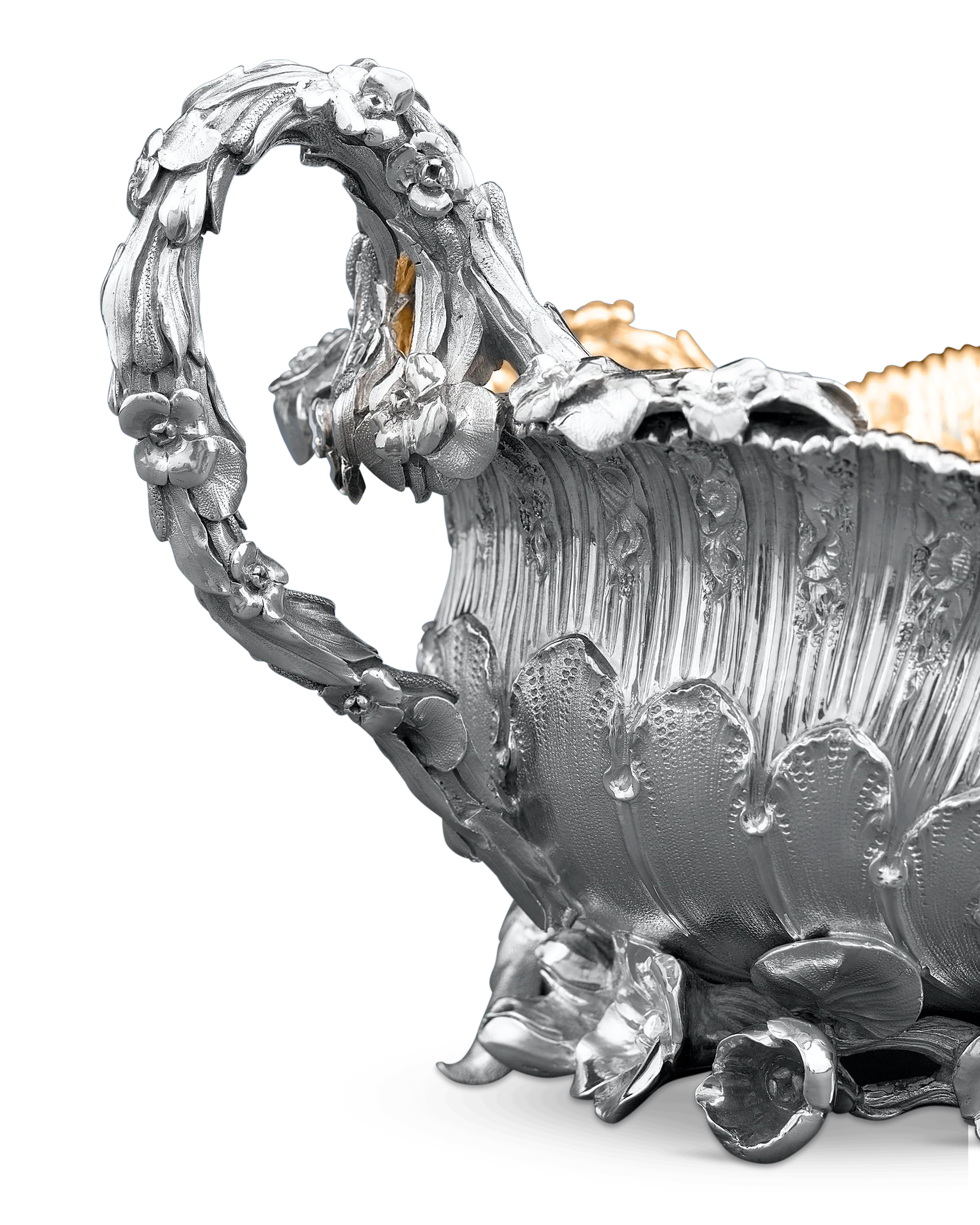
The handles of the sauceboats are equally imaginative. To sample the sauce, a diner must grip a dog depicted in the act of catching a bird, adding a tactile element with intricate detail. The feet of each sauceboat are designed as crouching men holding shells, further enhancing the decorative appeal.
Two of the sauceboats are further distinguished by the heraldic crest of a lion rampant, adding an element of nobility and historical significance to the collection. Together, these sauceboats exemplify Edward Farrell's ability to blend functionality with intricate artistry, making them remarkable examples of early 19th-century silverwork.
Each: 5 3/4" high x 8 1/4" wide x 4 1/2" deep
Provenance:
M.S. Rau, New Orleans
Red McCombs Collection, Texas
M.S. Rau, New Orleans
Edward Farrell
Hallmarked London, 1821
These sauceboats are a fine example of Edward Farrell's craftsmanship, reflecting his distinctive style and attention to detail. Drawing inspiration from 17th-century Dutch interiors, Farrell took a unique approach by decorating functional items such as sauceboats with intricate scenes depicting taverns, farmhouses and animals. Each sauceboat features two scenes, one on each side. Each sauceboat remains unique in its overall composition.
The scenes depicted are rich in narrative detail. In one, men are shown feasting and drinking, enjoying the lively music of a fiddler. Another scene captures a peasant playing the hornpipe, entertaining a solitary onlooker. These lively vignettes bring a sense of rustic charm and storytelling to the sauceboats, a hallmark of Farrell’s work.
The handles of the sauceboats are equally imaginative. To sample the sauce, a diner must grip a dog depicted in the act of catching a bird, adding a tactile element with intricate detail. The feet of each sauceboat are designed as crouching men holding shells, further enhancing the decorative appeal.
Two of the sauceboats are further distinguished by the heraldic crest of a lion rampant, adding an element of nobility and historical significance to the collection. Together, these sauceboats exemplify Edward Farrell's ability to blend functionality with intricate artistry, making them remarkable examples of early 19th-century silverwork.
Each: 5 3/4" high x 8 1/4" wide x 4 1/2" deep
Provenance:
M.S. Rau, New Orleans
Red McCombs Collection, Texas
M.S. Rau, New Orleans
Sauceboats, Set of 4
Edward Farrell
Hallmarked London, 1821
These sauceboats are a fine example of Edward Farrell's craftsmanship, reflecting his distinctive style and attention to detail. Drawing inspiration from 17th-century Dutch interiors, Farrell took a unique approach by decorating functional items such as sauceboats with intricate scenes depicting taverns, farmhouses and animals. Each sauceboat features two scenes, one on each side. Each sauceboat remains unique in its overall composition.
The scenes depicted are rich in narrative detail. In one, men are shown feasting and drinking, enjoying the lively music of a fiddler. Another scene captures a peasant playing the hornpipe, entertaining a solitary onlooker. These lively vignettes bring a sense of rustic charm and storytelling to the sauceboats, a hallmark of Farrell’s work.
The handles of the sauceboats are equally imaginative. To sample the sauce, a diner must grip a dog depicted in the act of catching a bird, adding a tactile element with intricate detail. The feet of each sauceboat are designed as crouching men holding shells, further enhancing the decorative appeal.
Two of the sauceboats are further distinguished by the heraldic crest of a lion rampant, adding an element of nobility and historical significance to the collection. Together, these sauceboats exemplify Edward Farrell's ability to blend functionality with intricate artistry, making them remarkable examples of early 19th-century silverwork.
Each: 5 3/4" high x 8 1/4" wide x 4 1/2" deep
Provenance:
M.S. Rau, New Orleans
Red McCombs Collection, Texas
M.S. Rau, New Orleans
Edward Farrell
Hallmarked London, 1821
These sauceboats are a fine example of Edward Farrell's craftsmanship, reflecting his distinctive style and attention to detail. Drawing inspiration from 17th-century Dutch interiors, Farrell took a unique approach by decorating functional items such as sauceboats with intricate scenes depicting taverns, farmhouses and animals. Each sauceboat features two scenes, one on each side. Each sauceboat remains unique in its overall composition.
The scenes depicted are rich in narrative detail. In one, men are shown feasting and drinking, enjoying the lively music of a fiddler. Another scene captures a peasant playing the hornpipe, entertaining a solitary onlooker. These lively vignettes bring a sense of rustic charm and storytelling to the sauceboats, a hallmark of Farrell’s work.
The handles of the sauceboats are equally imaginative. To sample the sauce, a diner must grip a dog depicted in the act of catching a bird, adding a tactile element with intricate detail. The feet of each sauceboat are designed as crouching men holding shells, further enhancing the decorative appeal.
Two of the sauceboats are further distinguished by the heraldic crest of a lion rampant, adding an element of nobility and historical significance to the collection. Together, these sauceboats exemplify Edward Farrell's ability to blend functionality with intricate artistry, making them remarkable examples of early 19th-century silverwork.
Each: 5 3/4" high x 8 1/4" wide x 4 1/2" deep
Provenance:
M.S. Rau, New Orleans
Red McCombs Collection, Texas
M.S. Rau, New Orleans
$9,975.00
Original: $28,500.00
-65%Four Silver Sauceboats by Edward Farrell—
$28,500.00
$9,975.00Description
Sauceboats, Set of 4
Edward Farrell
Hallmarked London, 1821
These sauceboats are a fine example of Edward Farrell's craftsmanship, reflecting his distinctive style and attention to detail. Drawing inspiration from 17th-century Dutch interiors, Farrell took a unique approach by decorating functional items such as sauceboats with intricate scenes depicting taverns, farmhouses and animals. Each sauceboat features two scenes, one on each side. Each sauceboat remains unique in its overall composition.
The scenes depicted are rich in narrative detail. In one, men are shown feasting and drinking, enjoying the lively music of a fiddler. Another scene captures a peasant playing the hornpipe, entertaining a solitary onlooker. These lively vignettes bring a sense of rustic charm and storytelling to the sauceboats, a hallmark of Farrell’s work.
The handles of the sauceboats are equally imaginative. To sample the sauce, a diner must grip a dog depicted in the act of catching a bird, adding a tactile element with intricate detail. The feet of each sauceboat are designed as crouching men holding shells, further enhancing the decorative appeal.
Two of the sauceboats are further distinguished by the heraldic crest of a lion rampant, adding an element of nobility and historical significance to the collection. Together, these sauceboats exemplify Edward Farrell's ability to blend functionality with intricate artistry, making them remarkable examples of early 19th-century silverwork.
Each: 5 3/4" high x 8 1/4" wide x 4 1/2" deep
Provenance:
M.S. Rau, New Orleans
Red McCombs Collection, Texas
M.S. Rau, New Orleans
Edward Farrell
Hallmarked London, 1821
These sauceboats are a fine example of Edward Farrell's craftsmanship, reflecting his distinctive style and attention to detail. Drawing inspiration from 17th-century Dutch interiors, Farrell took a unique approach by decorating functional items such as sauceboats with intricate scenes depicting taverns, farmhouses and animals. Each sauceboat features two scenes, one on each side. Each sauceboat remains unique in its overall composition.
The scenes depicted are rich in narrative detail. In one, men are shown feasting and drinking, enjoying the lively music of a fiddler. Another scene captures a peasant playing the hornpipe, entertaining a solitary onlooker. These lively vignettes bring a sense of rustic charm and storytelling to the sauceboats, a hallmark of Farrell’s work.
The handles of the sauceboats are equally imaginative. To sample the sauce, a diner must grip a dog depicted in the act of catching a bird, adding a tactile element with intricate detail. The feet of each sauceboat are designed as crouching men holding shells, further enhancing the decorative appeal.
Two of the sauceboats are further distinguished by the heraldic crest of a lion rampant, adding an element of nobility and historical significance to the collection. Together, these sauceboats exemplify Edward Farrell's ability to blend functionality with intricate artistry, making them remarkable examples of early 19th-century silverwork.
Each: 5 3/4" high x 8 1/4" wide x 4 1/2" deep
Provenance:
M.S. Rau, New Orleans
Red McCombs Collection, Texas
M.S. Rau, New Orleans