
1 / 7
+2
Genius of the Arts Mantel Clock by James Moore French
Genius of the Arts Mantel Clock
James Moore French, Royal Exchange, London
Circa 1815
This magnificent English Regency mantel clock stands among the most sculpturally ambitious timepieces of the period, bearing the prestigious signature of James Moore French of the Royal Exchange, London—one of the foremost clockmakers of the early 19th century. The clock features a monumental patinated bronze statue of the Genius of Literature, a winged male allegorical figure, who leans with ease against the gilt bronze clock case. Reserved for the finest commissions of the Regency period, objects of this sculptural complexity and horological distinction seldom appear on the market.
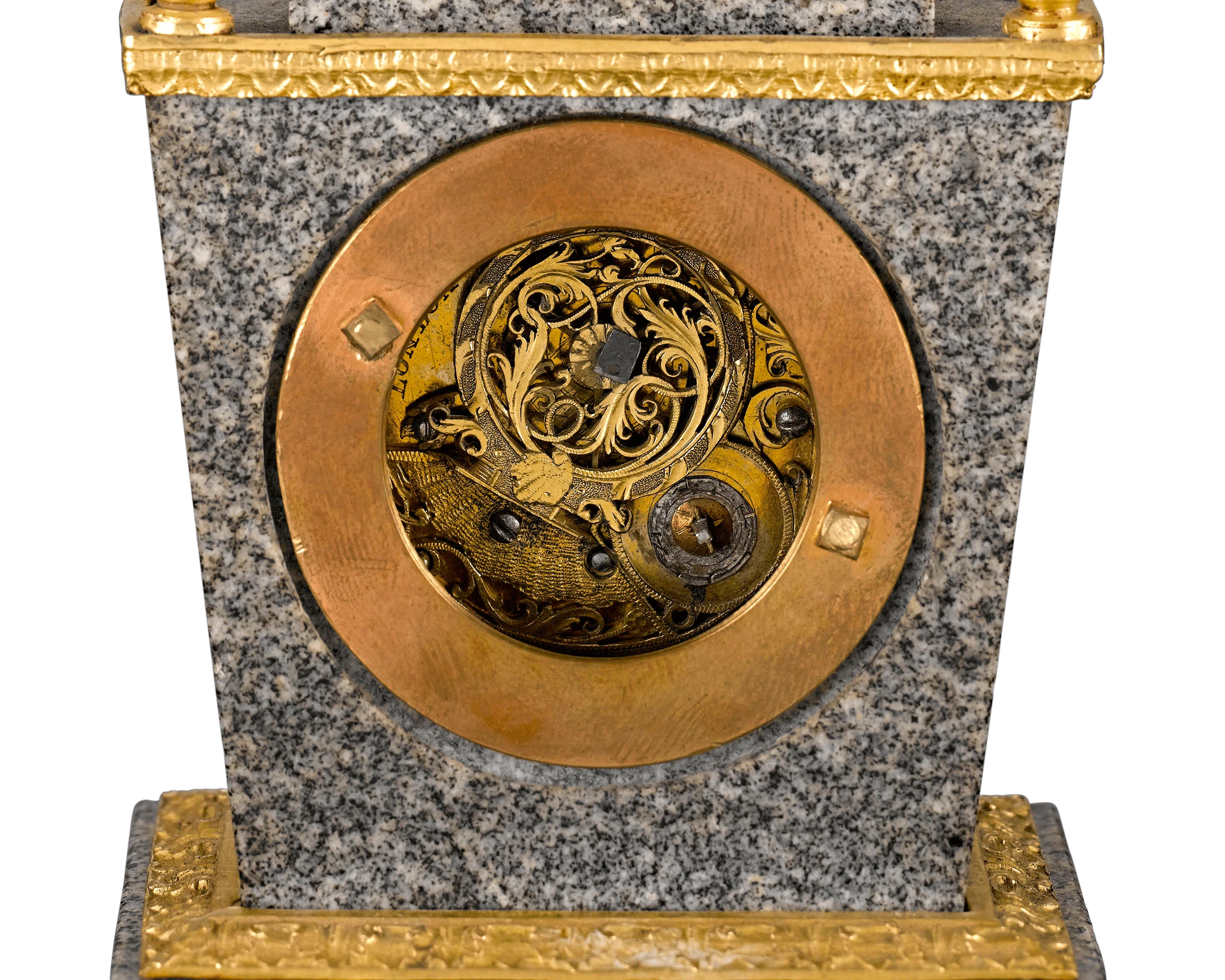
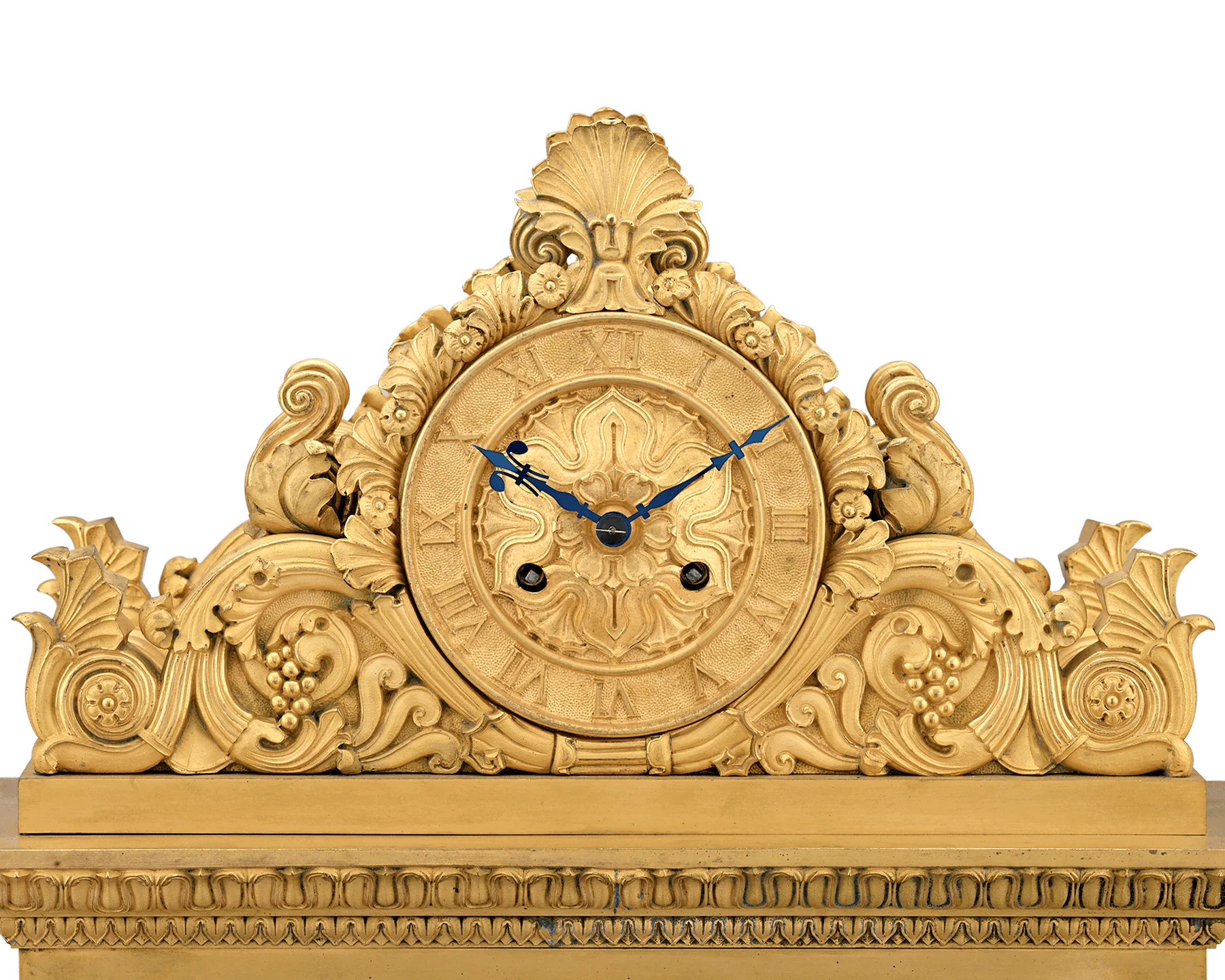
The mechanism rests on a Verde Antico marble plinth raised on ormolu bun feet, and the architectural clock case is densely ornamented in high relief with medallion portraits of celebrated classical writers and philosophers, framed by rope moldings, acanthus scrollwork and columns. The white enamel dial, signed French, Royal Exchange, London, features Roman numerals and blued steel hands within a finely engine-turned gilt bezel. Within, the movement is an outstanding eight-day fusee with its original chain, a fully signed backplate and a rare cylindrical pendulum.
James Moore French operated from the Royal Exchange, London, one of the most prestigious commercial addresses in Regency England, where only clockmakers of the highest reputation could maintain a presence. French was celebrated for the exceptional quality of his movements and for commissioning sculptural cases of great ambition, often uniting the finest English clockmaking with Continental bronze casting traditions.
Signed on dial and backplate: French, Royal Exchange, London
19 1/2" high x 13 1/4" wide x 5 1/2" deep
James Moore French, Royal Exchange, London
Circa 1815
This magnificent English Regency mantel clock stands among the most sculpturally ambitious timepieces of the period, bearing the prestigious signature of James Moore French of the Royal Exchange, London—one of the foremost clockmakers of the early 19th century. The clock features a monumental patinated bronze statue of the Genius of Literature, a winged male allegorical figure, who leans with ease against the gilt bronze clock case. Reserved for the finest commissions of the Regency period, objects of this sculptural complexity and horological distinction seldom appear on the market.
The mechanism rests on a Verde Antico marble plinth raised on ormolu bun feet, and the architectural clock case is densely ornamented in high relief with medallion portraits of celebrated classical writers and philosophers, framed by rope moldings, acanthus scrollwork and columns. The white enamel dial, signed French, Royal Exchange, London, features Roman numerals and blued steel hands within a finely engine-turned gilt bezel. Within, the movement is an outstanding eight-day fusee with its original chain, a fully signed backplate and a rare cylindrical pendulum.
James Moore French operated from the Royal Exchange, London, one of the most prestigious commercial addresses in Regency England, where only clockmakers of the highest reputation could maintain a presence. French was celebrated for the exceptional quality of his movements and for commissioning sculptural cases of great ambition, often uniting the finest English clockmaking with Continental bronze casting traditions.
Signed on dial and backplate: French, Royal Exchange, London
19 1/2" high x 13 1/4" wide x 5 1/2" deep
Genius of the Arts Mantel Clock
James Moore French, Royal Exchange, London
Circa 1815
This magnificent English Regency mantel clock stands among the most sculpturally ambitious timepieces of the period, bearing the prestigious signature of James Moore French of the Royal Exchange, London—one of the foremost clockmakers of the early 19th century. The clock features a monumental patinated bronze statue of the Genius of Literature, a winged male allegorical figure, who leans with ease against the gilt bronze clock case. Reserved for the finest commissions of the Regency period, objects of this sculptural complexity and horological distinction seldom appear on the market.
The mechanism rests on a Verde Antico marble plinth raised on ormolu bun feet, and the architectural clock case is densely ornamented in high relief with medallion portraits of celebrated classical writers and philosophers, framed by rope moldings, acanthus scrollwork and columns. The white enamel dial, signed French, Royal Exchange, London, features Roman numerals and blued steel hands within a finely engine-turned gilt bezel. Within, the movement is an outstanding eight-day fusee with its original chain, a fully signed backplate and a rare cylindrical pendulum.
James Moore French operated from the Royal Exchange, London, one of the most prestigious commercial addresses in Regency England, where only clockmakers of the highest reputation could maintain a presence. French was celebrated for the exceptional quality of his movements and for commissioning sculptural cases of great ambition, often uniting the finest English clockmaking with Continental bronze casting traditions.
Signed on dial and backplate: French, Royal Exchange, London
19 1/2" high x 13 1/4" wide x 5 1/2" deep
James Moore French, Royal Exchange, London
Circa 1815
This magnificent English Regency mantel clock stands among the most sculpturally ambitious timepieces of the period, bearing the prestigious signature of James Moore French of the Royal Exchange, London—one of the foremost clockmakers of the early 19th century. The clock features a monumental patinated bronze statue of the Genius of Literature, a winged male allegorical figure, who leans with ease against the gilt bronze clock case. Reserved for the finest commissions of the Regency period, objects of this sculptural complexity and horological distinction seldom appear on the market.
The mechanism rests on a Verde Antico marble plinth raised on ormolu bun feet, and the architectural clock case is densely ornamented in high relief with medallion portraits of celebrated classical writers and philosophers, framed by rope moldings, acanthus scrollwork and columns. The white enamel dial, signed French, Royal Exchange, London, features Roman numerals and blued steel hands within a finely engine-turned gilt bezel. Within, the movement is an outstanding eight-day fusee with its original chain, a fully signed backplate and a rare cylindrical pendulum.
James Moore French operated from the Royal Exchange, London, one of the most prestigious commercial addresses in Regency England, where only clockmakers of the highest reputation could maintain a presence. French was celebrated for the exceptional quality of his movements and for commissioning sculptural cases of great ambition, often uniting the finest English clockmaking with Continental bronze casting traditions.
Signed on dial and backplate: French, Royal Exchange, London
19 1/2" high x 13 1/4" wide x 5 1/2" deep
$12,075.00
Original: $34,500.00
-65%Genius of the Arts Mantel Clock by James Moore French—
$34,500.00
$12,075.00Description
Genius of the Arts Mantel Clock
James Moore French, Royal Exchange, London
Circa 1815
This magnificent English Regency mantel clock stands among the most sculpturally ambitious timepieces of the period, bearing the prestigious signature of James Moore French of the Royal Exchange, London—one of the foremost clockmakers of the early 19th century. The clock features a monumental patinated bronze statue of the Genius of Literature, a winged male allegorical figure, who leans with ease against the gilt bronze clock case. Reserved for the finest commissions of the Regency period, objects of this sculptural complexity and horological distinction seldom appear on the market.
The mechanism rests on a Verde Antico marble plinth raised on ormolu bun feet, and the architectural clock case is densely ornamented in high relief with medallion portraits of celebrated classical writers and philosophers, framed by rope moldings, acanthus scrollwork and columns. The white enamel dial, signed French, Royal Exchange, London, features Roman numerals and blued steel hands within a finely engine-turned gilt bezel. Within, the movement is an outstanding eight-day fusee with its original chain, a fully signed backplate and a rare cylindrical pendulum.
James Moore French operated from the Royal Exchange, London, one of the most prestigious commercial addresses in Regency England, where only clockmakers of the highest reputation could maintain a presence. French was celebrated for the exceptional quality of his movements and for commissioning sculptural cases of great ambition, often uniting the finest English clockmaking with Continental bronze casting traditions.
Signed on dial and backplate: French, Royal Exchange, London
19 1/2" high x 13 1/4" wide x 5 1/2" deep
James Moore French, Royal Exchange, London
Circa 1815
This magnificent English Regency mantel clock stands among the most sculpturally ambitious timepieces of the period, bearing the prestigious signature of James Moore French of the Royal Exchange, London—one of the foremost clockmakers of the early 19th century. The clock features a monumental patinated bronze statue of the Genius of Literature, a winged male allegorical figure, who leans with ease against the gilt bronze clock case. Reserved for the finest commissions of the Regency period, objects of this sculptural complexity and horological distinction seldom appear on the market.
The mechanism rests on a Verde Antico marble plinth raised on ormolu bun feet, and the architectural clock case is densely ornamented in high relief with medallion portraits of celebrated classical writers and philosophers, framed by rope moldings, acanthus scrollwork and columns. The white enamel dial, signed French, Royal Exchange, London, features Roman numerals and blued steel hands within a finely engine-turned gilt bezel. Within, the movement is an outstanding eight-day fusee with its original chain, a fully signed backplate and a rare cylindrical pendulum.
James Moore French operated from the Royal Exchange, London, one of the most prestigious commercial addresses in Regency England, where only clockmakers of the highest reputation could maintain a presence. French was celebrated for the exceptional quality of his movements and for commissioning sculptural cases of great ambition, often uniting the finest English clockmaking with Continental bronze casting traditions.
Signed on dial and backplate: French, Royal Exchange, London
19 1/2" high x 13 1/4" wide x 5 1/2" deep