1 / 5
Grainstacks in the Plains of Ajoux, Giverny by Theodore Earl Butler
Theodore Earl Butler
1861-1936 | American
Grainstacks in the Plains of Ajoux, Giverny
Oil on canvas
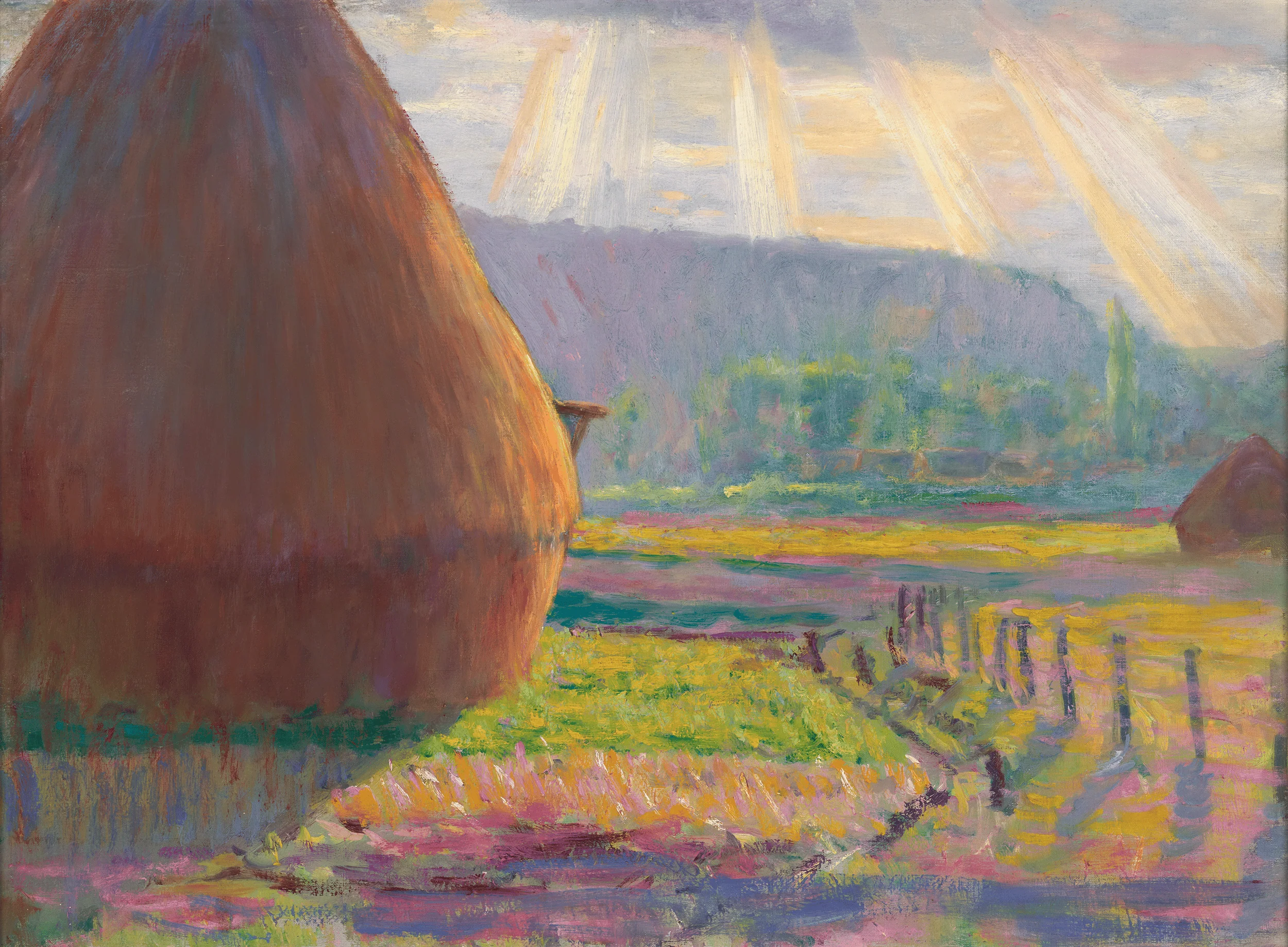
Theodore Earl Butler was one of the leading American Impressionists, known for his vibrant landscapes that displayed his virtuosity with color, light and texture. This stunning canvas, entitled Grainstacks in the Plains of Ajoux, Giverny, is quintessential Butler, and it also pays homage to his most important mentor, Claude Monet.
Butler was one of the only Americans that Monet allowed into his inner circle in Giverny, and the two artists frequently painted alongside each other. This work embodies Butler's profound admiration for Monet, both in its extraordinary atmospheric effects and in its subject of the haystack—one of Monet's most iconic motifs. An explosion of electric color and light, the painting perfectly blends Butler's Impressionist roots with a brilliant palette that is distinctly his own.
Born in Columbus, Ohio, in 1861, Butler moved to New York in 1882 to study at the Art Students League under several major American artists, including William Merritt Chase. Within three years, the young artist had moved to Paris, receiving an honorable mention at the Salon of 1888. This would prove to be a fateful year for Butler, when he also met and befriended Claude Monet and moved to Giverny to join the thriving artist community there. He eventually became Monet's son-in-law, marrying his stepdaughter, Suzanne Hoschedé in 1892. Butler would briefly return to the United States between 1913 and 1921, creating important murals and participating in major exhibitions such as the Armory Show, and then return to Giverny until his death in 1936.
This work will be included in Patrick Bertrand's forthcoming catalogue raisonné on the artist.
Circa 1897
Canvas: 20 5/8" high x 28 1/8" wide (52.39 x 71.44 cm)
Frame: 29" high x 36 1/2" wide x 2 3/4" deep (73.66 x 92.71 x 6.99 cm)
Provenance:
The artist
Estate of the above
By descent through the artist's family
Patrick Bertrand, Oakland, California, acquired from the above, 1997
Private Collection, 1999
M.S. Rau, New Orleans
1861-1936 | American
Grainstacks in the Plains of Ajoux, Giverny
Oil on canvas
Theodore Earl Butler was one of the leading American Impressionists, known for his vibrant landscapes that displayed his virtuosity with color, light and texture. This stunning canvas, entitled Grainstacks in the Plains of Ajoux, Giverny, is quintessential Butler, and it also pays homage to his most important mentor, Claude Monet.
Butler was one of the only Americans that Monet allowed into his inner circle in Giverny, and the two artists frequently painted alongside each other. This work embodies Butler's profound admiration for Monet, both in its extraordinary atmospheric effects and in its subject of the haystack—one of Monet's most iconic motifs. An explosion of electric color and light, the painting perfectly blends Butler's Impressionist roots with a brilliant palette that is distinctly his own.
Born in Columbus, Ohio, in 1861, Butler moved to New York in 1882 to study at the Art Students League under several major American artists, including William Merritt Chase. Within three years, the young artist had moved to Paris, receiving an honorable mention at the Salon of 1888. This would prove to be a fateful year for Butler, when he also met and befriended Claude Monet and moved to Giverny to join the thriving artist community there. He eventually became Monet's son-in-law, marrying his stepdaughter, Suzanne Hoschedé in 1892. Butler would briefly return to the United States between 1913 and 1921, creating important murals and participating in major exhibitions such as the Armory Show, and then return to Giverny until his death in 1936.
This work will be included in Patrick Bertrand's forthcoming catalogue raisonné on the artist.
Circa 1897
Canvas: 20 5/8" high x 28 1/8" wide (52.39 x 71.44 cm)
Frame: 29" high x 36 1/2" wide x 2 3/4" deep (73.66 x 92.71 x 6.99 cm)
Provenance:
The artist
Estate of the above
By descent through the artist's family
Patrick Bertrand, Oakland, California, acquired from the above, 1997
Private Collection, 1999
M.S. Rau, New Orleans
Theodore Earl Butler
1861-1936 | American
Grainstacks in the Plains of Ajoux, Giverny
Oil on canvas
Theodore Earl Butler was one of the leading American Impressionists, known for his vibrant landscapes that displayed his virtuosity with color, light and texture. This stunning canvas, entitled Grainstacks in the Plains of Ajoux, Giverny, is quintessential Butler, and it also pays homage to his most important mentor, Claude Monet.
Butler was one of the only Americans that Monet allowed into his inner circle in Giverny, and the two artists frequently painted alongside each other. This work embodies Butler's profound admiration for Monet, both in its extraordinary atmospheric effects and in its subject of the haystack—one of Monet's most iconic motifs. An explosion of electric color and light, the painting perfectly blends Butler's Impressionist roots with a brilliant palette that is distinctly his own.
Born in Columbus, Ohio, in 1861, Butler moved to New York in 1882 to study at the Art Students League under several major American artists, including William Merritt Chase. Within three years, the young artist had moved to Paris, receiving an honorable mention at the Salon of 1888. This would prove to be a fateful year for Butler, when he also met and befriended Claude Monet and moved to Giverny to join the thriving artist community there. He eventually became Monet's son-in-law, marrying his stepdaughter, Suzanne Hoschedé in 1892. Butler would briefly return to the United States between 1913 and 1921, creating important murals and participating in major exhibitions such as the Armory Show, and then return to Giverny until his death in 1936.
This work will be included in Patrick Bertrand's forthcoming catalogue raisonné on the artist.
Circa 1897
Canvas: 20 5/8" high x 28 1/8" wide (52.39 x 71.44 cm)
Frame: 29" high x 36 1/2" wide x 2 3/4" deep (73.66 x 92.71 x 6.99 cm)
Provenance:
The artist
Estate of the above
By descent through the artist's family
Patrick Bertrand, Oakland, California, acquired from the above, 1997
Private Collection, 1999
M.S. Rau, New Orleans
1861-1936 | American
Grainstacks in the Plains of Ajoux, Giverny
Oil on canvas
Theodore Earl Butler was one of the leading American Impressionists, known for his vibrant landscapes that displayed his virtuosity with color, light and texture. This stunning canvas, entitled Grainstacks in the Plains of Ajoux, Giverny, is quintessential Butler, and it also pays homage to his most important mentor, Claude Monet.
Butler was one of the only Americans that Monet allowed into his inner circle in Giverny, and the two artists frequently painted alongside each other. This work embodies Butler's profound admiration for Monet, both in its extraordinary atmospheric effects and in its subject of the haystack—one of Monet's most iconic motifs. An explosion of electric color and light, the painting perfectly blends Butler's Impressionist roots with a brilliant palette that is distinctly his own.
Born in Columbus, Ohio, in 1861, Butler moved to New York in 1882 to study at the Art Students League under several major American artists, including William Merritt Chase. Within three years, the young artist had moved to Paris, receiving an honorable mention at the Salon of 1888. This would prove to be a fateful year for Butler, when he also met and befriended Claude Monet and moved to Giverny to join the thriving artist community there. He eventually became Monet's son-in-law, marrying his stepdaughter, Suzanne Hoschedé in 1892. Butler would briefly return to the United States between 1913 and 1921, creating important murals and participating in major exhibitions such as the Armory Show, and then return to Giverny until his death in 1936.
This work will be included in Patrick Bertrand's forthcoming catalogue raisonné on the artist.
Circa 1897
Canvas: 20 5/8" high x 28 1/8" wide (52.39 x 71.44 cm)
Frame: 29" high x 36 1/2" wide x 2 3/4" deep (73.66 x 92.71 x 6.99 cm)
Provenance:
The artist
Estate of the above
By descent through the artist's family
Patrick Bertrand, Oakland, California, acquired from the above, 1997
Private Collection, 1999
M.S. Rau, New Orleans
$78,500.00
Grainstacks in the Plains of Ajoux, Giverny by Theodore Earl Butler—
$78,500.00
Description
Theodore Earl Butler
1861-1936 | American
Grainstacks in the Plains of Ajoux, Giverny
Oil on canvas
Theodore Earl Butler was one of the leading American Impressionists, known for his vibrant landscapes that displayed his virtuosity with color, light and texture. This stunning canvas, entitled Grainstacks in the Plains of Ajoux, Giverny, is quintessential Butler, and it also pays homage to his most important mentor, Claude Monet.
Butler was one of the only Americans that Monet allowed into his inner circle in Giverny, and the two artists frequently painted alongside each other. This work embodies Butler's profound admiration for Monet, both in its extraordinary atmospheric effects and in its subject of the haystack—one of Monet's most iconic motifs. An explosion of electric color and light, the painting perfectly blends Butler's Impressionist roots with a brilliant palette that is distinctly his own.
Born in Columbus, Ohio, in 1861, Butler moved to New York in 1882 to study at the Art Students League under several major American artists, including William Merritt Chase. Within three years, the young artist had moved to Paris, receiving an honorable mention at the Salon of 1888. This would prove to be a fateful year for Butler, when he also met and befriended Claude Monet and moved to Giverny to join the thriving artist community there. He eventually became Monet's son-in-law, marrying his stepdaughter, Suzanne Hoschedé in 1892. Butler would briefly return to the United States between 1913 and 1921, creating important murals and participating in major exhibitions such as the Armory Show, and then return to Giverny until his death in 1936.
This work will be included in Patrick Bertrand's forthcoming catalogue raisonné on the artist.
Circa 1897
Canvas: 20 5/8" high x 28 1/8" wide (52.39 x 71.44 cm)
Frame: 29" high x 36 1/2" wide x 2 3/4" deep (73.66 x 92.71 x 6.99 cm)
Provenance:
The artist
Estate of the above
By descent through the artist's family
Patrick Bertrand, Oakland, California, acquired from the above, 1997
Private Collection, 1999
M.S. Rau, New Orleans
1861-1936 | American
Grainstacks in the Plains of Ajoux, Giverny
Oil on canvas
Theodore Earl Butler was one of the leading American Impressionists, known for his vibrant landscapes that displayed his virtuosity with color, light and texture. This stunning canvas, entitled Grainstacks in the Plains of Ajoux, Giverny, is quintessential Butler, and it also pays homage to his most important mentor, Claude Monet.
Butler was one of the only Americans that Monet allowed into his inner circle in Giverny, and the two artists frequently painted alongside each other. This work embodies Butler's profound admiration for Monet, both in its extraordinary atmospheric effects and in its subject of the haystack—one of Monet's most iconic motifs. An explosion of electric color and light, the painting perfectly blends Butler's Impressionist roots with a brilliant palette that is distinctly his own.
Born in Columbus, Ohio, in 1861, Butler moved to New York in 1882 to study at the Art Students League under several major American artists, including William Merritt Chase. Within three years, the young artist had moved to Paris, receiving an honorable mention at the Salon of 1888. This would prove to be a fateful year for Butler, when he also met and befriended Claude Monet and moved to Giverny to join the thriving artist community there. He eventually became Monet's son-in-law, marrying his stepdaughter, Suzanne Hoschedé in 1892. Butler would briefly return to the United States between 1913 and 1921, creating important murals and participating in major exhibitions such as the Armory Show, and then return to Giverny until his death in 1936.
This work will be included in Patrick Bertrand's forthcoming catalogue raisonné on the artist.
Circa 1897
Canvas: 20 5/8" high x 28 1/8" wide (52.39 x 71.44 cm)
Frame: 29" high x 36 1/2" wide x 2 3/4" deep (73.66 x 92.71 x 6.99 cm)
Provenance:
The artist
Estate of the above
By descent through the artist's family
Patrick Bertrand, Oakland, California, acquired from the above, 1997
Private Collection, 1999
M.S. Rau, New Orleans