1 / 6
+1
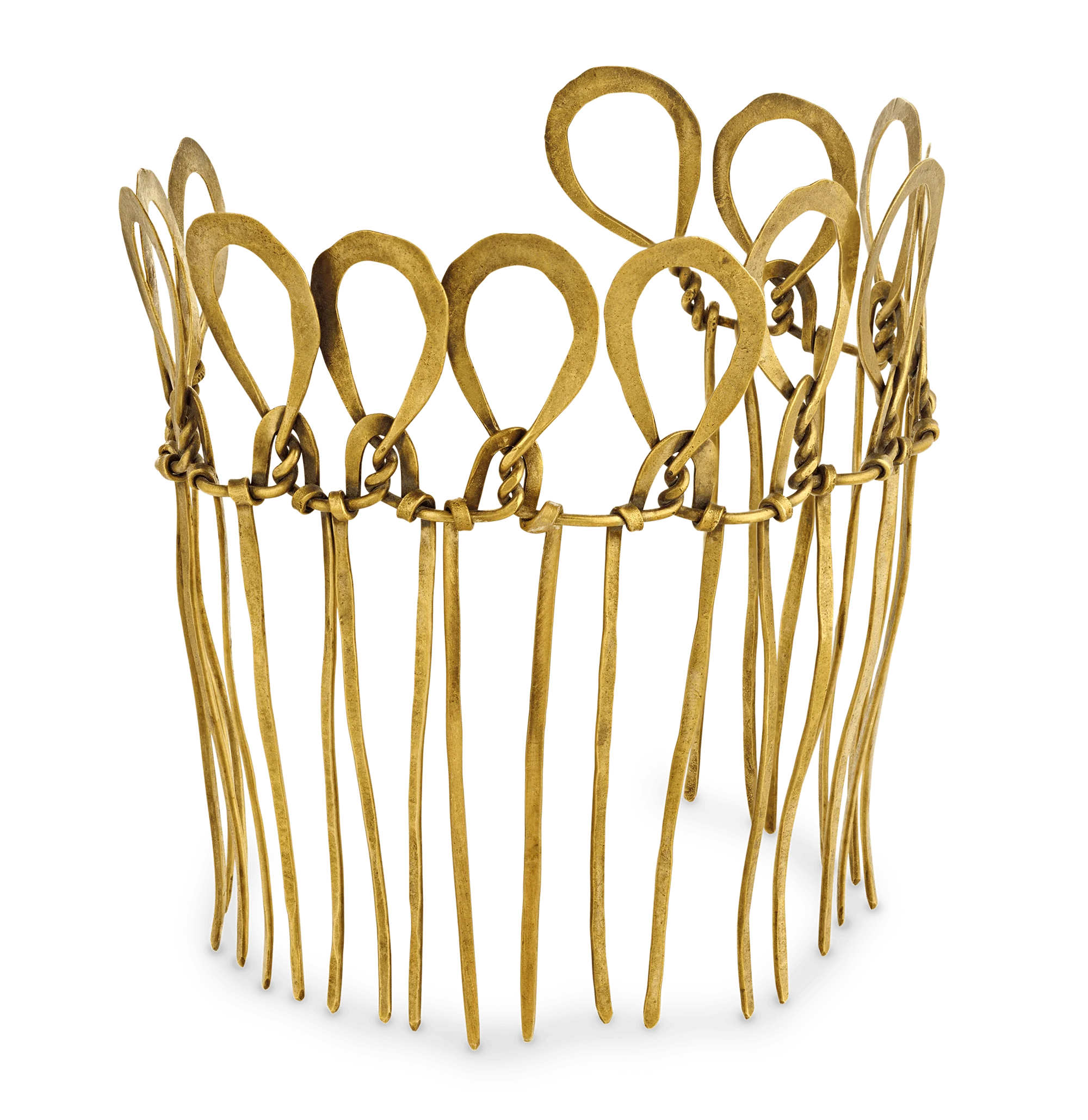
Hair Comb by Alexander Calder
Alexander Calder
1898-1976 | American
Hair Comb
Brass wire
This exceptional brass wire hair comb by Alexander Calder exemplifies the artist's revolutionary approach to sculptural form, transforming simple materials into a wearable masterpiece of modernist design. Created circa 1940, this museum-exhibited work embodies Calder's distinctive ability to blur the boundaries between jewelry and fine art, demonstrating why his sculptural accessories are considered significant contributions to 20th-century art history.
The comb's elegant composition showcases Calder's mastery of line and space, featuring delicate teardrop shapes that seem to dance atop slender vertical wires. With its crown-like silhouette and rhythmic arrangement, the piece demonstrates the artist's genius for imbuing metal with a sense of weightlessness and implied movement. Each hand-formed element reveals Calder's command of the brass medium, highlighting his commitment to maintaining the integrity of materials while achieving a lyrical visual expression.
Alexander Calder revolutionized modern sculpture through his invention of the mobile and his innovative approach to three-dimensional form. For Calder, jewelry and personal accessories held equal artistic significance to his monumental works, representing an intimate extension of his sculptural practice.
Born into a family of accomplished artists, Calder received formal training as an engineer before dedicating himself to art, bringing a unique understanding of balance, tension and kinetics to his creative output. His jewelry pieces were never mass-produced but individually crafted as unique works of art, pushing boundaries of form and function. Today, Calder's jewelry is represented in the permanent collections of major institutions including the Metropolitan Museum of Art, the Museum of Modern Art and the Smithsonian American Art Museum, and has been worn by artistic luminaries including Georgia O'Keeffe, Joan Miró and Peggy Guggenheim.
Circa 1940
4“ high x 4” wide x 4“ deep
Provenance:
Perls Galleries, New York
Herbert Lust (acquired from the above in 1973)
Private Collection
M.S. Rau, New Orleans
Exhibited:
New York, Museum of Modern Art, Alexander Calder: Sculptures and Constructions, September 29, 1943–January 16, 1944, p. 51 (illustrated)
Greenwich, Connecticut, Bruce Museum, The Mobile, The Stabile, The Animal: Wit in the Art of Alexander Calder, September 14–December 31, 1995, no. 1, pp. 36, 44 (illustrated, p. 36)
Hartford, Wadsworth Atheneum Museum of Art, Calder in Connecticut, April 28–August 6, 2000, no. 36, fig. 107, pp. 97, 165 (illustrated, p. 97)
Palm Beach, Pace Gallery, Calder: Dimensions, November 4–21, 2021
Literature:
James Johnson Sweeney, Alexander Calder, New York, 1951, p. 53 (illustrated)
Kenneth D. Winebrenner, Jewelry Making: As An Art Expression, Scranton, 1953, no. 1, p. 6 (illustrated)
Jean Lipman, ed., What is American in American Art, New York, 1963, p. 89 (illustrated)
Alexander S. C. Rower, ed., Calder by Matter, Paris, 2013, p. 152 (illustrated)
1898-1976 | American
Hair Comb
Brass wire
This exceptional brass wire hair comb by Alexander Calder exemplifies the artist's revolutionary approach to sculptural form, transforming simple materials into a wearable masterpiece of modernist design. Created circa 1940, this museum-exhibited work embodies Calder's distinctive ability to blur the boundaries between jewelry and fine art, demonstrating why his sculptural accessories are considered significant contributions to 20th-century art history.
The comb's elegant composition showcases Calder's mastery of line and space, featuring delicate teardrop shapes that seem to dance atop slender vertical wires. With its crown-like silhouette and rhythmic arrangement, the piece demonstrates the artist's genius for imbuing metal with a sense of weightlessness and implied movement. Each hand-formed element reveals Calder's command of the brass medium, highlighting his commitment to maintaining the integrity of materials while achieving a lyrical visual expression.
Alexander Calder revolutionized modern sculpture through his invention of the mobile and his innovative approach to three-dimensional form. For Calder, jewelry and personal accessories held equal artistic significance to his monumental works, representing an intimate extension of his sculptural practice.
Born into a family of accomplished artists, Calder received formal training as an engineer before dedicating himself to art, bringing a unique understanding of balance, tension and kinetics to his creative output. His jewelry pieces were never mass-produced but individually crafted as unique works of art, pushing boundaries of form and function. Today, Calder's jewelry is represented in the permanent collections of major institutions including the Metropolitan Museum of Art, the Museum of Modern Art and the Smithsonian American Art Museum, and has been worn by artistic luminaries including Georgia O'Keeffe, Joan Miró and Peggy Guggenheim.
Circa 1940
4“ high x 4” wide x 4“ deep
Provenance:
Perls Galleries, New York
Herbert Lust (acquired from the above in 1973)
Private Collection
M.S. Rau, New Orleans
Exhibited:
New York, Museum of Modern Art, Alexander Calder: Sculptures and Constructions, September 29, 1943–January 16, 1944, p. 51 (illustrated)
Greenwich, Connecticut, Bruce Museum, The Mobile, The Stabile, The Animal: Wit in the Art of Alexander Calder, September 14–December 31, 1995, no. 1, pp. 36, 44 (illustrated, p. 36)
Hartford, Wadsworth Atheneum Museum of Art, Calder in Connecticut, April 28–August 6, 2000, no. 36, fig. 107, pp. 97, 165 (illustrated, p. 97)
Palm Beach, Pace Gallery, Calder: Dimensions, November 4–21, 2021
Literature:
James Johnson Sweeney, Alexander Calder, New York, 1951, p. 53 (illustrated)
Kenneth D. Winebrenner, Jewelry Making: As An Art Expression, Scranton, 1953, no. 1, p. 6 (illustrated)
Jean Lipman, ed., What is American in American Art, New York, 1963, p. 89 (illustrated)
Alexander S. C. Rower, ed., Calder by Matter, Paris, 2013, p. 152 (illustrated)
Alexander Calder
1898-1976 | American
Hair Comb
Brass wire
This exceptional brass wire hair comb by Alexander Calder exemplifies the artist's revolutionary approach to sculptural form, transforming simple materials into a wearable masterpiece of modernist design. Created circa 1940, this museum-exhibited work embodies Calder's distinctive ability to blur the boundaries between jewelry and fine art, demonstrating why his sculptural accessories are considered significant contributions to 20th-century art history.
The comb's elegant composition showcases Calder's mastery of line and space, featuring delicate teardrop shapes that seem to dance atop slender vertical wires. With its crown-like silhouette and rhythmic arrangement, the piece demonstrates the artist's genius for imbuing metal with a sense of weightlessness and implied movement. Each hand-formed element reveals Calder's command of the brass medium, highlighting his commitment to maintaining the integrity of materials while achieving a lyrical visual expression.
Alexander Calder revolutionized modern sculpture through his invention of the mobile and his innovative approach to three-dimensional form. For Calder, jewelry and personal accessories held equal artistic significance to his monumental works, representing an intimate extension of his sculptural practice.
Born into a family of accomplished artists, Calder received formal training as an engineer before dedicating himself to art, bringing a unique understanding of balance, tension and kinetics to his creative output. His jewelry pieces were never mass-produced but individually crafted as unique works of art, pushing boundaries of form and function. Today, Calder's jewelry is represented in the permanent collections of major institutions including the Metropolitan Museum of Art, the Museum of Modern Art and the Smithsonian American Art Museum, and has been worn by artistic luminaries including Georgia O'Keeffe, Joan Miró and Peggy Guggenheim.
Circa 1940
4“ high x 4” wide x 4“ deep
Provenance:
Perls Galleries, New York
Herbert Lust (acquired from the above in 1973)
Private Collection
M.S. Rau, New Orleans
Exhibited:
New York, Museum of Modern Art, Alexander Calder: Sculptures and Constructions, September 29, 1943–January 16, 1944, p. 51 (illustrated)
Greenwich, Connecticut, Bruce Museum, The Mobile, The Stabile, The Animal: Wit in the Art of Alexander Calder, September 14–December 31, 1995, no. 1, pp. 36, 44 (illustrated, p. 36)
Hartford, Wadsworth Atheneum Museum of Art, Calder in Connecticut, April 28–August 6, 2000, no. 36, fig. 107, pp. 97, 165 (illustrated, p. 97)
Palm Beach, Pace Gallery, Calder: Dimensions, November 4–21, 2021
Literature:
James Johnson Sweeney, Alexander Calder, New York, 1951, p. 53 (illustrated)
Kenneth D. Winebrenner, Jewelry Making: As An Art Expression, Scranton, 1953, no. 1, p. 6 (illustrated)
Jean Lipman, ed., What is American in American Art, New York, 1963, p. 89 (illustrated)
Alexander S. C. Rower, ed., Calder by Matter, Paris, 2013, p. 152 (illustrated)
1898-1976 | American
Hair Comb
Brass wire
This exceptional brass wire hair comb by Alexander Calder exemplifies the artist's revolutionary approach to sculptural form, transforming simple materials into a wearable masterpiece of modernist design. Created circa 1940, this museum-exhibited work embodies Calder's distinctive ability to blur the boundaries between jewelry and fine art, demonstrating why his sculptural accessories are considered significant contributions to 20th-century art history.
The comb's elegant composition showcases Calder's mastery of line and space, featuring delicate teardrop shapes that seem to dance atop slender vertical wires. With its crown-like silhouette and rhythmic arrangement, the piece demonstrates the artist's genius for imbuing metal with a sense of weightlessness and implied movement. Each hand-formed element reveals Calder's command of the brass medium, highlighting his commitment to maintaining the integrity of materials while achieving a lyrical visual expression.
Alexander Calder revolutionized modern sculpture through his invention of the mobile and his innovative approach to three-dimensional form. For Calder, jewelry and personal accessories held equal artistic significance to his monumental works, representing an intimate extension of his sculptural practice.
Born into a family of accomplished artists, Calder received formal training as an engineer before dedicating himself to art, bringing a unique understanding of balance, tension and kinetics to his creative output. His jewelry pieces were never mass-produced but individually crafted as unique works of art, pushing boundaries of form and function. Today, Calder's jewelry is represented in the permanent collections of major institutions including the Metropolitan Museum of Art, the Museum of Modern Art and the Smithsonian American Art Museum, and has been worn by artistic luminaries including Georgia O'Keeffe, Joan Miró and Peggy Guggenheim.
Circa 1940
4“ high x 4” wide x 4“ deep
Provenance:
Perls Galleries, New York
Herbert Lust (acquired from the above in 1973)
Private Collection
M.S. Rau, New Orleans
Exhibited:
New York, Museum of Modern Art, Alexander Calder: Sculptures and Constructions, September 29, 1943–January 16, 1944, p. 51 (illustrated)
Greenwich, Connecticut, Bruce Museum, The Mobile, The Stabile, The Animal: Wit in the Art of Alexander Calder, September 14–December 31, 1995, no. 1, pp. 36, 44 (illustrated, p. 36)
Hartford, Wadsworth Atheneum Museum of Art, Calder in Connecticut, April 28–August 6, 2000, no. 36, fig. 107, pp. 97, 165 (illustrated, p. 97)
Palm Beach, Pace Gallery, Calder: Dimensions, November 4–21, 2021
Literature:
James Johnson Sweeney, Alexander Calder, New York, 1951, p. 53 (illustrated)
Kenneth D. Winebrenner, Jewelry Making: As An Art Expression, Scranton, 1953, no. 1, p. 6 (illustrated)
Jean Lipman, ed., What is American in American Art, New York, 1963, p. 89 (illustrated)
Alexander S. C. Rower, ed., Calder by Matter, Paris, 2013, p. 152 (illustrated)
$34,475.00
Original: $98,500.00
-65%Hair Comb by Alexander Calder—
$98,500.00
$34,475.00Description
Alexander Calder
1898-1976 | American
Hair Comb
Brass wire
This exceptional brass wire hair comb by Alexander Calder exemplifies the artist's revolutionary approach to sculptural form, transforming simple materials into a wearable masterpiece of modernist design. Created circa 1940, this museum-exhibited work embodies Calder's distinctive ability to blur the boundaries between jewelry and fine art, demonstrating why his sculptural accessories are considered significant contributions to 20th-century art history.
The comb's elegant composition showcases Calder's mastery of line and space, featuring delicate teardrop shapes that seem to dance atop slender vertical wires. With its crown-like silhouette and rhythmic arrangement, the piece demonstrates the artist's genius for imbuing metal with a sense of weightlessness and implied movement. Each hand-formed element reveals Calder's command of the brass medium, highlighting his commitment to maintaining the integrity of materials while achieving a lyrical visual expression.
Alexander Calder revolutionized modern sculpture through his invention of the mobile and his innovative approach to three-dimensional form. For Calder, jewelry and personal accessories held equal artistic significance to his monumental works, representing an intimate extension of his sculptural practice.
Born into a family of accomplished artists, Calder received formal training as an engineer before dedicating himself to art, bringing a unique understanding of balance, tension and kinetics to his creative output. His jewelry pieces were never mass-produced but individually crafted as unique works of art, pushing boundaries of form and function. Today, Calder's jewelry is represented in the permanent collections of major institutions including the Metropolitan Museum of Art, the Museum of Modern Art and the Smithsonian American Art Museum, and has been worn by artistic luminaries including Georgia O'Keeffe, Joan Miró and Peggy Guggenheim.
Circa 1940
4“ high x 4” wide x 4“ deep
Provenance:
Perls Galleries, New York
Herbert Lust (acquired from the above in 1973)
Private Collection
M.S. Rau, New Orleans
Exhibited:
New York, Museum of Modern Art, Alexander Calder: Sculptures and Constructions, September 29, 1943–January 16, 1944, p. 51 (illustrated)
Greenwich, Connecticut, Bruce Museum, The Mobile, The Stabile, The Animal: Wit in the Art of Alexander Calder, September 14–December 31, 1995, no. 1, pp. 36, 44 (illustrated, p. 36)
Hartford, Wadsworth Atheneum Museum of Art, Calder in Connecticut, April 28–August 6, 2000, no. 36, fig. 107, pp. 97, 165 (illustrated, p. 97)
Palm Beach, Pace Gallery, Calder: Dimensions, November 4–21, 2021
Literature:
James Johnson Sweeney, Alexander Calder, New York, 1951, p. 53 (illustrated)
Kenneth D. Winebrenner, Jewelry Making: As An Art Expression, Scranton, 1953, no. 1, p. 6 (illustrated)
Jean Lipman, ed., What is American in American Art, New York, 1963, p. 89 (illustrated)
Alexander S. C. Rower, ed., Calder by Matter, Paris, 2013, p. 152 (illustrated)
1898-1976 | American
Hair Comb
Brass wire
This exceptional brass wire hair comb by Alexander Calder exemplifies the artist's revolutionary approach to sculptural form, transforming simple materials into a wearable masterpiece of modernist design. Created circa 1940, this museum-exhibited work embodies Calder's distinctive ability to blur the boundaries between jewelry and fine art, demonstrating why his sculptural accessories are considered significant contributions to 20th-century art history.
The comb's elegant composition showcases Calder's mastery of line and space, featuring delicate teardrop shapes that seem to dance atop slender vertical wires. With its crown-like silhouette and rhythmic arrangement, the piece demonstrates the artist's genius for imbuing metal with a sense of weightlessness and implied movement. Each hand-formed element reveals Calder's command of the brass medium, highlighting his commitment to maintaining the integrity of materials while achieving a lyrical visual expression.
Alexander Calder revolutionized modern sculpture through his invention of the mobile and his innovative approach to three-dimensional form. For Calder, jewelry and personal accessories held equal artistic significance to his monumental works, representing an intimate extension of his sculptural practice.
Born into a family of accomplished artists, Calder received formal training as an engineer before dedicating himself to art, bringing a unique understanding of balance, tension and kinetics to his creative output. His jewelry pieces were never mass-produced but individually crafted as unique works of art, pushing boundaries of form and function. Today, Calder's jewelry is represented in the permanent collections of major institutions including the Metropolitan Museum of Art, the Museum of Modern Art and the Smithsonian American Art Museum, and has been worn by artistic luminaries including Georgia O'Keeffe, Joan Miró and Peggy Guggenheim.
Circa 1940
4“ high x 4” wide x 4“ deep
Provenance:
Perls Galleries, New York
Herbert Lust (acquired from the above in 1973)
Private Collection
M.S. Rau, New Orleans
Exhibited:
New York, Museum of Modern Art, Alexander Calder: Sculptures and Constructions, September 29, 1943–January 16, 1944, p. 51 (illustrated)
Greenwich, Connecticut, Bruce Museum, The Mobile, The Stabile, The Animal: Wit in the Art of Alexander Calder, September 14–December 31, 1995, no. 1, pp. 36, 44 (illustrated, p. 36)
Hartford, Wadsworth Atheneum Museum of Art, Calder in Connecticut, April 28–August 6, 2000, no. 36, fig. 107, pp. 97, 165 (illustrated, p. 97)
Palm Beach, Pace Gallery, Calder: Dimensions, November 4–21, 2021
Literature:
James Johnson Sweeney, Alexander Calder, New York, 1951, p. 53 (illustrated)
Kenneth D. Winebrenner, Jewelry Making: As An Art Expression, Scranton, 1953, no. 1, p. 6 (illustrated)
Jean Lipman, ed., What is American in American Art, New York, 1963, p. 89 (illustrated)
Alexander S. C. Rower, ed., Calder by Matter, Paris, 2013, p. 152 (illustrated)