1 / 3
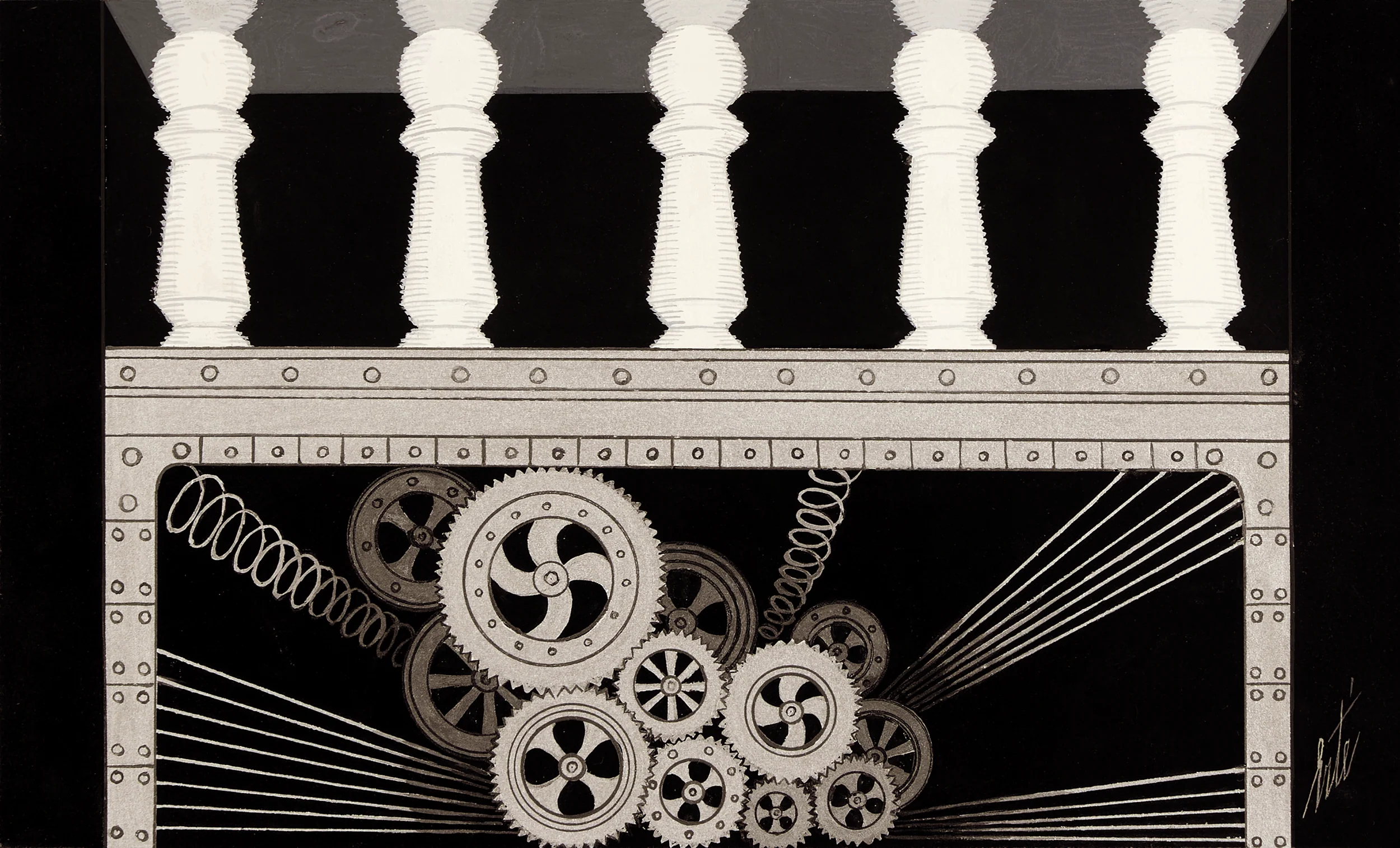
Les Machinistes by Erté
Erté (Romain de Tirtoff)
1892-1990 | Russian-French
Les Machinistes, 2e aspect du décor
Set Design for Les Machinistes/em>
Signed “Erté” (lower right)
Inscribed "No. 18.402 /Les Machinistes, 2e aspect du décor / Composition originale (en verso)
Gouache and silver on paper
This captivating gouache painting by Erté showcases the famed artist genius as a set designer. A showcase of Erté's pioneering creativity and engagement with the traditions of theater, this beautiful set design for Les Machinistes epitomizes the creative grandeur of the man often hailed as the "Father of Art Deco."
This gouache features an elaborate and very apropos backdrop for the namesake production. The backdrop is composed of a profusion of cog wheels and interlocking gears rendered in iridescent silver leaf. The stage’s proscenium design matches the industrial theme and features several bits and bobs, though the top of the arch is crowned by more traditional undulating columns. Artful and over-the-top, this set design showcases how the Art Deco master embraced modern times and found beauty in the machinery and industries of progress.
The captivating alliance between the Erté and the flourishing performing arts scene of Paris transported audiences to new realms throughout the early 20th century. Erté quickly forged relationships with luminaries of the performing arts world — including Zizi Jeanmaire, Roland Petit and Misinguett — and leant his distinctive Art Deco vision to operatic and theater productions. These collaborations rose above mere aesthetic embellishments, penetrating to the core of performances and adding greater depth to the narratives on display. The artist possessed a great range of vision and was equally adept at capturing Rococo decadence in the sets of Cosi Fan Tutte as he was in creating supernatural, moody interiors for Les Mamelles de Tirésias. His Art Deco stylings brought both a fantasy and modernity to the stage that has rarely been matched since. Parrying the spectacle of these fantastical productions, fashion grew more opulent, with luxury canes, pocketwatches and compacts becoming essentials for a modern Parisian.
Russian-French visionary Romain de Tirtoff (1892-1990), popularly known as Erté, began his artistic journey in the culturally rich city of St. Petersburg, where he developed an early fondness for ballet and theatrical performances. He moved to Paris in 1912 to study architecture, and quickly found his creative niche in crafting fantastical costumes for the city’s bustling nightlife. Erté‘s expertise, refined under the guidance of the famed Paul Poiret, captured the attention of Harper’s Bazaar, marking the beginning of a significant partnership that spanned from 1915 to 1936. The artist also designed sets for notable cinematic masterpieces including Ben Hur and La Bohème, and created sets and costumes for cabarets, operas and other performances at the Folies-Bergères, Bal Tabarin, the Théâtre du Bataclan and Le Casino de Paris. Often remembered as the “Father of Art Deco,” Erté was a trailblazer whose colorful creations shaped the groundbreaking Art Deco era more than any other, leaving an indelible mark on the history of art and design. His artworks reside in prestigious museum collections worldwide, including the Metropolitan Museum of Art in New York, the Victoria & Albert Museum in London and the Los Angeles County Museum of Art.
Circa 1974
Paper: 7” high by 11 1/2” wide
Frame: 13 1/8” high by 17 3/4” wide by 3/4" deep
Exhibitions:
M.S. Rau, New Orleans, Erté and the Era of Art Deco, October 14, 2023 - January 3, 2024
Provenance:
Sale, Sotheby’s Arcade, 1994
Private collection, Paris
M.S. Rau, New Orleans
1892-1990 | Russian-French
Les Machinistes, 2e aspect du décor
Set Design for Les Machinistes/em>
Signed “Erté” (lower right)
Inscribed "No. 18.402 /Les Machinistes, 2e aspect du décor / Composition originale (en verso)
Gouache and silver on paper
This captivating gouache painting by Erté showcases the famed artist genius as a set designer. A showcase of Erté's pioneering creativity and engagement with the traditions of theater, this beautiful set design for Les Machinistes epitomizes the creative grandeur of the man often hailed as the "Father of Art Deco."
This gouache features an elaborate and very apropos backdrop for the namesake production. The backdrop is composed of a profusion of cog wheels and interlocking gears rendered in iridescent silver leaf. The stage’s proscenium design matches the industrial theme and features several bits and bobs, though the top of the arch is crowned by more traditional undulating columns. Artful and over-the-top, this set design showcases how the Art Deco master embraced modern times and found beauty in the machinery and industries of progress.
The captivating alliance between the Erté and the flourishing performing arts scene of Paris transported audiences to new realms throughout the early 20th century. Erté quickly forged relationships with luminaries of the performing arts world — including Zizi Jeanmaire, Roland Petit and Misinguett — and leant his distinctive Art Deco vision to operatic and theater productions. These collaborations rose above mere aesthetic embellishments, penetrating to the core of performances and adding greater depth to the narratives on display. The artist possessed a great range of vision and was equally adept at capturing Rococo decadence in the sets of Cosi Fan Tutte as he was in creating supernatural, moody interiors for Les Mamelles de Tirésias. His Art Deco stylings brought both a fantasy and modernity to the stage that has rarely been matched since. Parrying the spectacle of these fantastical productions, fashion grew more opulent, with luxury canes, pocketwatches and compacts becoming essentials for a modern Parisian.
Russian-French visionary Romain de Tirtoff (1892-1990), popularly known as Erté, began his artistic journey in the culturally rich city of St. Petersburg, where he developed an early fondness for ballet and theatrical performances. He moved to Paris in 1912 to study architecture, and quickly found his creative niche in crafting fantastical costumes for the city’s bustling nightlife. Erté‘s expertise, refined under the guidance of the famed Paul Poiret, captured the attention of Harper’s Bazaar, marking the beginning of a significant partnership that spanned from 1915 to 1936. The artist also designed sets for notable cinematic masterpieces including Ben Hur and La Bohème, and created sets and costumes for cabarets, operas and other performances at the Folies-Bergères, Bal Tabarin, the Théâtre du Bataclan and Le Casino de Paris. Often remembered as the “Father of Art Deco,” Erté was a trailblazer whose colorful creations shaped the groundbreaking Art Deco era more than any other, leaving an indelible mark on the history of art and design. His artworks reside in prestigious museum collections worldwide, including the Metropolitan Museum of Art in New York, the Victoria & Albert Museum in London and the Los Angeles County Museum of Art.
Circa 1974
Paper: 7” high by 11 1/2” wide
Frame: 13 1/8” high by 17 3/4” wide by 3/4" deep
Exhibitions:
M.S. Rau, New Orleans, Erté and the Era of Art Deco, October 14, 2023 - January 3, 2024
Provenance:
Sale, Sotheby’s Arcade, 1994
Private collection, Paris
M.S. Rau, New Orleans
Erté (Romain de Tirtoff)
1892-1990 | Russian-French
Les Machinistes, 2e aspect du décor
Set Design for Les Machinistes/em>
Signed “Erté” (lower right)
Inscribed "No. 18.402 /Les Machinistes, 2e aspect du décor / Composition originale (en verso)
Gouache and silver on paper
This captivating gouache painting by Erté showcases the famed artist genius as a set designer. A showcase of Erté's pioneering creativity and engagement with the traditions of theater, this beautiful set design for Les Machinistes epitomizes the creative grandeur of the man often hailed as the "Father of Art Deco."
This gouache features an elaborate and very apropos backdrop for the namesake production. The backdrop is composed of a profusion of cog wheels and interlocking gears rendered in iridescent silver leaf. The stage’s proscenium design matches the industrial theme and features several bits and bobs, though the top of the arch is crowned by more traditional undulating columns. Artful and over-the-top, this set design showcases how the Art Deco master embraced modern times and found beauty in the machinery and industries of progress.
The captivating alliance between the Erté and the flourishing performing arts scene of Paris transported audiences to new realms throughout the early 20th century. Erté quickly forged relationships with luminaries of the performing arts world — including Zizi Jeanmaire, Roland Petit and Misinguett — and leant his distinctive Art Deco vision to operatic and theater productions. These collaborations rose above mere aesthetic embellishments, penetrating to the core of performances and adding greater depth to the narratives on display. The artist possessed a great range of vision and was equally adept at capturing Rococo decadence in the sets of Cosi Fan Tutte as he was in creating supernatural, moody interiors for Les Mamelles de Tirésias. His Art Deco stylings brought both a fantasy and modernity to the stage that has rarely been matched since. Parrying the spectacle of these fantastical productions, fashion grew more opulent, with luxury canes, pocketwatches and compacts becoming essentials for a modern Parisian.
Russian-French visionary Romain de Tirtoff (1892-1990), popularly known as Erté, began his artistic journey in the culturally rich city of St. Petersburg, where he developed an early fondness for ballet and theatrical performances. He moved to Paris in 1912 to study architecture, and quickly found his creative niche in crafting fantastical costumes for the city’s bustling nightlife. Erté‘s expertise, refined under the guidance of the famed Paul Poiret, captured the attention of Harper’s Bazaar, marking the beginning of a significant partnership that spanned from 1915 to 1936. The artist also designed sets for notable cinematic masterpieces including Ben Hur and La Bohème, and created sets and costumes for cabarets, operas and other performances at the Folies-Bergères, Bal Tabarin, the Théâtre du Bataclan and Le Casino de Paris. Often remembered as the “Father of Art Deco,” Erté was a trailblazer whose colorful creations shaped the groundbreaking Art Deco era more than any other, leaving an indelible mark on the history of art and design. His artworks reside in prestigious museum collections worldwide, including the Metropolitan Museum of Art in New York, the Victoria & Albert Museum in London and the Los Angeles County Museum of Art.
Circa 1974
Paper: 7” high by 11 1/2” wide
Frame: 13 1/8” high by 17 3/4” wide by 3/4" deep
Exhibitions:
M.S. Rau, New Orleans, Erté and the Era of Art Deco, October 14, 2023 - January 3, 2024
Provenance:
Sale, Sotheby’s Arcade, 1994
Private collection, Paris
M.S. Rau, New Orleans
1892-1990 | Russian-French
Les Machinistes, 2e aspect du décor
Set Design for Les Machinistes/em>
Signed “Erté” (lower right)
Inscribed "No. 18.402 /Les Machinistes, 2e aspect du décor / Composition originale (en verso)
Gouache and silver on paper
This captivating gouache painting by Erté showcases the famed artist genius as a set designer. A showcase of Erté's pioneering creativity and engagement with the traditions of theater, this beautiful set design for Les Machinistes epitomizes the creative grandeur of the man often hailed as the "Father of Art Deco."
This gouache features an elaborate and very apropos backdrop for the namesake production. The backdrop is composed of a profusion of cog wheels and interlocking gears rendered in iridescent silver leaf. The stage’s proscenium design matches the industrial theme and features several bits and bobs, though the top of the arch is crowned by more traditional undulating columns. Artful and over-the-top, this set design showcases how the Art Deco master embraced modern times and found beauty in the machinery and industries of progress.
The captivating alliance between the Erté and the flourishing performing arts scene of Paris transported audiences to new realms throughout the early 20th century. Erté quickly forged relationships with luminaries of the performing arts world — including Zizi Jeanmaire, Roland Petit and Misinguett — and leant his distinctive Art Deco vision to operatic and theater productions. These collaborations rose above mere aesthetic embellishments, penetrating to the core of performances and adding greater depth to the narratives on display. The artist possessed a great range of vision and was equally adept at capturing Rococo decadence in the sets of Cosi Fan Tutte as he was in creating supernatural, moody interiors for Les Mamelles de Tirésias. His Art Deco stylings brought both a fantasy and modernity to the stage that has rarely been matched since. Parrying the spectacle of these fantastical productions, fashion grew more opulent, with luxury canes, pocketwatches and compacts becoming essentials for a modern Parisian.
Russian-French visionary Romain de Tirtoff (1892-1990), popularly known as Erté, began his artistic journey in the culturally rich city of St. Petersburg, where he developed an early fondness for ballet and theatrical performances. He moved to Paris in 1912 to study architecture, and quickly found his creative niche in crafting fantastical costumes for the city’s bustling nightlife. Erté‘s expertise, refined under the guidance of the famed Paul Poiret, captured the attention of Harper’s Bazaar, marking the beginning of a significant partnership that spanned from 1915 to 1936. The artist also designed sets for notable cinematic masterpieces including Ben Hur and La Bohème, and created sets and costumes for cabarets, operas and other performances at the Folies-Bergères, Bal Tabarin, the Théâtre du Bataclan and Le Casino de Paris. Often remembered as the “Father of Art Deco,” Erté was a trailblazer whose colorful creations shaped the groundbreaking Art Deco era more than any other, leaving an indelible mark on the history of art and design. His artworks reside in prestigious museum collections worldwide, including the Metropolitan Museum of Art in New York, the Victoria & Albert Museum in London and the Los Angeles County Museum of Art.
Circa 1974
Paper: 7” high by 11 1/2” wide
Frame: 13 1/8” high by 17 3/4” wide by 3/4" deep
Exhibitions:
M.S. Rau, New Orleans, Erté and the Era of Art Deco, October 14, 2023 - January 3, 2024
Provenance:
Sale, Sotheby’s Arcade, 1994
Private collection, Paris
M.S. Rau, New Orleans
$6,947.50
Original: $19,850.00
-65%Les Machinistes by Erté—
$19,850.00
$6,947.50Description
Erté (Romain de Tirtoff)
1892-1990 | Russian-French
Les Machinistes, 2e aspect du décor
Set Design for Les Machinistes/em>
Signed “Erté” (lower right)
Inscribed "No. 18.402 /Les Machinistes, 2e aspect du décor / Composition originale (en verso)
Gouache and silver on paper
This captivating gouache painting by Erté showcases the famed artist genius as a set designer. A showcase of Erté's pioneering creativity and engagement with the traditions of theater, this beautiful set design for Les Machinistes epitomizes the creative grandeur of the man often hailed as the "Father of Art Deco."
This gouache features an elaborate and very apropos backdrop for the namesake production. The backdrop is composed of a profusion of cog wheels and interlocking gears rendered in iridescent silver leaf. The stage’s proscenium design matches the industrial theme and features several bits and bobs, though the top of the arch is crowned by more traditional undulating columns. Artful and over-the-top, this set design showcases how the Art Deco master embraced modern times and found beauty in the machinery and industries of progress.
The captivating alliance between the Erté and the flourishing performing arts scene of Paris transported audiences to new realms throughout the early 20th century. Erté quickly forged relationships with luminaries of the performing arts world — including Zizi Jeanmaire, Roland Petit and Misinguett — and leant his distinctive Art Deco vision to operatic and theater productions. These collaborations rose above mere aesthetic embellishments, penetrating to the core of performances and adding greater depth to the narratives on display. The artist possessed a great range of vision and was equally adept at capturing Rococo decadence in the sets of Cosi Fan Tutte as he was in creating supernatural, moody interiors for Les Mamelles de Tirésias. His Art Deco stylings brought both a fantasy and modernity to the stage that has rarely been matched since. Parrying the spectacle of these fantastical productions, fashion grew more opulent, with luxury canes, pocketwatches and compacts becoming essentials for a modern Parisian.
Russian-French visionary Romain de Tirtoff (1892-1990), popularly known as Erté, began his artistic journey in the culturally rich city of St. Petersburg, where he developed an early fondness for ballet and theatrical performances. He moved to Paris in 1912 to study architecture, and quickly found his creative niche in crafting fantastical costumes for the city’s bustling nightlife. Erté‘s expertise, refined under the guidance of the famed Paul Poiret, captured the attention of Harper’s Bazaar, marking the beginning of a significant partnership that spanned from 1915 to 1936. The artist also designed sets for notable cinematic masterpieces including Ben Hur and La Bohème, and created sets and costumes for cabarets, operas and other performances at the Folies-Bergères, Bal Tabarin, the Théâtre du Bataclan and Le Casino de Paris. Often remembered as the “Father of Art Deco,” Erté was a trailblazer whose colorful creations shaped the groundbreaking Art Deco era more than any other, leaving an indelible mark on the history of art and design. His artworks reside in prestigious museum collections worldwide, including the Metropolitan Museum of Art in New York, the Victoria & Albert Museum in London and the Los Angeles County Museum of Art.
Circa 1974
Paper: 7” high by 11 1/2” wide
Frame: 13 1/8” high by 17 3/4” wide by 3/4" deep
Exhibitions:
M.S. Rau, New Orleans, Erté and the Era of Art Deco, October 14, 2023 - January 3, 2024
Provenance:
Sale, Sotheby’s Arcade, 1994
Private collection, Paris
M.S. Rau, New Orleans
1892-1990 | Russian-French
Les Machinistes, 2e aspect du décor
Set Design for Les Machinistes/em>
Signed “Erté” (lower right)
Inscribed "No. 18.402 /Les Machinistes, 2e aspect du décor / Composition originale (en verso)
Gouache and silver on paper
This captivating gouache painting by Erté showcases the famed artist genius as a set designer. A showcase of Erté's pioneering creativity and engagement with the traditions of theater, this beautiful set design for Les Machinistes epitomizes the creative grandeur of the man often hailed as the "Father of Art Deco."
This gouache features an elaborate and very apropos backdrop for the namesake production. The backdrop is composed of a profusion of cog wheels and interlocking gears rendered in iridescent silver leaf. The stage’s proscenium design matches the industrial theme and features several bits and bobs, though the top of the arch is crowned by more traditional undulating columns. Artful and over-the-top, this set design showcases how the Art Deco master embraced modern times and found beauty in the machinery and industries of progress.
The captivating alliance between the Erté and the flourishing performing arts scene of Paris transported audiences to new realms throughout the early 20th century. Erté quickly forged relationships with luminaries of the performing arts world — including Zizi Jeanmaire, Roland Petit and Misinguett — and leant his distinctive Art Deco vision to operatic and theater productions. These collaborations rose above mere aesthetic embellishments, penetrating to the core of performances and adding greater depth to the narratives on display. The artist possessed a great range of vision and was equally adept at capturing Rococo decadence in the sets of Cosi Fan Tutte as he was in creating supernatural, moody interiors for Les Mamelles de Tirésias. His Art Deco stylings brought both a fantasy and modernity to the stage that has rarely been matched since. Parrying the spectacle of these fantastical productions, fashion grew more opulent, with luxury canes, pocketwatches and compacts becoming essentials for a modern Parisian.
Russian-French visionary Romain de Tirtoff (1892-1990), popularly known as Erté, began his artistic journey in the culturally rich city of St. Petersburg, where he developed an early fondness for ballet and theatrical performances. He moved to Paris in 1912 to study architecture, and quickly found his creative niche in crafting fantastical costumes for the city’s bustling nightlife. Erté‘s expertise, refined under the guidance of the famed Paul Poiret, captured the attention of Harper’s Bazaar, marking the beginning of a significant partnership that spanned from 1915 to 1936. The artist also designed sets for notable cinematic masterpieces including Ben Hur and La Bohème, and created sets and costumes for cabarets, operas and other performances at the Folies-Bergères, Bal Tabarin, the Théâtre du Bataclan and Le Casino de Paris. Often remembered as the “Father of Art Deco,” Erté was a trailblazer whose colorful creations shaped the groundbreaking Art Deco era more than any other, leaving an indelible mark on the history of art and design. His artworks reside in prestigious museum collections worldwide, including the Metropolitan Museum of Art in New York, the Victoria & Albert Museum in London and the Los Angeles County Museum of Art.
Circa 1974
Paper: 7” high by 11 1/2” wide
Frame: 13 1/8” high by 17 3/4” wide by 3/4" deep
Exhibitions:
M.S. Rau, New Orleans, Erté and the Era of Art Deco, October 14, 2023 - January 3, 2024
Provenance:
Sale, Sotheby’s Arcade, 1994
Private collection, Paris
M.S. Rau, New Orleans