1 / 5
Louis XVI Style Gilt Marble Cassolettes and Clock
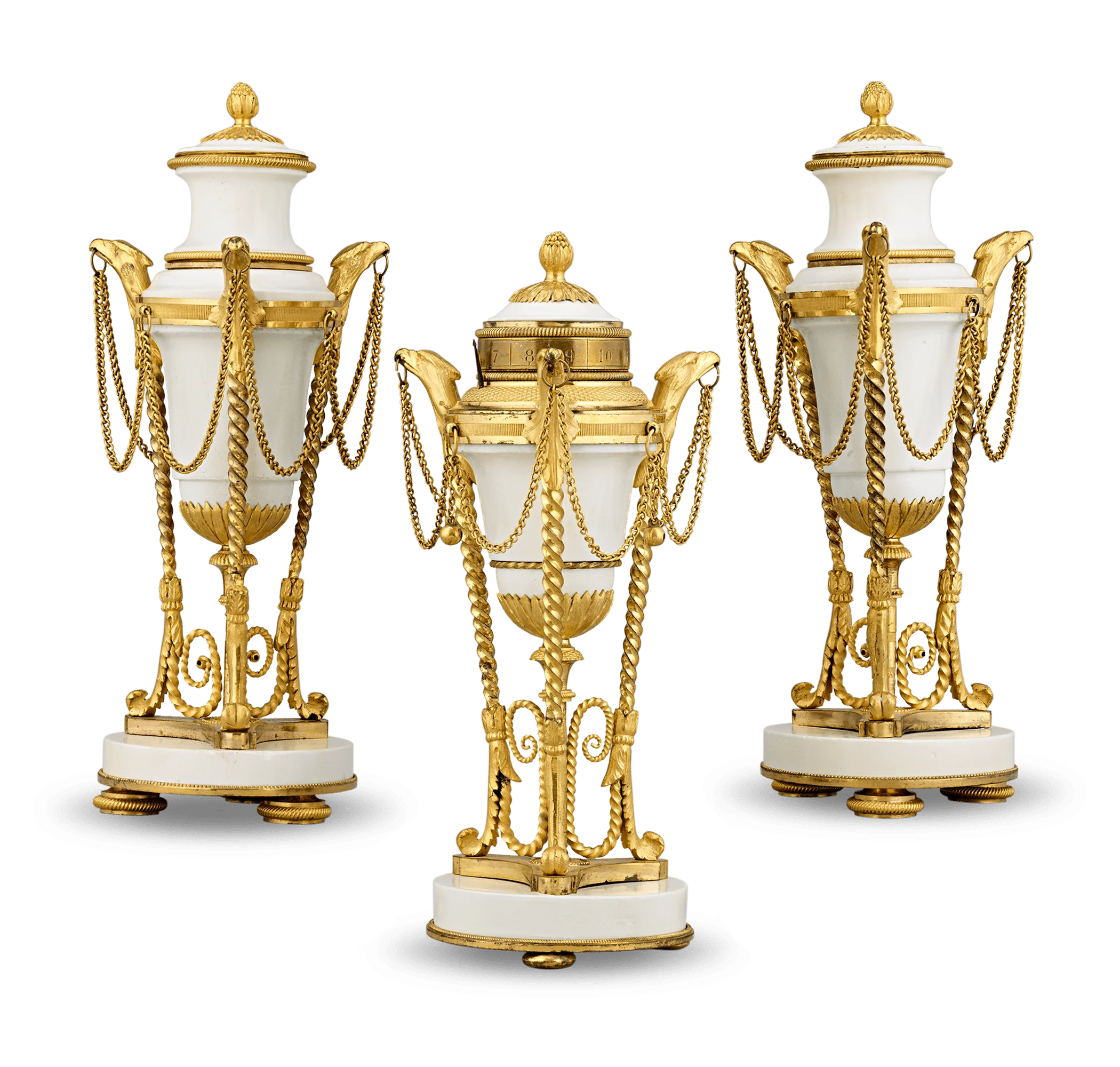
The bodies of this exquisite pair of Louis XVI-style cassolettes, along with a complementary annular clock, are crafted from exceptional specimens of Carrara white marble, each measuring almost a foot in height. Doré bronze mounts, emblematic of the Louis XVI style, create a striking contrast with the vibrant hues of the hardstone. Classical eagle masks adorn the legs, featuring intricately detailed foliate festoons held in their beaks. These mounts imbue the neoclassical pieces with a distinct aura of luxury. The cassolettes are accompanied by a matching clock, executed in the same design.
The annular clock, a crown wheel with a deadbeat escapement, is distinguished by a gilt timepiece at its summit, instead of a removable lid. Its winding mechanism at the base bears the signature of the maker, Victor Athanase Pierret (1806-1893). Operating in Paris, Pierret was the innovator behind lamp clocks featuring rotating globes marked with hour figures, patented in 1863. This clock, marked "SGDG," indicates that innovation, marking its accordance with Parisian patent law.
The term "cassolette" is from the French for "small container." While the word has other meanings in culinary respects, in the decorative arts, cassolettes are small covered vases meant to hold perfumed substances or incense. Popular during the 18th and 19th centuries, these objets d'art were crafted from all manner of materials, including marble, porcelain and bronze.
Circa 1865
Clock marked: VAP / BREVETE / SGDG
Cassolettes: 11" high x 4 1/4" wide x 4 1/2" deep
Clock: 10“ high x 4 5/8” wide x 4 1/2“ deep
The annular clock, a crown wheel with a deadbeat escapement, is distinguished by a gilt timepiece at its summit, instead of a removable lid. Its winding mechanism at the base bears the signature of the maker, Victor Athanase Pierret (1806-1893). Operating in Paris, Pierret was the innovator behind lamp clocks featuring rotating globes marked with hour figures, patented in 1863. This clock, marked "SGDG," indicates that innovation, marking its accordance with Parisian patent law.
The term "cassolette" is from the French for "small container." While the word has other meanings in culinary respects, in the decorative arts, cassolettes are small covered vases meant to hold perfumed substances or incense. Popular during the 18th and 19th centuries, these objets d'art were crafted from all manner of materials, including marble, porcelain and bronze.
Circa 1865
Clock marked: VAP / BREVETE / SGDG
Cassolettes: 11" high x 4 1/4" wide x 4 1/2" deep
Clock: 10“ high x 4 5/8” wide x 4 1/2“ deep
The bodies of this exquisite pair of Louis XVI-style cassolettes, along with a complementary annular clock, are crafted from exceptional specimens of Carrara white marble, each measuring almost a foot in height. Doré bronze mounts, emblematic of the Louis XVI style, create a striking contrast with the vibrant hues of the hardstone. Classical eagle masks adorn the legs, featuring intricately detailed foliate festoons held in their beaks. These mounts imbue the neoclassical pieces with a distinct aura of luxury. The cassolettes are accompanied by a matching clock, executed in the same design.
The annular clock, a crown wheel with a deadbeat escapement, is distinguished by a gilt timepiece at its summit, instead of a removable lid. Its winding mechanism at the base bears the signature of the maker, Victor Athanase Pierret (1806-1893). Operating in Paris, Pierret was the innovator behind lamp clocks featuring rotating globes marked with hour figures, patented in 1863. This clock, marked "SGDG," indicates that innovation, marking its accordance with Parisian patent law.
The term "cassolette" is from the French for "small container." While the word has other meanings in culinary respects, in the decorative arts, cassolettes are small covered vases meant to hold perfumed substances or incense. Popular during the 18th and 19th centuries, these objets d'art were crafted from all manner of materials, including marble, porcelain and bronze.
Circa 1865
Clock marked: VAP / BREVETE / SGDG
Cassolettes: 11" high x 4 1/4" wide x 4 1/2" deep
Clock: 10“ high x 4 5/8” wide x 4 1/2“ deep
The annular clock, a crown wheel with a deadbeat escapement, is distinguished by a gilt timepiece at its summit, instead of a removable lid. Its winding mechanism at the base bears the signature of the maker, Victor Athanase Pierret (1806-1893). Operating in Paris, Pierret was the innovator behind lamp clocks featuring rotating globes marked with hour figures, patented in 1863. This clock, marked "SGDG," indicates that innovation, marking its accordance with Parisian patent law.
The term "cassolette" is from the French for "small container." While the word has other meanings in culinary respects, in the decorative arts, cassolettes are small covered vases meant to hold perfumed substances or incense. Popular during the 18th and 19th centuries, these objets d'art were crafted from all manner of materials, including marble, porcelain and bronze.
Circa 1865
Clock marked: VAP / BREVETE / SGDG
Cassolettes: 11" high x 4 1/4" wide x 4 1/2" deep
Clock: 10“ high x 4 5/8” wide x 4 1/2“ deep
$29,850.00
Louis XVI Style Gilt Marble Cassolettes and Clock—
$29,850.00
Description
The bodies of this exquisite pair of Louis XVI-style cassolettes, along with a complementary annular clock, are crafted from exceptional specimens of Carrara white marble, each measuring almost a foot in height. Doré bronze mounts, emblematic of the Louis XVI style, create a striking contrast with the vibrant hues of the hardstone. Classical eagle masks adorn the legs, featuring intricately detailed foliate festoons held in their beaks. These mounts imbue the neoclassical pieces with a distinct aura of luxury. The cassolettes are accompanied by a matching clock, executed in the same design.
The annular clock, a crown wheel with a deadbeat escapement, is distinguished by a gilt timepiece at its summit, instead of a removable lid. Its winding mechanism at the base bears the signature of the maker, Victor Athanase Pierret (1806-1893). Operating in Paris, Pierret was the innovator behind lamp clocks featuring rotating globes marked with hour figures, patented in 1863. This clock, marked "SGDG," indicates that innovation, marking its accordance with Parisian patent law.
The term "cassolette" is from the French for "small container." While the word has other meanings in culinary respects, in the decorative arts, cassolettes are small covered vases meant to hold perfumed substances or incense. Popular during the 18th and 19th centuries, these objets d'art were crafted from all manner of materials, including marble, porcelain and bronze.
Circa 1865
Clock marked: VAP / BREVETE / SGDG
Cassolettes: 11" high x 4 1/4" wide x 4 1/2" deep
Clock: 10“ high x 4 5/8” wide x 4 1/2“ deep
The annular clock, a crown wheel with a deadbeat escapement, is distinguished by a gilt timepiece at its summit, instead of a removable lid. Its winding mechanism at the base bears the signature of the maker, Victor Athanase Pierret (1806-1893). Operating in Paris, Pierret was the innovator behind lamp clocks featuring rotating globes marked with hour figures, patented in 1863. This clock, marked "SGDG," indicates that innovation, marking its accordance with Parisian patent law.
The term "cassolette" is from the French for "small container." While the word has other meanings in culinary respects, in the decorative arts, cassolettes are small covered vases meant to hold perfumed substances or incense. Popular during the 18th and 19th centuries, these objets d'art were crafted from all manner of materials, including marble, porcelain and bronze.
Circa 1865
Clock marked: VAP / BREVETE / SGDG
Cassolettes: 11" high x 4 1/4" wide x 4 1/2" deep
Clock: 10“ high x 4 5/8” wide x 4 1/2“ deep