1 / 6
+1
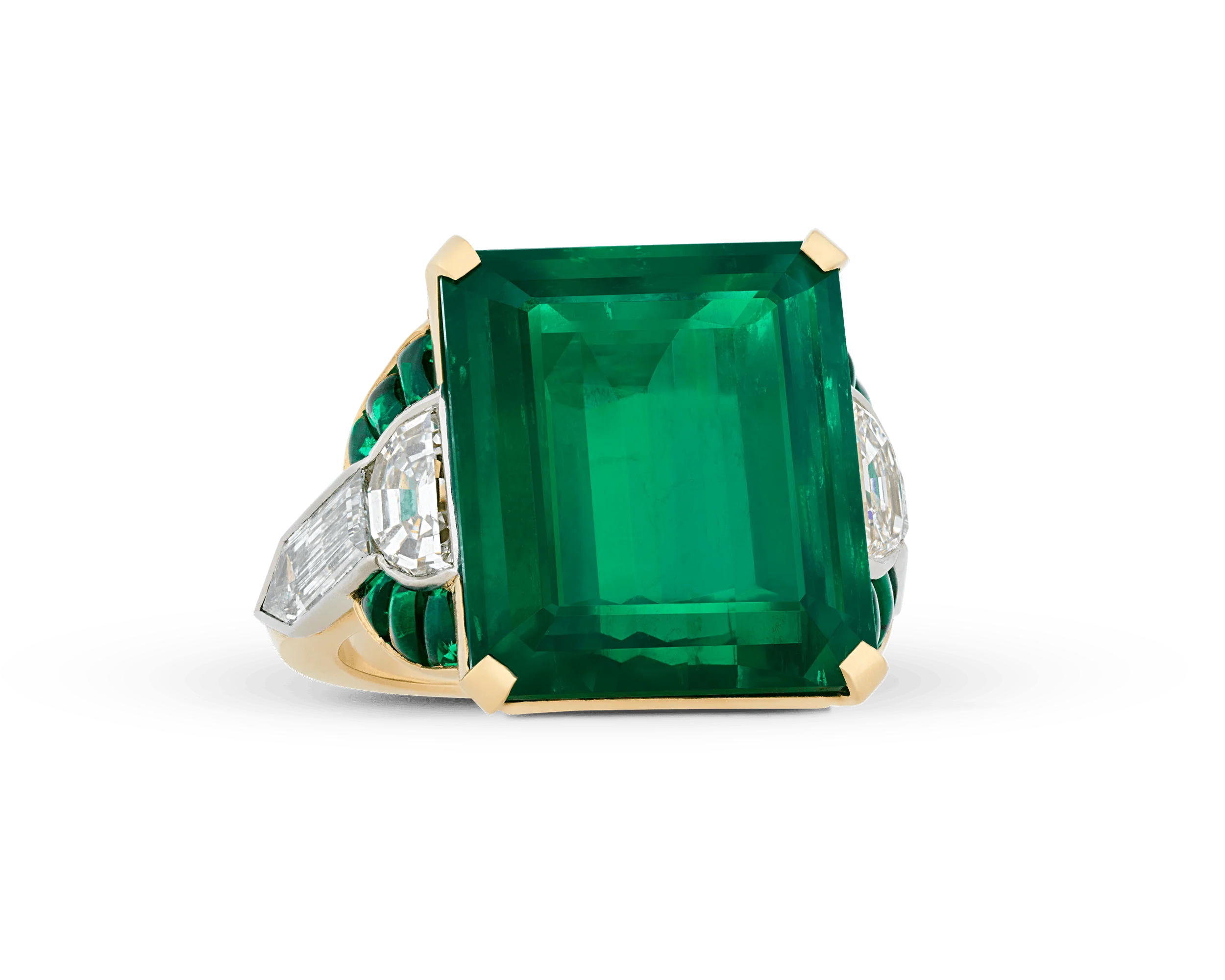
Marcus & Co. Untreated Colombian Emerald Ring, 14.29 Carats
Among the most esteemed emeralds in the history of jewelry are those from Colombia’s famed Muzo mines, whose output established the standard by which all others have long been judged. Often described as old-mine emeralds, these stones entered Europe through Spanish trade in the 16th and 17th centuries and have for generations been celebrated for the extraordinary depth, saturation and character of their color. Their reputation rests not only on rarity, but on a distinct visual quality that has made Colombian emeralds, and Muzo stones in particular, the most coveted examples of the species.
Emeralds differ from rubies and sapphires in that they are almost always marked by natural inclusions and fissures, features inherent to their formation. For that reason, the overwhelming majority are treated with oil to reduce the visibility of these internal characteristics, a practice especially common in stones of significant size. A gem-quality emerald exceeding 10 carats and showing no evidence of treatment is exceptionally uncommon. Weighing 14.29 carats and displaying the coveted hue associated with the finest old-mine Colombian stones, this emerald belongs to a rare category of singular importance.
Its significance is further enhanced by its setting, executed by Marcus & Co., one of the foremost American jewelers of the early 20th century. Founded by Herman Marcus, the firm earned a reputation for refinement and technical accomplishment that placed it alongside Tiffany & Co. among the leading American houses of the period. Jewels of this caliber were reserved for makers of the highest standing, and the present ring reflects that level of distinction in both conception and execution. AGL-certified and set in platinum and 18K yellow gold accented with diamonds, the ring was created circa 1925 and reflects the assured elegance of the Art Deco period.
Circa 1925
Download the Report
Emeralds differ from rubies and sapphires in that they are almost always marked by natural inclusions and fissures, features inherent to their formation. For that reason, the overwhelming majority are treated with oil to reduce the visibility of these internal characteristics, a practice especially common in stones of significant size. A gem-quality emerald exceeding 10 carats and showing no evidence of treatment is exceptionally uncommon. Weighing 14.29 carats and displaying the coveted hue associated with the finest old-mine Colombian stones, this emerald belongs to a rare category of singular importance.
Its significance is further enhanced by its setting, executed by Marcus & Co., one of the foremost American jewelers of the early 20th century. Founded by Herman Marcus, the firm earned a reputation for refinement and technical accomplishment that placed it alongside Tiffany & Co. among the leading American houses of the period. Jewels of this caliber were reserved for makers of the highest standing, and the present ring reflects that level of distinction in both conception and execution. AGL-certified and set in platinum and 18K yellow gold accented with diamonds, the ring was created circa 1925 and reflects the assured elegance of the Art Deco period.
Circa 1925
Download the Report
Among the most esteemed emeralds in the history of jewelry are those from Colombia’s famed Muzo mines, whose output established the standard by which all others have long been judged. Often described as old-mine emeralds, these stones entered Europe through Spanish trade in the 16th and 17th centuries and have for generations been celebrated for the extraordinary depth, saturation and character of their color. Their reputation rests not only on rarity, but on a distinct visual quality that has made Colombian emeralds, and Muzo stones in particular, the most coveted examples of the species.
Emeralds differ from rubies and sapphires in that they are almost always marked by natural inclusions and fissures, features inherent to their formation. For that reason, the overwhelming majority are treated with oil to reduce the visibility of these internal characteristics, a practice especially common in stones of significant size. A gem-quality emerald exceeding 10 carats and showing no evidence of treatment is exceptionally uncommon. Weighing 14.29 carats and displaying the coveted hue associated with the finest old-mine Colombian stones, this emerald belongs to a rare category of singular importance.
Its significance is further enhanced by its setting, executed by Marcus & Co., one of the foremost American jewelers of the early 20th century. Founded by Herman Marcus, the firm earned a reputation for refinement and technical accomplishment that placed it alongside Tiffany & Co. among the leading American houses of the period. Jewels of this caliber were reserved for makers of the highest standing, and the present ring reflects that level of distinction in both conception and execution. AGL-certified and set in platinum and 18K yellow gold accented with diamonds, the ring was created circa 1925 and reflects the assured elegance of the Art Deco period.
Circa 1925
Download the Report
Emeralds differ from rubies and sapphires in that they are almost always marked by natural inclusions and fissures, features inherent to their formation. For that reason, the overwhelming majority are treated with oil to reduce the visibility of these internal characteristics, a practice especially common in stones of significant size. A gem-quality emerald exceeding 10 carats and showing no evidence of treatment is exceptionally uncommon. Weighing 14.29 carats and displaying the coveted hue associated with the finest old-mine Colombian stones, this emerald belongs to a rare category of singular importance.
Its significance is further enhanced by its setting, executed by Marcus & Co., one of the foremost American jewelers of the early 20th century. Founded by Herman Marcus, the firm earned a reputation for refinement and technical accomplishment that placed it alongside Tiffany & Co. among the leading American houses of the period. Jewels of this caliber were reserved for makers of the highest standing, and the present ring reflects that level of distinction in both conception and execution. AGL-certified and set in platinum and 18K yellow gold accented with diamonds, the ring was created circa 1925 and reflects the assured elegance of the Art Deco period.
Circa 1925
Download the Report
$1,985,000.00
Marcus & Co. Untreated Colombian Emerald Ring, 14.29 Carats—
$1,985,000.00
Description
Among the most esteemed emeralds in the history of jewelry are those from Colombia’s famed Muzo mines, whose output established the standard by which all others have long been judged. Often described as old-mine emeralds, these stones entered Europe through Spanish trade in the 16th and 17th centuries and have for generations been celebrated for the extraordinary depth, saturation and character of their color. Their reputation rests not only on rarity, but on a distinct visual quality that has made Colombian emeralds, and Muzo stones in particular, the most coveted examples of the species.
Emeralds differ from rubies and sapphires in that they are almost always marked by natural inclusions and fissures, features inherent to their formation. For that reason, the overwhelming majority are treated with oil to reduce the visibility of these internal characteristics, a practice especially common in stones of significant size. A gem-quality emerald exceeding 10 carats and showing no evidence of treatment is exceptionally uncommon. Weighing 14.29 carats and displaying the coveted hue associated with the finest old-mine Colombian stones, this emerald belongs to a rare category of singular importance.
Its significance is further enhanced by its setting, executed by Marcus & Co., one of the foremost American jewelers of the early 20th century. Founded by Herman Marcus, the firm earned a reputation for refinement and technical accomplishment that placed it alongside Tiffany & Co. among the leading American houses of the period. Jewels of this caliber were reserved for makers of the highest standing, and the present ring reflects that level of distinction in both conception and execution. AGL-certified and set in platinum and 18K yellow gold accented with diamonds, the ring was created circa 1925 and reflects the assured elegance of the Art Deco period.
Circa 1925
Download the Report
Emeralds differ from rubies and sapphires in that they are almost always marked by natural inclusions and fissures, features inherent to their formation. For that reason, the overwhelming majority are treated with oil to reduce the visibility of these internal characteristics, a practice especially common in stones of significant size. A gem-quality emerald exceeding 10 carats and showing no evidence of treatment is exceptionally uncommon. Weighing 14.29 carats and displaying the coveted hue associated with the finest old-mine Colombian stones, this emerald belongs to a rare category of singular importance.
Its significance is further enhanced by its setting, executed by Marcus & Co., one of the foremost American jewelers of the early 20th century. Founded by Herman Marcus, the firm earned a reputation for refinement and technical accomplishment that placed it alongside Tiffany & Co. among the leading American houses of the period. Jewels of this caliber were reserved for makers of the highest standing, and the present ring reflects that level of distinction in both conception and execution. AGL-certified and set in platinum and 18K yellow gold accented with diamonds, the ring was created circa 1925 and reflects the assured elegance of the Art Deco period.
Circa 1925
Download the Report