1 / 9
+4
Merab and Michal by Edwin Longsden Long
Edwin Longsden Long
1829–1891 | British
Merab and Michal
Both signed with monogram (lower left and right)
Oil on canvas
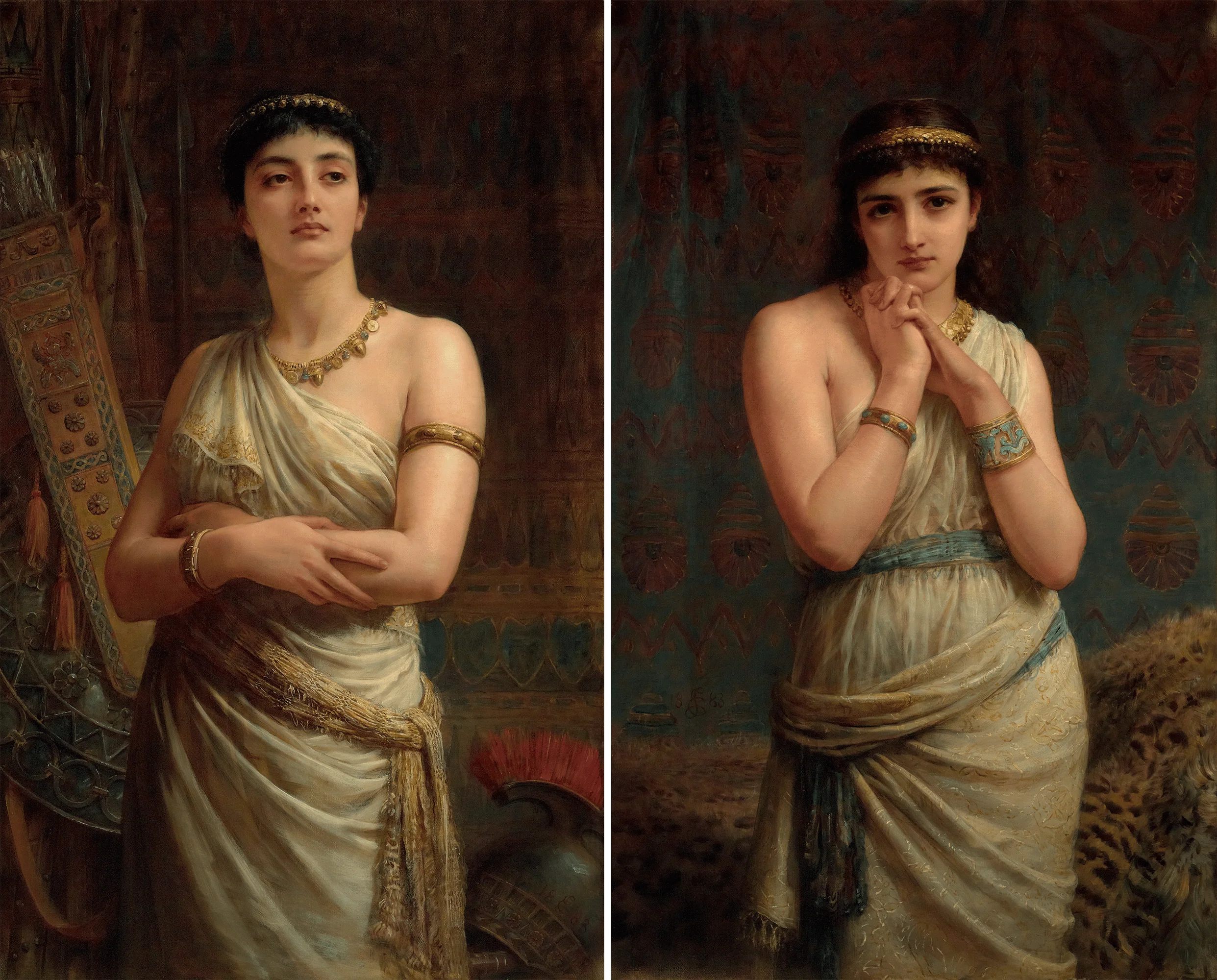
The paintings of Edwin Longsden Long stand among the most celebrated achievements of Victorian historical painting, distinguished by their meticulous detail, archaeological rigor and dramatic narrative force. Exhibited as a pair at the Royal Academy of Arts in 1883, Merab and Michal were immediately recognized as exceptional works within the artist’s oeuvre. Contemporary critics were unequivocal in their praise, with Lady’s Pictorial declaring the figures “perhaps the finest single figures Mr. Long has painted.” Preserved together for over 140 years, these paintings represent a rare survival of Long’s most ambitious and critically acclaimed masterworks.
Depicting the daughters of King Saul, the compositions explore contrasting expressions of feminine character. Rather than relying solely on the biblical text, Long drew on the dramatic interpretations in the oratorio Saul by George Frideric Handel, enriching each figure with psychological nuance. Merab, the elder daughter, is rendered with commanding presence, her upright stance and proximity to arms and armor underscoring her pride and royal authority. Michal, by contrast, is imbued with quiet introspection, her softened gaze and delicately clasped hands framed by sumptuous textiles. Together, the paintings form a carefully balanced dialogue between strength and tenderness, authority and devotion—an intellectual and aesthetic pairing characteristic of Long’s most sophisticated works.
When exhibited at the Royal Academy, the paintings were singled out for their beauty and commanding presence. The Globe praised their “great beauty of an Oriental type,” while noting that neighboring works paled in comparison. Their impact was such that they were later exhibited across Britain alongside Long’s monumental biblical canvas Anno Domini, further cementing their status within his most important productions.
Long’s reputation during his lifetime was extraordinary. In 1882, just one year before these works were completed, his Babylonian Marriage Market achieved £6,615 at auction—the highest price ever paid for a work by a living artist at that time. Many of his most significant paintings are held in important collections, including the Yale Center for British Art, the National Gallery of Victoria and the Russell-Cotes Art Gallery & Museum.
Both dated 1883
Canvas (each): 47 3/4" high x 29 3/8" wide (121.3 x 74.6 cm)
Frame (each): 60" high x 44 1/4" wide x 4 1/4" deep (152.4 x 112.4 x 10.8 cm)
View the Dossier
Provenance:
Fairless & Beeforth, London
Sir John Holder, Bart., by 1906
Anonymous sale, Sotheby’s, London, 21 March 1990, lot 221
With Zangrilli & Co., London
Private collection, United Kingdom
Private collection, Paris
M.S. Rau, New Orleans
Literature:
The Echo, 11 April 1883, p. 2
The Times, 5 May 1883, p. 12
The Globe, 5 May 1883, p. 6
Saturday Review, 5 May 1883, p. 566; 26 May 1883, p. 665; 16 February 1884, p. 216
Evening Irish Times, 7 May 1883, p. 6
Punch, 12 May 1883, p. 220
Athenaeum, 12 May 1883, p. 607
Building News, 18 May 1883, p. 656
Lady's Pictorial, 26 May 1883, p. 359; 5 September 1885, p. 210
Art Journal, 1883, p. 202
Academy Notes, 1883, p. 13
Birmingham Daily Gazette, 29 March 1906, p. 6
Austin Chester, “The Art of Edwin Long RA,” Windsor Magazine, February 1908, p. 548
Richard Quick, The Life and Works of Edwin Long, R.A., Bournemouth, 1931, p. 44
Mark Bills, Edwin Longsden Long RA, London, 1998, no. 194 (Merab), pp. 137–138, illustrated; no. 195 (Michal), pp. 138–139, illustrated
Exhibited:
London, Royal Academy, 1883, no. 91 (Merab) and no. 97 (Michal)
Fairless and Beeforth, 168 Bond Street, London, 1884–85
Toured with Anno Domini, 1889: T. Cranfield Galleries, Dublin (April–May); Rodman’s Gallery, Belfast (June); Frost and Reed, Bristol (September–October)
Birmingham Art Gallery, Royal Society of Artists, 1906
1829–1891 | British
Merab and Michal
Both signed with monogram (lower left and right)
Oil on canvas
The paintings of Edwin Longsden Long stand among the most celebrated achievements of Victorian historical painting, distinguished by their meticulous detail, archaeological rigor and dramatic narrative force. Exhibited as a pair at the Royal Academy of Arts in 1883, Merab and Michal were immediately recognized as exceptional works within the artist’s oeuvre. Contemporary critics were unequivocal in their praise, with Lady’s Pictorial declaring the figures “perhaps the finest single figures Mr. Long has painted.” Preserved together for over 140 years, these paintings represent a rare survival of Long’s most ambitious and critically acclaimed masterworks.
Depicting the daughters of King Saul, the compositions explore contrasting expressions of feminine character. Rather than relying solely on the biblical text, Long drew on the dramatic interpretations in the oratorio Saul by George Frideric Handel, enriching each figure with psychological nuance. Merab, the elder daughter, is rendered with commanding presence, her upright stance and proximity to arms and armor underscoring her pride and royal authority. Michal, by contrast, is imbued with quiet introspection, her softened gaze and delicately clasped hands framed by sumptuous textiles. Together, the paintings form a carefully balanced dialogue between strength and tenderness, authority and devotion—an intellectual and aesthetic pairing characteristic of Long’s most sophisticated works.
When exhibited at the Royal Academy, the paintings were singled out for their beauty and commanding presence. The Globe praised their “great beauty of an Oriental type,” while noting that neighboring works paled in comparison. Their impact was such that they were later exhibited across Britain alongside Long’s monumental biblical canvas Anno Domini, further cementing their status within his most important productions.
Long’s reputation during his lifetime was extraordinary. In 1882, just one year before these works were completed, his Babylonian Marriage Market achieved £6,615 at auction—the highest price ever paid for a work by a living artist at that time. Many of his most significant paintings are held in important collections, including the Yale Center for British Art, the National Gallery of Victoria and the Russell-Cotes Art Gallery & Museum.
Both dated 1883
Canvas (each): 47 3/4" high x 29 3/8" wide (121.3 x 74.6 cm)
Frame (each): 60" high x 44 1/4" wide x 4 1/4" deep (152.4 x 112.4 x 10.8 cm)
View the Dossier
Provenance:
Fairless & Beeforth, London
Sir John Holder, Bart., by 1906
Anonymous sale, Sotheby’s, London, 21 March 1990, lot 221
With Zangrilli & Co., London
Private collection, United Kingdom
Private collection, Paris
M.S. Rau, New Orleans
Literature:
The Echo, 11 April 1883, p. 2
The Times, 5 May 1883, p. 12
The Globe, 5 May 1883, p. 6
Saturday Review, 5 May 1883, p. 566; 26 May 1883, p. 665; 16 February 1884, p. 216
Evening Irish Times, 7 May 1883, p. 6
Punch, 12 May 1883, p. 220
Athenaeum, 12 May 1883, p. 607
Building News, 18 May 1883, p. 656
Lady's Pictorial, 26 May 1883, p. 359; 5 September 1885, p. 210
Art Journal, 1883, p. 202
Academy Notes, 1883, p. 13
Birmingham Daily Gazette, 29 March 1906, p. 6
Austin Chester, “The Art of Edwin Long RA,” Windsor Magazine, February 1908, p. 548
Richard Quick, The Life and Works of Edwin Long, R.A., Bournemouth, 1931, p. 44
Mark Bills, Edwin Longsden Long RA, London, 1998, no. 194 (Merab), pp. 137–138, illustrated; no. 195 (Michal), pp. 138–139, illustrated
Exhibited:
London, Royal Academy, 1883, no. 91 (Merab) and no. 97 (Michal)
Fairless and Beeforth, 168 Bond Street, London, 1884–85
Toured with Anno Domini, 1889: T. Cranfield Galleries, Dublin (April–May); Rodman’s Gallery, Belfast (June); Frost and Reed, Bristol (September–October)
Birmingham Art Gallery, Royal Society of Artists, 1906
Edwin Longsden Long
1829–1891 | British
Merab and Michal
Both signed with monogram (lower left and right)
Oil on canvas
The paintings of Edwin Longsden Long stand among the most celebrated achievements of Victorian historical painting, distinguished by their meticulous detail, archaeological rigor and dramatic narrative force. Exhibited as a pair at the Royal Academy of Arts in 1883, Merab and Michal were immediately recognized as exceptional works within the artist’s oeuvre. Contemporary critics were unequivocal in their praise, with Lady’s Pictorial declaring the figures “perhaps the finest single figures Mr. Long has painted.” Preserved together for over 140 years, these paintings represent a rare survival of Long’s most ambitious and critically acclaimed masterworks.
Depicting the daughters of King Saul, the compositions explore contrasting expressions of feminine character. Rather than relying solely on the biblical text, Long drew on the dramatic interpretations in the oratorio Saul by George Frideric Handel, enriching each figure with psychological nuance. Merab, the elder daughter, is rendered with commanding presence, her upright stance and proximity to arms and armor underscoring her pride and royal authority. Michal, by contrast, is imbued with quiet introspection, her softened gaze and delicately clasped hands framed by sumptuous textiles. Together, the paintings form a carefully balanced dialogue between strength and tenderness, authority and devotion—an intellectual and aesthetic pairing characteristic of Long’s most sophisticated works.
When exhibited at the Royal Academy, the paintings were singled out for their beauty and commanding presence. The Globe praised their “great beauty of an Oriental type,” while noting that neighboring works paled in comparison. Their impact was such that they were later exhibited across Britain alongside Long’s monumental biblical canvas Anno Domini, further cementing their status within his most important productions.
Long’s reputation during his lifetime was extraordinary. In 1882, just one year before these works were completed, his Babylonian Marriage Market achieved £6,615 at auction—the highest price ever paid for a work by a living artist at that time. Many of his most significant paintings are held in important collections, including the Yale Center for British Art, the National Gallery of Victoria and the Russell-Cotes Art Gallery & Museum.
Both dated 1883
Canvas (each): 47 3/4" high x 29 3/8" wide (121.3 x 74.6 cm)
Frame (each): 60" high x 44 1/4" wide x 4 1/4" deep (152.4 x 112.4 x 10.8 cm)
View the Dossier
Provenance:
Fairless & Beeforth, London
Sir John Holder, Bart., by 1906
Anonymous sale, Sotheby’s, London, 21 March 1990, lot 221
With Zangrilli & Co., London
Private collection, United Kingdom
Private collection, Paris
M.S. Rau, New Orleans
Literature:
The Echo, 11 April 1883, p. 2
The Times, 5 May 1883, p. 12
The Globe, 5 May 1883, p. 6
Saturday Review, 5 May 1883, p. 566; 26 May 1883, p. 665; 16 February 1884, p. 216
Evening Irish Times, 7 May 1883, p. 6
Punch, 12 May 1883, p. 220
Athenaeum, 12 May 1883, p. 607
Building News, 18 May 1883, p. 656
Lady's Pictorial, 26 May 1883, p. 359; 5 September 1885, p. 210
Art Journal, 1883, p. 202
Academy Notes, 1883, p. 13
Birmingham Daily Gazette, 29 March 1906, p. 6
Austin Chester, “The Art of Edwin Long RA,” Windsor Magazine, February 1908, p. 548
Richard Quick, The Life and Works of Edwin Long, R.A., Bournemouth, 1931, p. 44
Mark Bills, Edwin Longsden Long RA, London, 1998, no. 194 (Merab), pp. 137–138, illustrated; no. 195 (Michal), pp. 138–139, illustrated
Exhibited:
London, Royal Academy, 1883, no. 91 (Merab) and no. 97 (Michal)
Fairless and Beeforth, 168 Bond Street, London, 1884–85
Toured with Anno Domini, 1889: T. Cranfield Galleries, Dublin (April–May); Rodman’s Gallery, Belfast (June); Frost and Reed, Bristol (September–October)
Birmingham Art Gallery, Royal Society of Artists, 1906
1829–1891 | British
Merab and Michal
Both signed with monogram (lower left and right)
Oil on canvas
The paintings of Edwin Longsden Long stand among the most celebrated achievements of Victorian historical painting, distinguished by their meticulous detail, archaeological rigor and dramatic narrative force. Exhibited as a pair at the Royal Academy of Arts in 1883, Merab and Michal were immediately recognized as exceptional works within the artist’s oeuvre. Contemporary critics were unequivocal in their praise, with Lady’s Pictorial declaring the figures “perhaps the finest single figures Mr. Long has painted.” Preserved together for over 140 years, these paintings represent a rare survival of Long’s most ambitious and critically acclaimed masterworks.
Depicting the daughters of King Saul, the compositions explore contrasting expressions of feminine character. Rather than relying solely on the biblical text, Long drew on the dramatic interpretations in the oratorio Saul by George Frideric Handel, enriching each figure with psychological nuance. Merab, the elder daughter, is rendered with commanding presence, her upright stance and proximity to arms and armor underscoring her pride and royal authority. Michal, by contrast, is imbued with quiet introspection, her softened gaze and delicately clasped hands framed by sumptuous textiles. Together, the paintings form a carefully balanced dialogue between strength and tenderness, authority and devotion—an intellectual and aesthetic pairing characteristic of Long’s most sophisticated works.
When exhibited at the Royal Academy, the paintings were singled out for their beauty and commanding presence. The Globe praised their “great beauty of an Oriental type,” while noting that neighboring works paled in comparison. Their impact was such that they were later exhibited across Britain alongside Long’s monumental biblical canvas Anno Domini, further cementing their status within his most important productions.
Long’s reputation during his lifetime was extraordinary. In 1882, just one year before these works were completed, his Babylonian Marriage Market achieved £6,615 at auction—the highest price ever paid for a work by a living artist at that time. Many of his most significant paintings are held in important collections, including the Yale Center for British Art, the National Gallery of Victoria and the Russell-Cotes Art Gallery & Museum.
Both dated 1883
Canvas (each): 47 3/4" high x 29 3/8" wide (121.3 x 74.6 cm)
Frame (each): 60" high x 44 1/4" wide x 4 1/4" deep (152.4 x 112.4 x 10.8 cm)
View the Dossier
Provenance:
Fairless & Beeforth, London
Sir John Holder, Bart., by 1906
Anonymous sale, Sotheby’s, London, 21 March 1990, lot 221
With Zangrilli & Co., London
Private collection, United Kingdom
Private collection, Paris
M.S. Rau, New Orleans
Literature:
The Echo, 11 April 1883, p. 2
The Times, 5 May 1883, p. 12
The Globe, 5 May 1883, p. 6
Saturday Review, 5 May 1883, p. 566; 26 May 1883, p. 665; 16 February 1884, p. 216
Evening Irish Times, 7 May 1883, p. 6
Punch, 12 May 1883, p. 220
Athenaeum, 12 May 1883, p. 607
Building News, 18 May 1883, p. 656
Lady's Pictorial, 26 May 1883, p. 359; 5 September 1885, p. 210
Art Journal, 1883, p. 202
Academy Notes, 1883, p. 13
Birmingham Daily Gazette, 29 March 1906, p. 6
Austin Chester, “The Art of Edwin Long RA,” Windsor Magazine, February 1908, p. 548
Richard Quick, The Life and Works of Edwin Long, R.A., Bournemouth, 1931, p. 44
Mark Bills, Edwin Longsden Long RA, London, 1998, no. 194 (Merab), pp. 137–138, illustrated; no. 195 (Michal), pp. 138–139, illustrated
Exhibited:
London, Royal Academy, 1883, no. 91 (Merab) and no. 97 (Michal)
Fairless and Beeforth, 168 Bond Street, London, 1884–85
Toured with Anno Domini, 1889: T. Cranfield Galleries, Dublin (April–May); Rodman’s Gallery, Belfast (June); Frost and Reed, Bristol (September–October)
Birmingham Art Gallery, Royal Society of Artists, 1906
$174,475.00
Original: $498,500.00
-65%Merab and Michal by Edwin Longsden Long—
$498,500.00
$174,475.00Description
Edwin Longsden Long
1829–1891 | British
Merab and Michal
Both signed with monogram (lower left and right)
Oil on canvas
The paintings of Edwin Longsden Long stand among the most celebrated achievements of Victorian historical painting, distinguished by their meticulous detail, archaeological rigor and dramatic narrative force. Exhibited as a pair at the Royal Academy of Arts in 1883, Merab and Michal were immediately recognized as exceptional works within the artist’s oeuvre. Contemporary critics were unequivocal in their praise, with Lady’s Pictorial declaring the figures “perhaps the finest single figures Mr. Long has painted.” Preserved together for over 140 years, these paintings represent a rare survival of Long’s most ambitious and critically acclaimed masterworks.
Depicting the daughters of King Saul, the compositions explore contrasting expressions of feminine character. Rather than relying solely on the biblical text, Long drew on the dramatic interpretations in the oratorio Saul by George Frideric Handel, enriching each figure with psychological nuance. Merab, the elder daughter, is rendered with commanding presence, her upright stance and proximity to arms and armor underscoring her pride and royal authority. Michal, by contrast, is imbued with quiet introspection, her softened gaze and delicately clasped hands framed by sumptuous textiles. Together, the paintings form a carefully balanced dialogue between strength and tenderness, authority and devotion—an intellectual and aesthetic pairing characteristic of Long’s most sophisticated works.
When exhibited at the Royal Academy, the paintings were singled out for their beauty and commanding presence. The Globe praised their “great beauty of an Oriental type,” while noting that neighboring works paled in comparison. Their impact was such that they were later exhibited across Britain alongside Long’s monumental biblical canvas Anno Domini, further cementing their status within his most important productions.
Long’s reputation during his lifetime was extraordinary. In 1882, just one year before these works were completed, his Babylonian Marriage Market achieved £6,615 at auction—the highest price ever paid for a work by a living artist at that time. Many of his most significant paintings are held in important collections, including the Yale Center for British Art, the National Gallery of Victoria and the Russell-Cotes Art Gallery & Museum.
Both dated 1883
Canvas (each): 47 3/4" high x 29 3/8" wide (121.3 x 74.6 cm)
Frame (each): 60" high x 44 1/4" wide x 4 1/4" deep (152.4 x 112.4 x 10.8 cm)
View the Dossier
Provenance:
Fairless & Beeforth, London
Sir John Holder, Bart., by 1906
Anonymous sale, Sotheby’s, London, 21 March 1990, lot 221
With Zangrilli & Co., London
Private collection, United Kingdom
Private collection, Paris
M.S. Rau, New Orleans
Literature:
The Echo, 11 April 1883, p. 2
The Times, 5 May 1883, p. 12
The Globe, 5 May 1883, p. 6
Saturday Review, 5 May 1883, p. 566; 26 May 1883, p. 665; 16 February 1884, p. 216
Evening Irish Times, 7 May 1883, p. 6
Punch, 12 May 1883, p. 220
Athenaeum, 12 May 1883, p. 607
Building News, 18 May 1883, p. 656
Lady's Pictorial, 26 May 1883, p. 359; 5 September 1885, p. 210
Art Journal, 1883, p. 202
Academy Notes, 1883, p. 13
Birmingham Daily Gazette, 29 March 1906, p. 6
Austin Chester, “The Art of Edwin Long RA,” Windsor Magazine, February 1908, p. 548
Richard Quick, The Life and Works of Edwin Long, R.A., Bournemouth, 1931, p. 44
Mark Bills, Edwin Longsden Long RA, London, 1998, no. 194 (Merab), pp. 137–138, illustrated; no. 195 (Michal), pp. 138–139, illustrated
Exhibited:
London, Royal Academy, 1883, no. 91 (Merab) and no. 97 (Michal)
Fairless and Beeforth, 168 Bond Street, London, 1884–85
Toured with Anno Domini, 1889: T. Cranfield Galleries, Dublin (April–May); Rodman’s Gallery, Belfast (June); Frost and Reed, Bristol (September–October)
Birmingham Art Gallery, Royal Society of Artists, 1906
1829–1891 | British
Merab and Michal
Both signed with monogram (lower left and right)
Oil on canvas
The paintings of Edwin Longsden Long stand among the most celebrated achievements of Victorian historical painting, distinguished by their meticulous detail, archaeological rigor and dramatic narrative force. Exhibited as a pair at the Royal Academy of Arts in 1883, Merab and Michal were immediately recognized as exceptional works within the artist’s oeuvre. Contemporary critics were unequivocal in their praise, with Lady’s Pictorial declaring the figures “perhaps the finest single figures Mr. Long has painted.” Preserved together for over 140 years, these paintings represent a rare survival of Long’s most ambitious and critically acclaimed masterworks.
Depicting the daughters of King Saul, the compositions explore contrasting expressions of feminine character. Rather than relying solely on the biblical text, Long drew on the dramatic interpretations in the oratorio Saul by George Frideric Handel, enriching each figure with psychological nuance. Merab, the elder daughter, is rendered with commanding presence, her upright stance and proximity to arms and armor underscoring her pride and royal authority. Michal, by contrast, is imbued with quiet introspection, her softened gaze and delicately clasped hands framed by sumptuous textiles. Together, the paintings form a carefully balanced dialogue between strength and tenderness, authority and devotion—an intellectual and aesthetic pairing characteristic of Long’s most sophisticated works.
When exhibited at the Royal Academy, the paintings were singled out for their beauty and commanding presence. The Globe praised their “great beauty of an Oriental type,” while noting that neighboring works paled in comparison. Their impact was such that they were later exhibited across Britain alongside Long’s monumental biblical canvas Anno Domini, further cementing their status within his most important productions.
Long’s reputation during his lifetime was extraordinary. In 1882, just one year before these works were completed, his Babylonian Marriage Market achieved £6,615 at auction—the highest price ever paid for a work by a living artist at that time. Many of his most significant paintings are held in important collections, including the Yale Center for British Art, the National Gallery of Victoria and the Russell-Cotes Art Gallery & Museum.
Both dated 1883
Canvas (each): 47 3/4" high x 29 3/8" wide (121.3 x 74.6 cm)
Frame (each): 60" high x 44 1/4" wide x 4 1/4" deep (152.4 x 112.4 x 10.8 cm)
View the Dossier
Provenance:
Fairless & Beeforth, London
Sir John Holder, Bart., by 1906
Anonymous sale, Sotheby’s, London, 21 March 1990, lot 221
With Zangrilli & Co., London
Private collection, United Kingdom
Private collection, Paris
M.S. Rau, New Orleans
Literature:
The Echo, 11 April 1883, p. 2
The Times, 5 May 1883, p. 12
The Globe, 5 May 1883, p. 6
Saturday Review, 5 May 1883, p. 566; 26 May 1883, p. 665; 16 February 1884, p. 216
Evening Irish Times, 7 May 1883, p. 6
Punch, 12 May 1883, p. 220
Athenaeum, 12 May 1883, p. 607
Building News, 18 May 1883, p. 656
Lady's Pictorial, 26 May 1883, p. 359; 5 September 1885, p. 210
Art Journal, 1883, p. 202
Academy Notes, 1883, p. 13
Birmingham Daily Gazette, 29 March 1906, p. 6
Austin Chester, “The Art of Edwin Long RA,” Windsor Magazine, February 1908, p. 548
Richard Quick, The Life and Works of Edwin Long, R.A., Bournemouth, 1931, p. 44
Mark Bills, Edwin Longsden Long RA, London, 1998, no. 194 (Merab), pp. 137–138, illustrated; no. 195 (Michal), pp. 138–139, illustrated
Exhibited:
London, Royal Academy, 1883, no. 91 (Merab) and no. 97 (Michal)
Fairless and Beeforth, 168 Bond Street, London, 1884–85
Toured with Anno Domini, 1889: T. Cranfield Galleries, Dublin (April–May); Rodman’s Gallery, Belfast (June); Frost and Reed, Bristol (September–October)
Birmingham Art Gallery, Royal Society of Artists, 1906