1 / 5
Nu allongé avec bracelet by Tamara de Lempicka
Tamara De Lempicka
1898-1980 | Polish
Nu allongé avec bracelet
(Nude lying down with bracelet)
Signed “Lempicka”(bottom right)
Pencil on paper
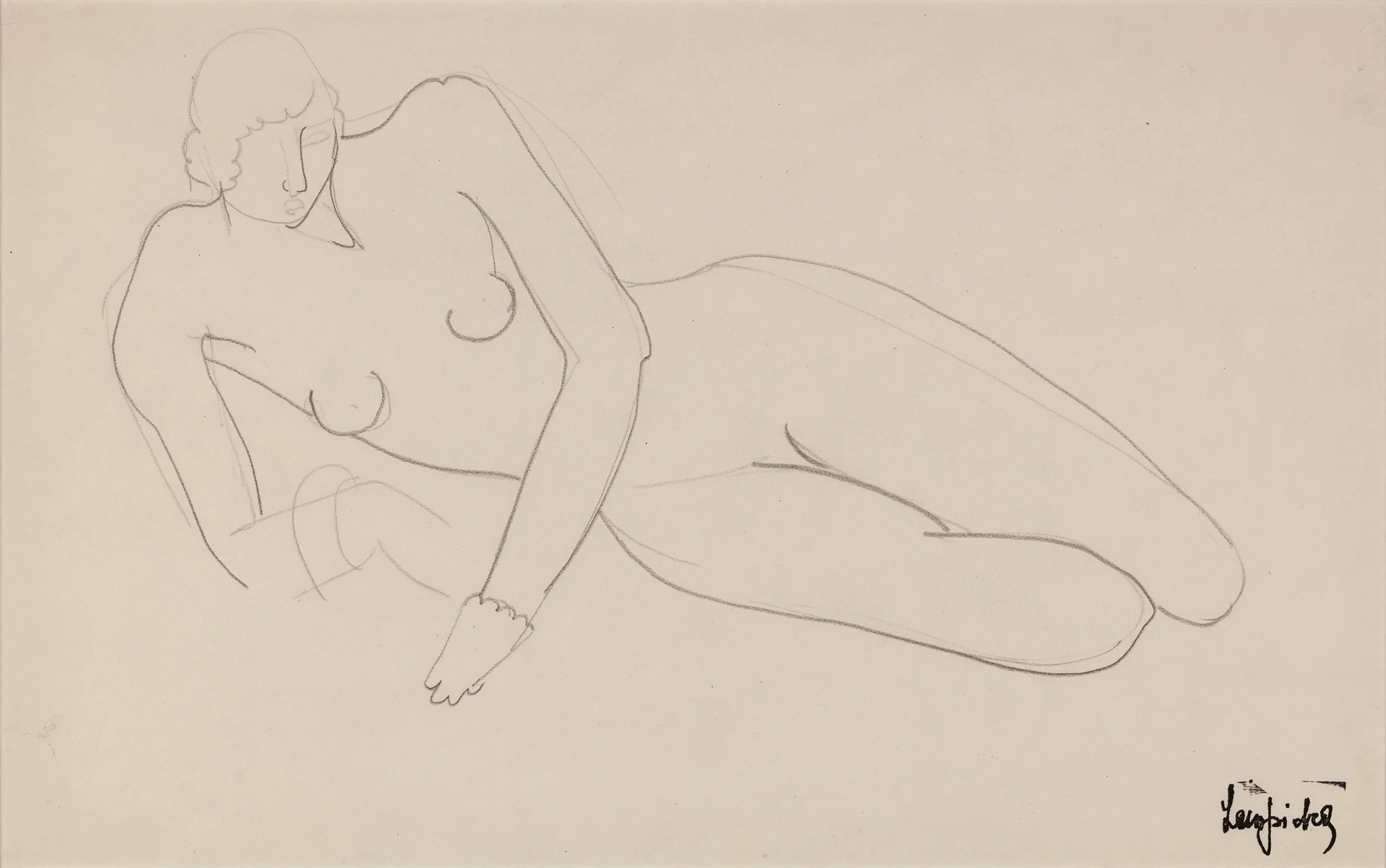
This exquisite pencil on paper by Tamara de Lempicka radiates Art Deco's signature blend of elegance and modernity, a movement that Lempicka defined in her trailblazing career. This nude drawing of a woman, elegant in its minimalism and fluidity, exemplifies Lempicka’s superb draftsmanship and compositional finesse.
With a few deft strokes, she confidently portrays her subject in a languid pose, with delicate bracelets gracing her wrists. Her model represents the popular ‘20s aesthetic, featuring the classic Flapper bob hairstyle. Unique, semi-erased lines are visible beneath the completed drawing, showcasing the experimental nature of Lempicka’s process. Her talent seamlessly merges various modern art movements and design principles, capturing the streamlined sophistication of modern architecture with the more avant-garde nature of her fellow painters. Best known for her paintings of stylish women, this anonymous nude offers the rare opportunity to peek behind the curtain to see the working process of one of the 20th century’s most glamorous artists.
Born in Poland in 1898, Lempicka’s life was marked by constant movement. At the beginning of the Russian Revolution, Tamara’s life was turned upside down, and her family found refuge in Paris, where she lived for twenty years. Building on a love of art that began during a visit to Italy in her youth, Lempicka enrolled in Académie de la Grande Chaumière in Paris to study painting. Under the mentorship of famed avant-garde artists Maurice Denis and André Lhote, who introduced her to Cubism, Lempicka began exhibiting avant-garde art in Parisian salons in 1922. Lempicka won first prize at the Exposition Internationale des Beaux-Arts in 1927 with her iconic Cubist-Art Deco style, a year before this drawing was made.
With a resurgence of appreciation for the Art Deco period beginning in the 1960s, combined with the upcoming first major museum retrospective exhibition of her work in the United States at the de Young in San Francisco, Lempicka’s work is reaching new heights of acclaim in recent decades. Much of her work resides in collections worldwide, including the Metropolitan Museum of Art, the Musée des Beaux-Arts du Havre, and the National Museum Warsaw, to name a few. Not only did Lempicka flout gender expectations by establishing a successful career as a fine artist and defying traditional artistic trends, but she also created a unique genre found only in her oeuvre.
Circa 1928
Paper: 10 3/8" high x 16 1/2" wide (26.35 x 41.91 cm)
Frame: 18" high x 24 3/8" wide x 7/8" deep (45.72 x 61.91 x 2.22 cm)
Provenance:
By descent, from the artist
1898-1980 | Polish
Nu allongé avec bracelet
(Nude lying down with bracelet)
Signed “Lempicka”(bottom right)
Pencil on paper
This exquisite pencil on paper by Tamara de Lempicka radiates Art Deco's signature blend of elegance and modernity, a movement that Lempicka defined in her trailblazing career. This nude drawing of a woman, elegant in its minimalism and fluidity, exemplifies Lempicka’s superb draftsmanship and compositional finesse.
With a few deft strokes, she confidently portrays her subject in a languid pose, with delicate bracelets gracing her wrists. Her model represents the popular ‘20s aesthetic, featuring the classic Flapper bob hairstyle. Unique, semi-erased lines are visible beneath the completed drawing, showcasing the experimental nature of Lempicka’s process. Her talent seamlessly merges various modern art movements and design principles, capturing the streamlined sophistication of modern architecture with the more avant-garde nature of her fellow painters. Best known for her paintings of stylish women, this anonymous nude offers the rare opportunity to peek behind the curtain to see the working process of one of the 20th century’s most glamorous artists.
Born in Poland in 1898, Lempicka’s life was marked by constant movement. At the beginning of the Russian Revolution, Tamara’s life was turned upside down, and her family found refuge in Paris, where she lived for twenty years. Building on a love of art that began during a visit to Italy in her youth, Lempicka enrolled in Académie de la Grande Chaumière in Paris to study painting. Under the mentorship of famed avant-garde artists Maurice Denis and André Lhote, who introduced her to Cubism, Lempicka began exhibiting avant-garde art in Parisian salons in 1922. Lempicka won first prize at the Exposition Internationale des Beaux-Arts in 1927 with her iconic Cubist-Art Deco style, a year before this drawing was made.
With a resurgence of appreciation for the Art Deco period beginning in the 1960s, combined with the upcoming first major museum retrospective exhibition of her work in the United States at the de Young in San Francisco, Lempicka’s work is reaching new heights of acclaim in recent decades. Much of her work resides in collections worldwide, including the Metropolitan Museum of Art, the Musée des Beaux-Arts du Havre, and the National Museum Warsaw, to name a few. Not only did Lempicka flout gender expectations by establishing a successful career as a fine artist and defying traditional artistic trends, but she also created a unique genre found only in her oeuvre.
Circa 1928
Paper: 10 3/8" high x 16 1/2" wide (26.35 x 41.91 cm)
Frame: 18" high x 24 3/8" wide x 7/8" deep (45.72 x 61.91 x 2.22 cm)
Provenance:
By descent, from the artist
Tamara De Lempicka
1898-1980 | Polish
Nu allongé avec bracelet
(Nude lying down with bracelet)
Signed “Lempicka”(bottom right)
Pencil on paper
This exquisite pencil on paper by Tamara de Lempicka radiates Art Deco's signature blend of elegance and modernity, a movement that Lempicka defined in her trailblazing career. This nude drawing of a woman, elegant in its minimalism and fluidity, exemplifies Lempicka’s superb draftsmanship and compositional finesse.
With a few deft strokes, she confidently portrays her subject in a languid pose, with delicate bracelets gracing her wrists. Her model represents the popular ‘20s aesthetic, featuring the classic Flapper bob hairstyle. Unique, semi-erased lines are visible beneath the completed drawing, showcasing the experimental nature of Lempicka’s process. Her talent seamlessly merges various modern art movements and design principles, capturing the streamlined sophistication of modern architecture with the more avant-garde nature of her fellow painters. Best known for her paintings of stylish women, this anonymous nude offers the rare opportunity to peek behind the curtain to see the working process of one of the 20th century’s most glamorous artists.
Born in Poland in 1898, Lempicka’s life was marked by constant movement. At the beginning of the Russian Revolution, Tamara’s life was turned upside down, and her family found refuge in Paris, where she lived for twenty years. Building on a love of art that began during a visit to Italy in her youth, Lempicka enrolled in Académie de la Grande Chaumière in Paris to study painting. Under the mentorship of famed avant-garde artists Maurice Denis and André Lhote, who introduced her to Cubism, Lempicka began exhibiting avant-garde art in Parisian salons in 1922. Lempicka won first prize at the Exposition Internationale des Beaux-Arts in 1927 with her iconic Cubist-Art Deco style, a year before this drawing was made.
With a resurgence of appreciation for the Art Deco period beginning in the 1960s, combined with the upcoming first major museum retrospective exhibition of her work in the United States at the de Young in San Francisco, Lempicka’s work is reaching new heights of acclaim in recent decades. Much of her work resides in collections worldwide, including the Metropolitan Museum of Art, the Musée des Beaux-Arts du Havre, and the National Museum Warsaw, to name a few. Not only did Lempicka flout gender expectations by establishing a successful career as a fine artist and defying traditional artistic trends, but she also created a unique genre found only in her oeuvre.
Circa 1928
Paper: 10 3/8" high x 16 1/2" wide (26.35 x 41.91 cm)
Frame: 18" high x 24 3/8" wide x 7/8" deep (45.72 x 61.91 x 2.22 cm)
Provenance:
By descent, from the artist
1898-1980 | Polish
Nu allongé avec bracelet
(Nude lying down with bracelet)
Signed “Lempicka”(bottom right)
Pencil on paper
This exquisite pencil on paper by Tamara de Lempicka radiates Art Deco's signature blend of elegance and modernity, a movement that Lempicka defined in her trailblazing career. This nude drawing of a woman, elegant in its minimalism and fluidity, exemplifies Lempicka’s superb draftsmanship and compositional finesse.
With a few deft strokes, she confidently portrays her subject in a languid pose, with delicate bracelets gracing her wrists. Her model represents the popular ‘20s aesthetic, featuring the classic Flapper bob hairstyle. Unique, semi-erased lines are visible beneath the completed drawing, showcasing the experimental nature of Lempicka’s process. Her talent seamlessly merges various modern art movements and design principles, capturing the streamlined sophistication of modern architecture with the more avant-garde nature of her fellow painters. Best known for her paintings of stylish women, this anonymous nude offers the rare opportunity to peek behind the curtain to see the working process of one of the 20th century’s most glamorous artists.
Born in Poland in 1898, Lempicka’s life was marked by constant movement. At the beginning of the Russian Revolution, Tamara’s life was turned upside down, and her family found refuge in Paris, where she lived for twenty years. Building on a love of art that began during a visit to Italy in her youth, Lempicka enrolled in Académie de la Grande Chaumière in Paris to study painting. Under the mentorship of famed avant-garde artists Maurice Denis and André Lhote, who introduced her to Cubism, Lempicka began exhibiting avant-garde art in Parisian salons in 1922. Lempicka won first prize at the Exposition Internationale des Beaux-Arts in 1927 with her iconic Cubist-Art Deco style, a year before this drawing was made.
With a resurgence of appreciation for the Art Deco period beginning in the 1960s, combined with the upcoming first major museum retrospective exhibition of her work in the United States at the de Young in San Francisco, Lempicka’s work is reaching new heights of acclaim in recent decades. Much of her work resides in collections worldwide, including the Metropolitan Museum of Art, the Musée des Beaux-Arts du Havre, and the National Museum Warsaw, to name a few. Not only did Lempicka flout gender expectations by establishing a successful career as a fine artist and defying traditional artistic trends, but she also created a unique genre found only in her oeuvre.
Circa 1928
Paper: 10 3/8" high x 16 1/2" wide (26.35 x 41.91 cm)
Frame: 18" high x 24 3/8" wide x 7/8" deep (45.72 x 61.91 x 2.22 cm)
Provenance:
By descent, from the artist
$39,850.00
Nu allongé avec bracelet by Tamara de Lempicka—
$39,850.00
Description
Tamara De Lempicka
1898-1980 | Polish
Nu allongé avec bracelet
(Nude lying down with bracelet)
Signed “Lempicka”(bottom right)
Pencil on paper
This exquisite pencil on paper by Tamara de Lempicka radiates Art Deco's signature blend of elegance and modernity, a movement that Lempicka defined in her trailblazing career. This nude drawing of a woman, elegant in its minimalism and fluidity, exemplifies Lempicka’s superb draftsmanship and compositional finesse.
With a few deft strokes, she confidently portrays her subject in a languid pose, with delicate bracelets gracing her wrists. Her model represents the popular ‘20s aesthetic, featuring the classic Flapper bob hairstyle. Unique, semi-erased lines are visible beneath the completed drawing, showcasing the experimental nature of Lempicka’s process. Her talent seamlessly merges various modern art movements and design principles, capturing the streamlined sophistication of modern architecture with the more avant-garde nature of her fellow painters. Best known for her paintings of stylish women, this anonymous nude offers the rare opportunity to peek behind the curtain to see the working process of one of the 20th century’s most glamorous artists.
Born in Poland in 1898, Lempicka’s life was marked by constant movement. At the beginning of the Russian Revolution, Tamara’s life was turned upside down, and her family found refuge in Paris, where she lived for twenty years. Building on a love of art that began during a visit to Italy in her youth, Lempicka enrolled in Académie de la Grande Chaumière in Paris to study painting. Under the mentorship of famed avant-garde artists Maurice Denis and André Lhote, who introduced her to Cubism, Lempicka began exhibiting avant-garde art in Parisian salons in 1922. Lempicka won first prize at the Exposition Internationale des Beaux-Arts in 1927 with her iconic Cubist-Art Deco style, a year before this drawing was made.
With a resurgence of appreciation for the Art Deco period beginning in the 1960s, combined with the upcoming first major museum retrospective exhibition of her work in the United States at the de Young in San Francisco, Lempicka’s work is reaching new heights of acclaim in recent decades. Much of her work resides in collections worldwide, including the Metropolitan Museum of Art, the Musée des Beaux-Arts du Havre, and the National Museum Warsaw, to name a few. Not only did Lempicka flout gender expectations by establishing a successful career as a fine artist and defying traditional artistic trends, but she also created a unique genre found only in her oeuvre.
Circa 1928
Paper: 10 3/8" high x 16 1/2" wide (26.35 x 41.91 cm)
Frame: 18" high x 24 3/8" wide x 7/8" deep (45.72 x 61.91 x 2.22 cm)
Provenance:
By descent, from the artist
1898-1980 | Polish
Nu allongé avec bracelet
(Nude lying down with bracelet)
Signed “Lempicka”(bottom right)
Pencil on paper
This exquisite pencil on paper by Tamara de Lempicka radiates Art Deco's signature blend of elegance and modernity, a movement that Lempicka defined in her trailblazing career. This nude drawing of a woman, elegant in its minimalism and fluidity, exemplifies Lempicka’s superb draftsmanship and compositional finesse.
With a few deft strokes, she confidently portrays her subject in a languid pose, with delicate bracelets gracing her wrists. Her model represents the popular ‘20s aesthetic, featuring the classic Flapper bob hairstyle. Unique, semi-erased lines are visible beneath the completed drawing, showcasing the experimental nature of Lempicka’s process. Her talent seamlessly merges various modern art movements and design principles, capturing the streamlined sophistication of modern architecture with the more avant-garde nature of her fellow painters. Best known for her paintings of stylish women, this anonymous nude offers the rare opportunity to peek behind the curtain to see the working process of one of the 20th century’s most glamorous artists.
Born in Poland in 1898, Lempicka’s life was marked by constant movement. At the beginning of the Russian Revolution, Tamara’s life was turned upside down, and her family found refuge in Paris, where she lived for twenty years. Building on a love of art that began during a visit to Italy in her youth, Lempicka enrolled in Académie de la Grande Chaumière in Paris to study painting. Under the mentorship of famed avant-garde artists Maurice Denis and André Lhote, who introduced her to Cubism, Lempicka began exhibiting avant-garde art in Parisian salons in 1922. Lempicka won first prize at the Exposition Internationale des Beaux-Arts in 1927 with her iconic Cubist-Art Deco style, a year before this drawing was made.
With a resurgence of appreciation for the Art Deco period beginning in the 1960s, combined with the upcoming first major museum retrospective exhibition of her work in the United States at the de Young in San Francisco, Lempicka’s work is reaching new heights of acclaim in recent decades. Much of her work resides in collections worldwide, including the Metropolitan Museum of Art, the Musée des Beaux-Arts du Havre, and the National Museum Warsaw, to name a few. Not only did Lempicka flout gender expectations by establishing a successful career as a fine artist and defying traditional artistic trends, but she also created a unique genre found only in her oeuvre.
Circa 1928
Paper: 10 3/8" high x 16 1/2" wide (26.35 x 41.91 cm)
Frame: 18" high x 24 3/8" wide x 7/8" deep (45.72 x 61.91 x 2.22 cm)
Provenance:
By descent, from the artist