1 / 4
Patek Philippe Silver Deck Chronometer
This distinguished 1911 Patek Philippe naval deck chronometer showcases precision timekeeping at its finest. The timepiece almost certainly garnered second-prize honors at the prestigious 1912 Chronometer timing trials, marking it as an instrument of extraordinary horological significance. The silver masterpiece exemplifies the sophisticated engineering and artistic refinement that elevated Patek Philippe to preeminence among Switzerland's most celebrated chronometer makers.
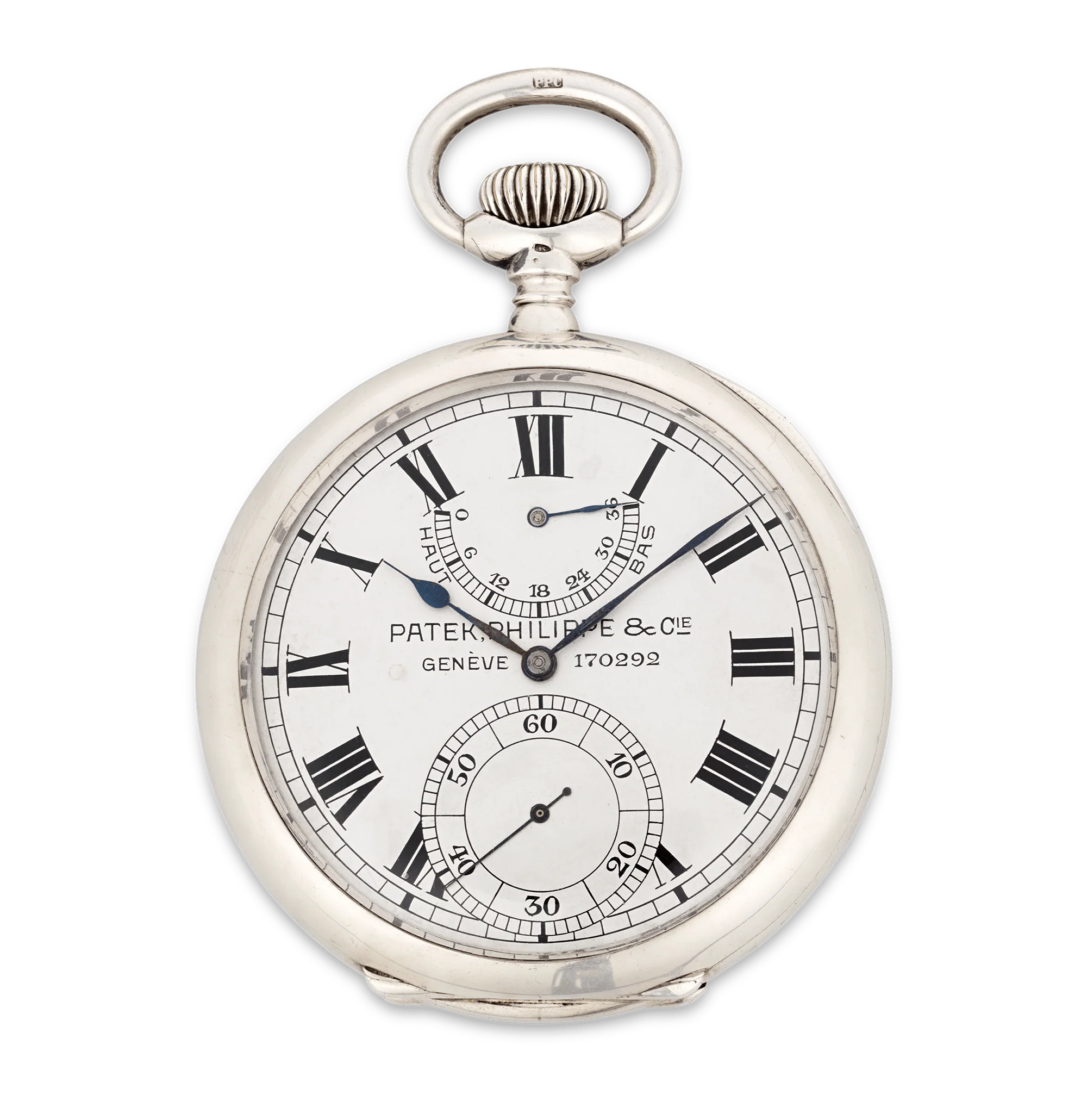
The bassine-style case houses a silvered dial with bold Roman numerals in black. A subsidiary seconds register at 6 o'clock demonstrates the dedication to precise timekeeping that characterized these sophisticated navigational instruments. The movement, designated "Extra" to denote Patek Philippe's high grade of precision engineering, incorporates a power reserve indicator and lever escapement.
Patek Philippe's dominance in the timing contests defined the golden age of precision chronometry. These trials subjected timepieces to rigorous testing under extreme temperatures and positions, pushing the boundaries of mechanical accuracy. This particular chronometer's distinguished service continued when it was acquired by the US Government in 1915 for use aboard an airship of the US Navy, where such precision instruments were vital for navigation. Typically, three chronometers would be carried aboard each vessel to ensure accuracy in navigation. Very few of these chronometers were made, and this rare example is an exceptional example of horological and maritime history.
Circa 1911
Movement No. 170292
Case No. 273603
Case: 61mm
Caseback marked “U.S. Navy”
The bassine-style case houses a silvered dial with bold Roman numerals in black. A subsidiary seconds register at 6 o'clock demonstrates the dedication to precise timekeeping that characterized these sophisticated navigational instruments. The movement, designated "Extra" to denote Patek Philippe's high grade of precision engineering, incorporates a power reserve indicator and lever escapement.
Patek Philippe's dominance in the timing contests defined the golden age of precision chronometry. These trials subjected timepieces to rigorous testing under extreme temperatures and positions, pushing the boundaries of mechanical accuracy. This particular chronometer's distinguished service continued when it was acquired by the US Government in 1915 for use aboard an airship of the US Navy, where such precision instruments were vital for navigation. Typically, three chronometers would be carried aboard each vessel to ensure accuracy in navigation. Very few of these chronometers were made, and this rare example is an exceptional example of horological and maritime history.
Circa 1911
Movement No. 170292
Case No. 273603
Case: 61mm
Caseback marked “U.S. Navy”
This distinguished 1911 Patek Philippe naval deck chronometer showcases precision timekeeping at its finest. The timepiece almost certainly garnered second-prize honors at the prestigious 1912 Chronometer timing trials, marking it as an instrument of extraordinary horological significance. The silver masterpiece exemplifies the sophisticated engineering and artistic refinement that elevated Patek Philippe to preeminence among Switzerland's most celebrated chronometer makers.
The bassine-style case houses a silvered dial with bold Roman numerals in black. A subsidiary seconds register at 6 o'clock demonstrates the dedication to precise timekeeping that characterized these sophisticated navigational instruments. The movement, designated "Extra" to denote Patek Philippe's high grade of precision engineering, incorporates a power reserve indicator and lever escapement.
Patek Philippe's dominance in the timing contests defined the golden age of precision chronometry. These trials subjected timepieces to rigorous testing under extreme temperatures and positions, pushing the boundaries of mechanical accuracy. This particular chronometer's distinguished service continued when it was acquired by the US Government in 1915 for use aboard an airship of the US Navy, where such precision instruments were vital for navigation. Typically, three chronometers would be carried aboard each vessel to ensure accuracy in navigation. Very few of these chronometers were made, and this rare example is an exceptional example of horological and maritime history.
Circa 1911
Movement No. 170292
Case No. 273603
Case: 61mm
Caseback marked “U.S. Navy”
The bassine-style case houses a silvered dial with bold Roman numerals in black. A subsidiary seconds register at 6 o'clock demonstrates the dedication to precise timekeeping that characterized these sophisticated navigational instruments. The movement, designated "Extra" to denote Patek Philippe's high grade of precision engineering, incorporates a power reserve indicator and lever escapement.
Patek Philippe's dominance in the timing contests defined the golden age of precision chronometry. These trials subjected timepieces to rigorous testing under extreme temperatures and positions, pushing the boundaries of mechanical accuracy. This particular chronometer's distinguished service continued when it was acquired by the US Government in 1915 for use aboard an airship of the US Navy, where such precision instruments were vital for navigation. Typically, three chronometers would be carried aboard each vessel to ensure accuracy in navigation. Very few of these chronometers were made, and this rare example is an exceptional example of horological and maritime history.
Circa 1911
Movement No. 170292
Case No. 273603
Case: 61mm
Caseback marked “U.S. Navy”
$24,097.50
Original: $68,850.00
-65%Patek Philippe Silver Deck Chronometer—
$68,850.00
$24,097.50Description
This distinguished 1911 Patek Philippe naval deck chronometer showcases precision timekeeping at its finest. The timepiece almost certainly garnered second-prize honors at the prestigious 1912 Chronometer timing trials, marking it as an instrument of extraordinary horological significance. The silver masterpiece exemplifies the sophisticated engineering and artistic refinement that elevated Patek Philippe to preeminence among Switzerland's most celebrated chronometer makers.
The bassine-style case houses a silvered dial with bold Roman numerals in black. A subsidiary seconds register at 6 o'clock demonstrates the dedication to precise timekeeping that characterized these sophisticated navigational instruments. The movement, designated "Extra" to denote Patek Philippe's high grade of precision engineering, incorporates a power reserve indicator and lever escapement.
Patek Philippe's dominance in the timing contests defined the golden age of precision chronometry. These trials subjected timepieces to rigorous testing under extreme temperatures and positions, pushing the boundaries of mechanical accuracy. This particular chronometer's distinguished service continued when it was acquired by the US Government in 1915 for use aboard an airship of the US Navy, where such precision instruments were vital for navigation. Typically, three chronometers would be carried aboard each vessel to ensure accuracy in navigation. Very few of these chronometers were made, and this rare example is an exceptional example of horological and maritime history.
Circa 1911
Movement No. 170292
Case No. 273603
Case: 61mm
Caseback marked “U.S. Navy”
The bassine-style case houses a silvered dial with bold Roman numerals in black. A subsidiary seconds register at 6 o'clock demonstrates the dedication to precise timekeeping that characterized these sophisticated navigational instruments. The movement, designated "Extra" to denote Patek Philippe's high grade of precision engineering, incorporates a power reserve indicator and lever escapement.
Patek Philippe's dominance in the timing contests defined the golden age of precision chronometry. These trials subjected timepieces to rigorous testing under extreme temperatures and positions, pushing the boundaries of mechanical accuracy. This particular chronometer's distinguished service continued when it was acquired by the US Government in 1915 for use aboard an airship of the US Navy, where such precision instruments were vital for navigation. Typically, three chronometers would be carried aboard each vessel to ensure accuracy in navigation. Very few of these chronometers were made, and this rare example is an exceptional example of horological and maritime history.
Circa 1911
Movement No. 170292
Case No. 273603
Case: 61mm
Caseback marked “U.S. Navy”