1 / 3
Satsuma Vase with Monks
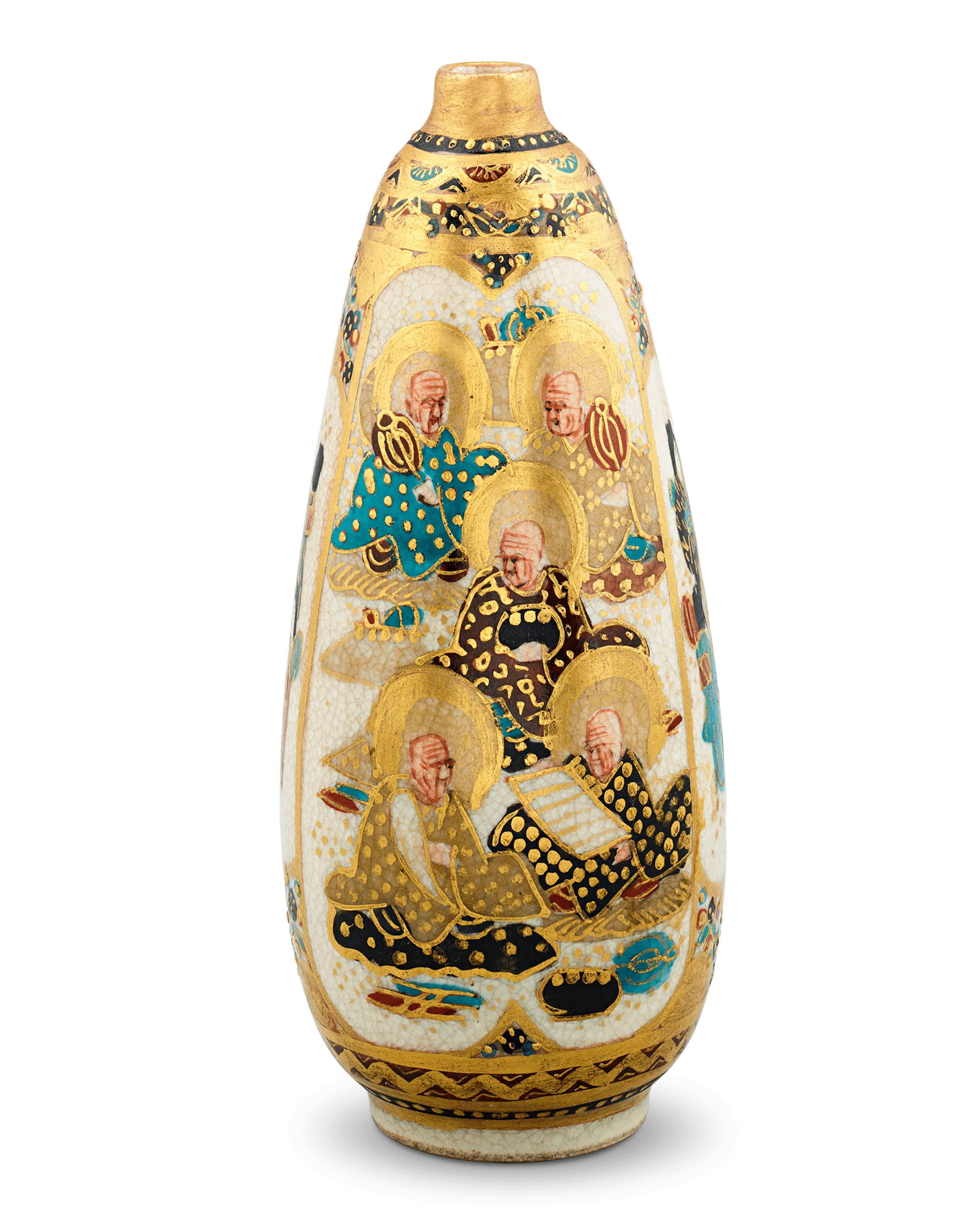
This Japanese Satsuma vase epitomizes the pinnacle of Japanese earthenware craftsmanship. Exquisitely hand-painted, it features a gathering of Buddhist monks adorned with gilded halos, which in Buddhist iconography signify enlightenment, divinity and spiritual importance. The vase is particularly impressive due to its small size, as the artist masterfully captures intricate details within the scene. Later scenes on Satsuma vessels often incorporate foreshortening to add depth, reflecting Western influence. The absence of foreshortening in this scene indicates its creation in the earlier Meiji period.
Legend holds that the finest Satsuma painters would go blind due to the extreme intricacy of their work, a testament to the meticulous detail exhibited in this pottery. The mark on the underside is typical of a Satsuma ware signature. The top circular symbol is the cross-in-circle Shimazu family crest, or mon, indicating this vase’s origin in the Satsuma Province. Below the crest are kanji characters for “Satsuma.”
Satsuma earthenware, a quintessential art form of the Meiji period, has captivated collectors for just over 150 years. First crafted in the 17th century, its distinctive style—featuring overglaze enamel and gilded detailing—was perfected around 1790. Early designs focused on nature, particularly floral and animal motifs, with architectural and human elements emerging in the 19th century.
Originating near Kagoshima Prefecture on Kyushu Island, Satsuma ware was initially created by Korean potters for the Shimazu family and local residents. Its popularity soared after being showcased at the 1867 Exposition Universelle in Paris. This exposure led to increased demand from the West, prompting production expansion to major Japanese cities like Kyoto, Osaka, Tokyo and Yokohama. The continued patronage of the Shimazu family further cemented Satsuma ware's success and global appeal.
Marked "Satsuma" with the Shimazu family crest
Meiji period (1868-1912)
3 3/4" high x 1 1/2" diameter
Legend holds that the finest Satsuma painters would go blind due to the extreme intricacy of their work, a testament to the meticulous detail exhibited in this pottery. The mark on the underside is typical of a Satsuma ware signature. The top circular symbol is the cross-in-circle Shimazu family crest, or mon, indicating this vase’s origin in the Satsuma Province. Below the crest are kanji characters for “Satsuma.”
Satsuma earthenware, a quintessential art form of the Meiji period, has captivated collectors for just over 150 years. First crafted in the 17th century, its distinctive style—featuring overglaze enamel and gilded detailing—was perfected around 1790. Early designs focused on nature, particularly floral and animal motifs, with architectural and human elements emerging in the 19th century.
Originating near Kagoshima Prefecture on Kyushu Island, Satsuma ware was initially created by Korean potters for the Shimazu family and local residents. Its popularity soared after being showcased at the 1867 Exposition Universelle in Paris. This exposure led to increased demand from the West, prompting production expansion to major Japanese cities like Kyoto, Osaka, Tokyo and Yokohama. The continued patronage of the Shimazu family further cemented Satsuma ware's success and global appeal.
Marked "Satsuma" with the Shimazu family crest
Meiji period (1868-1912)
3 3/4" high x 1 1/2" diameter
This Japanese Satsuma vase epitomizes the pinnacle of Japanese earthenware craftsmanship. Exquisitely hand-painted, it features a gathering of Buddhist monks adorned with gilded halos, which in Buddhist iconography signify enlightenment, divinity and spiritual importance. The vase is particularly impressive due to its small size, as the artist masterfully captures intricate details within the scene. Later scenes on Satsuma vessels often incorporate foreshortening to add depth, reflecting Western influence. The absence of foreshortening in this scene indicates its creation in the earlier Meiji period.
Legend holds that the finest Satsuma painters would go blind due to the extreme intricacy of their work, a testament to the meticulous detail exhibited in this pottery. The mark on the underside is typical of a Satsuma ware signature. The top circular symbol is the cross-in-circle Shimazu family crest, or mon, indicating this vase’s origin in the Satsuma Province. Below the crest are kanji characters for “Satsuma.”
Satsuma earthenware, a quintessential art form of the Meiji period, has captivated collectors for just over 150 years. First crafted in the 17th century, its distinctive style—featuring overglaze enamel and gilded detailing—was perfected around 1790. Early designs focused on nature, particularly floral and animal motifs, with architectural and human elements emerging in the 19th century.
Originating near Kagoshima Prefecture on Kyushu Island, Satsuma ware was initially created by Korean potters for the Shimazu family and local residents. Its popularity soared after being showcased at the 1867 Exposition Universelle in Paris. This exposure led to increased demand from the West, prompting production expansion to major Japanese cities like Kyoto, Osaka, Tokyo and Yokohama. The continued patronage of the Shimazu family further cemented Satsuma ware's success and global appeal.
Marked "Satsuma" with the Shimazu family crest
Meiji period (1868-1912)
3 3/4" high x 1 1/2" diameter
Legend holds that the finest Satsuma painters would go blind due to the extreme intricacy of their work, a testament to the meticulous detail exhibited in this pottery. The mark on the underside is typical of a Satsuma ware signature. The top circular symbol is the cross-in-circle Shimazu family crest, or mon, indicating this vase’s origin in the Satsuma Province. Below the crest are kanji characters for “Satsuma.”
Satsuma earthenware, a quintessential art form of the Meiji period, has captivated collectors for just over 150 years. First crafted in the 17th century, its distinctive style—featuring overglaze enamel and gilded detailing—was perfected around 1790. Early designs focused on nature, particularly floral and animal motifs, with architectural and human elements emerging in the 19th century.
Originating near Kagoshima Prefecture on Kyushu Island, Satsuma ware was initially created by Korean potters for the Shimazu family and local residents. Its popularity soared after being showcased at the 1867 Exposition Universelle in Paris. This exposure led to increased demand from the West, prompting production expansion to major Japanese cities like Kyoto, Osaka, Tokyo and Yokohama. The continued patronage of the Shimazu family further cemented Satsuma ware's success and global appeal.
Marked "Satsuma" with the Shimazu family crest
Meiji period (1868-1912)
3 3/4" high x 1 1/2" diameter
$694.75
Original: $1,985.00
-65%Satsuma Vase with Monks—
$1,985.00
$694.75Description
This Japanese Satsuma vase epitomizes the pinnacle of Japanese earthenware craftsmanship. Exquisitely hand-painted, it features a gathering of Buddhist monks adorned with gilded halos, which in Buddhist iconography signify enlightenment, divinity and spiritual importance. The vase is particularly impressive due to its small size, as the artist masterfully captures intricate details within the scene. Later scenes on Satsuma vessels often incorporate foreshortening to add depth, reflecting Western influence. The absence of foreshortening in this scene indicates its creation in the earlier Meiji period.
Legend holds that the finest Satsuma painters would go blind due to the extreme intricacy of their work, a testament to the meticulous detail exhibited in this pottery. The mark on the underside is typical of a Satsuma ware signature. The top circular symbol is the cross-in-circle Shimazu family crest, or mon, indicating this vase’s origin in the Satsuma Province. Below the crest are kanji characters for “Satsuma.”
Satsuma earthenware, a quintessential art form of the Meiji period, has captivated collectors for just over 150 years. First crafted in the 17th century, its distinctive style—featuring overglaze enamel and gilded detailing—was perfected around 1790. Early designs focused on nature, particularly floral and animal motifs, with architectural and human elements emerging in the 19th century.
Originating near Kagoshima Prefecture on Kyushu Island, Satsuma ware was initially created by Korean potters for the Shimazu family and local residents. Its popularity soared after being showcased at the 1867 Exposition Universelle in Paris. This exposure led to increased demand from the West, prompting production expansion to major Japanese cities like Kyoto, Osaka, Tokyo and Yokohama. The continued patronage of the Shimazu family further cemented Satsuma ware's success and global appeal.
Marked "Satsuma" with the Shimazu family crest
Meiji period (1868-1912)
3 3/4" high x 1 1/2" diameter
Legend holds that the finest Satsuma painters would go blind due to the extreme intricacy of their work, a testament to the meticulous detail exhibited in this pottery. The mark on the underside is typical of a Satsuma ware signature. The top circular symbol is the cross-in-circle Shimazu family crest, or mon, indicating this vase’s origin in the Satsuma Province. Below the crest are kanji characters for “Satsuma.”
Satsuma earthenware, a quintessential art form of the Meiji period, has captivated collectors for just over 150 years. First crafted in the 17th century, its distinctive style—featuring overglaze enamel and gilded detailing—was perfected around 1790. Early designs focused on nature, particularly floral and animal motifs, with architectural and human elements emerging in the 19th century.
Originating near Kagoshima Prefecture on Kyushu Island, Satsuma ware was initially created by Korean potters for the Shimazu family and local residents. Its popularity soared after being showcased at the 1867 Exposition Universelle in Paris. This exposure led to increased demand from the West, prompting production expansion to major Japanese cities like Kyoto, Osaka, Tokyo and Yokohama. The continued patronage of the Shimazu family further cemented Satsuma ware's success and global appeal.
Marked "Satsuma" with the Shimazu family crest
Meiji period (1868-1912)
3 3/4" high x 1 1/2" diameter