1 / 3
Specimen Table Attributed to William Trotter
Octagonal Specimen Table
William Trotter
Early 19th Century
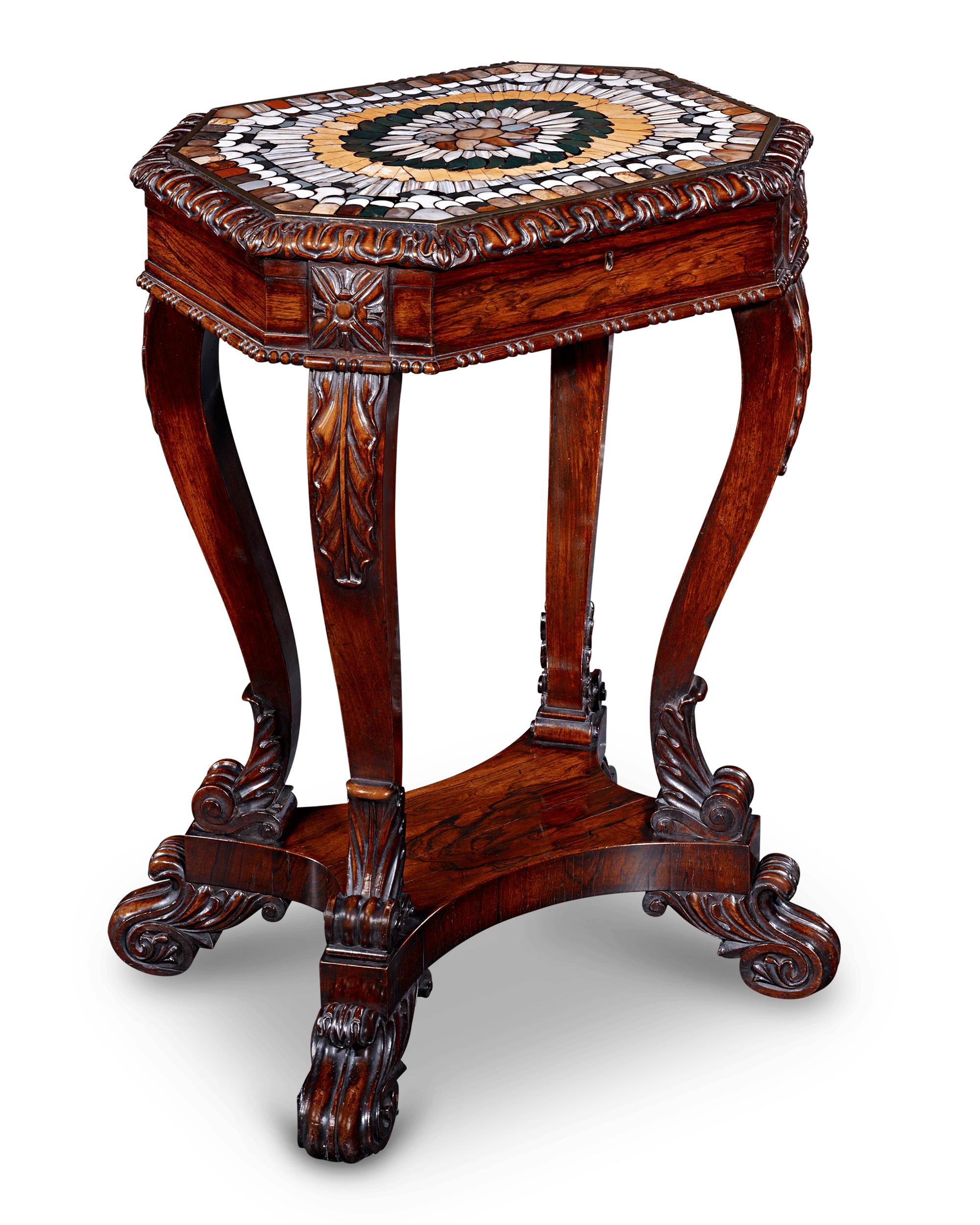
This extraordinary early 19th-century Scottish specimen table is a museum-quality masterpiece attributed to William Trotter of Edinburgh, who is widely regarded as Scotland’s greatest cabinetmaker. The octagonal top is exquisitely inlaid with agate, jasper and rare Scottish hardstones, arranged in a striking pattern reminiscent of a stunning plume of feathers. The result is a remarkable fusion of geometric precision and the natural beauty of indigenous minerals. It is among the most important Scottish specimen tables ever made, and no other like it is known to exist.
A finely carved foliate border in richly figured rosewood frames the top, enhancing its ornamental elegance. The vibrant gemstones are fitted with precision, reflecting a masterful command of both materials and technique. The table is supported by a well-balanced base and remains in untouched “country house” condition, a rare and desirable state that speaks to its long history and impeccable provenance.
William Trotter (1772–1833) was the preeminent cabinetmaker of the Scottish Regency period and served as Lord Provost of Edinburgh from 1825 to 1827. He established his firm on Princes Street in 1805 and supplied furnishings to Scotland’s most distinguished estates, as well as to the Royal Collection. His work is instantly recognizable for its refined lines and commanding presence. This table stands among the finest examples of his output, combining superior craftsmanship with exceptional materials in a work of singular historical and artistic importance.
28 3/4" high x 20 1/2" wide x 16 1/2" deep
William Trotter
Early 19th Century
This extraordinary early 19th-century Scottish specimen table is a museum-quality masterpiece attributed to William Trotter of Edinburgh, who is widely regarded as Scotland’s greatest cabinetmaker. The octagonal top is exquisitely inlaid with agate, jasper and rare Scottish hardstones, arranged in a striking pattern reminiscent of a stunning plume of feathers. The result is a remarkable fusion of geometric precision and the natural beauty of indigenous minerals. It is among the most important Scottish specimen tables ever made, and no other like it is known to exist.
A finely carved foliate border in richly figured rosewood frames the top, enhancing its ornamental elegance. The vibrant gemstones are fitted with precision, reflecting a masterful command of both materials and technique. The table is supported by a well-balanced base and remains in untouched “country house” condition, a rare and desirable state that speaks to its long history and impeccable provenance.
William Trotter (1772–1833) was the preeminent cabinetmaker of the Scottish Regency period and served as Lord Provost of Edinburgh from 1825 to 1827. He established his firm on Princes Street in 1805 and supplied furnishings to Scotland’s most distinguished estates, as well as to the Royal Collection. His work is instantly recognizable for its refined lines and commanding presence. This table stands among the finest examples of his output, combining superior craftsmanship with exceptional materials in a work of singular historical and artistic importance.
28 3/4" high x 20 1/2" wide x 16 1/2" deep
Octagonal Specimen Table
William Trotter
Early 19th Century
This extraordinary early 19th-century Scottish specimen table is a museum-quality masterpiece attributed to William Trotter of Edinburgh, who is widely regarded as Scotland’s greatest cabinetmaker. The octagonal top is exquisitely inlaid with agate, jasper and rare Scottish hardstones, arranged in a striking pattern reminiscent of a stunning plume of feathers. The result is a remarkable fusion of geometric precision and the natural beauty of indigenous minerals. It is among the most important Scottish specimen tables ever made, and no other like it is known to exist.
A finely carved foliate border in richly figured rosewood frames the top, enhancing its ornamental elegance. The vibrant gemstones are fitted with precision, reflecting a masterful command of both materials and technique. The table is supported by a well-balanced base and remains in untouched “country house” condition, a rare and desirable state that speaks to its long history and impeccable provenance.
William Trotter (1772–1833) was the preeminent cabinetmaker of the Scottish Regency period and served as Lord Provost of Edinburgh from 1825 to 1827. He established his firm on Princes Street in 1805 and supplied furnishings to Scotland’s most distinguished estates, as well as to the Royal Collection. His work is instantly recognizable for its refined lines and commanding presence. This table stands among the finest examples of his output, combining superior craftsmanship with exceptional materials in a work of singular historical and artistic importance.
28 3/4" high x 20 1/2" wide x 16 1/2" deep
William Trotter
Early 19th Century
This extraordinary early 19th-century Scottish specimen table is a museum-quality masterpiece attributed to William Trotter of Edinburgh, who is widely regarded as Scotland’s greatest cabinetmaker. The octagonal top is exquisitely inlaid with agate, jasper and rare Scottish hardstones, arranged in a striking pattern reminiscent of a stunning plume of feathers. The result is a remarkable fusion of geometric precision and the natural beauty of indigenous minerals. It is among the most important Scottish specimen tables ever made, and no other like it is known to exist.
A finely carved foliate border in richly figured rosewood frames the top, enhancing its ornamental elegance. The vibrant gemstones are fitted with precision, reflecting a masterful command of both materials and technique. The table is supported by a well-balanced base and remains in untouched “country house” condition, a rare and desirable state that speaks to its long history and impeccable provenance.
William Trotter (1772–1833) was the preeminent cabinetmaker of the Scottish Regency period and served as Lord Provost of Edinburgh from 1825 to 1827. He established his firm on Princes Street in 1805 and supplied furnishings to Scotland’s most distinguished estates, as well as to the Royal Collection. His work is instantly recognizable for its refined lines and commanding presence. This table stands among the finest examples of his output, combining superior craftsmanship with exceptional materials in a work of singular historical and artistic importance.
28 3/4" high x 20 1/2" wide x 16 1/2" deep
$17,097.50
Original: $48,850.00
-65%Specimen Table Attributed to William Trotter—
$48,850.00
$17,097.50Description
Octagonal Specimen Table
William Trotter
Early 19th Century
This extraordinary early 19th-century Scottish specimen table is a museum-quality masterpiece attributed to William Trotter of Edinburgh, who is widely regarded as Scotland’s greatest cabinetmaker. The octagonal top is exquisitely inlaid with agate, jasper and rare Scottish hardstones, arranged in a striking pattern reminiscent of a stunning plume of feathers. The result is a remarkable fusion of geometric precision and the natural beauty of indigenous minerals. It is among the most important Scottish specimen tables ever made, and no other like it is known to exist.
A finely carved foliate border in richly figured rosewood frames the top, enhancing its ornamental elegance. The vibrant gemstones are fitted with precision, reflecting a masterful command of both materials and technique. The table is supported by a well-balanced base and remains in untouched “country house” condition, a rare and desirable state that speaks to its long history and impeccable provenance.
William Trotter (1772–1833) was the preeminent cabinetmaker of the Scottish Regency period and served as Lord Provost of Edinburgh from 1825 to 1827. He established his firm on Princes Street in 1805 and supplied furnishings to Scotland’s most distinguished estates, as well as to the Royal Collection. His work is instantly recognizable for its refined lines and commanding presence. This table stands among the finest examples of his output, combining superior craftsmanship with exceptional materials in a work of singular historical and artistic importance.
28 3/4" high x 20 1/2" wide x 16 1/2" deep
William Trotter
Early 19th Century
This extraordinary early 19th-century Scottish specimen table is a museum-quality masterpiece attributed to William Trotter of Edinburgh, who is widely regarded as Scotland’s greatest cabinetmaker. The octagonal top is exquisitely inlaid with agate, jasper and rare Scottish hardstones, arranged in a striking pattern reminiscent of a stunning plume of feathers. The result is a remarkable fusion of geometric precision and the natural beauty of indigenous minerals. It is among the most important Scottish specimen tables ever made, and no other like it is known to exist.
A finely carved foliate border in richly figured rosewood frames the top, enhancing its ornamental elegance. The vibrant gemstones are fitted with precision, reflecting a masterful command of both materials and technique. The table is supported by a well-balanced base and remains in untouched “country house” condition, a rare and desirable state that speaks to its long history and impeccable provenance.
William Trotter (1772–1833) was the preeminent cabinetmaker of the Scottish Regency period and served as Lord Provost of Edinburgh from 1825 to 1827. He established his firm on Princes Street in 1805 and supplied furnishings to Scotland’s most distinguished estates, as well as to the Royal Collection. His work is instantly recognizable for its refined lines and commanding presence. This table stands among the finest examples of his output, combining superior craftsmanship with exceptional materials in a work of singular historical and artistic importance.
28 3/4" high x 20 1/2" wide x 16 1/2" deep