1 / 5
Thomas Webb & Sons Tri-Color Cameo Vase
Of all the glassworks produced in the late 19th century, cameo glass was the most challenging to perfect. Only a handful of artisans succeeded in mastering this intricate craft, with the firm of Thomas Webb & Sons standing out as the most accomplished. Webb’s cameo masterpieces surpassed those of their major French contemporaries in finesse and artistry. At Webb & Sons, the renowned brothers Thomas and George Woodall managed the cameo glass operations, ensuring the creation of glassworks that were exceptionally exquisite and rarely seen on the market today.
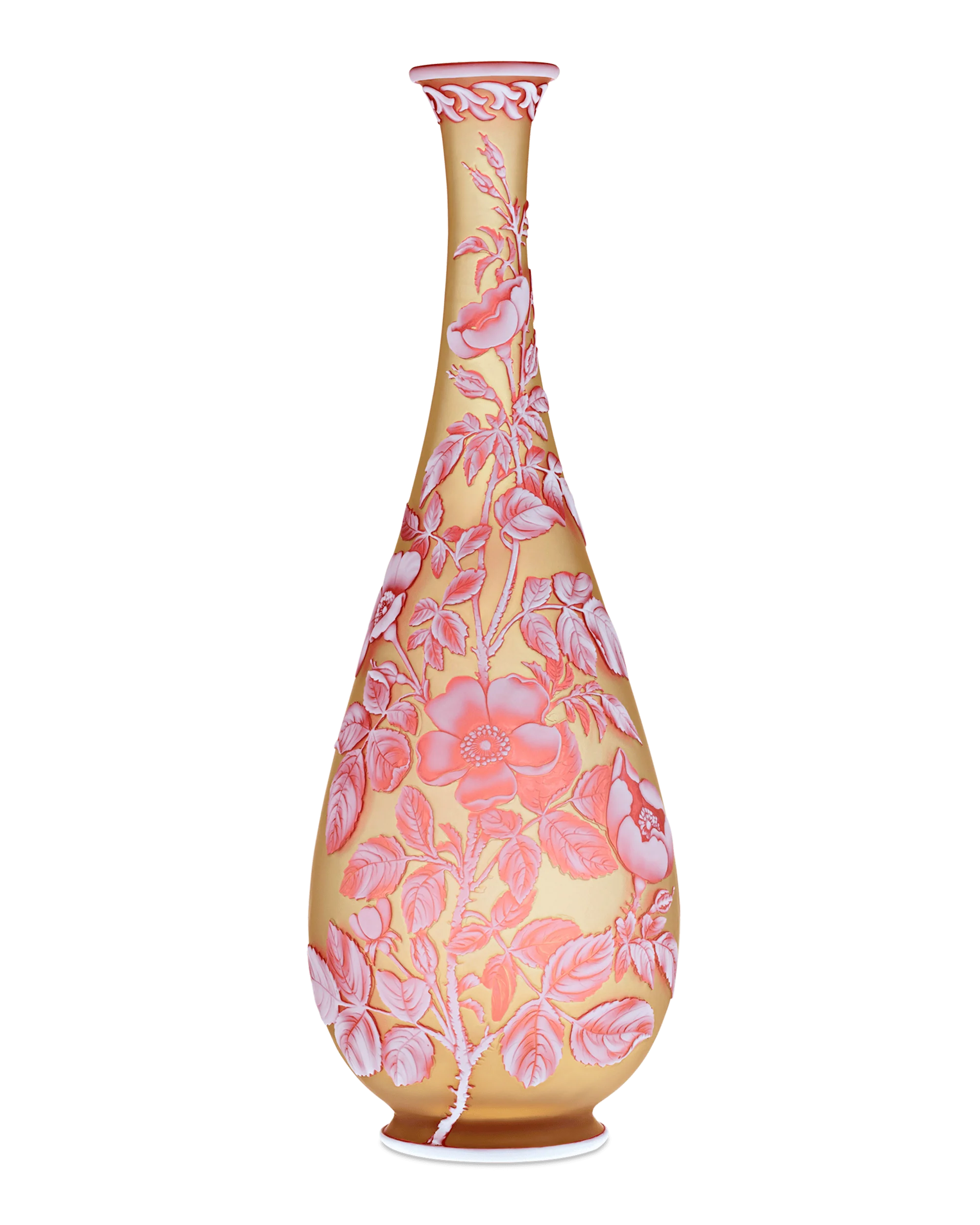
This intricately crafted bottle vase exemplifies Thomas Webb & Sons' unparalleled expertise. The slender vase stands gracefully, overlaid in translucent red and opaque white, and carved through to the amber yellow glass beneath. The delicately hand-carved rose branch motif wraps beautifully around the body of the vase, with the charming surprise of a butterfly fluttering across the back of the vase.
Born into a lineage of glassmakers, Thomas Wilkes Webb founded Thomas Webb & Sons in 1837, revolutionizing the market with high-quality engraved crystal and colored glass. His significant contributions earned him the title of Chevalier of the Legion of Honor, and the company gained renown as "The Crystal King of England." After his death in 1869, his sons Thomas, Charles, and Walter further elevated the company by improving working conditions and fostering creativity among their craftsmen. They hired notable artisans Thomas and his brother George Woodall, as well as art director James O’Fallon, who played pivotal roles in developing new cameo glass designs. The Woodall brothers, the master cameo artists, were instrumental in the success of Thomas Webb & Sons.
Circa 1884
10 3/4” high x 3 1/2” diameter
Provenance:
Leo Kaplan Antiques, New York (by 1982)
Private collection, New York
M.S. Rau, New Orleans
Literature:
A photograph of the present vase features in a Thomas Webb & Sons sales catalogue, circa 1884-1886, reproduced in Woodall Perry (cited below). In the photograph the vase is labeled L407, which the author suggests may be for Lionel Pearce
Sidney M. Goldstein, Cameo Glass: Masterpieces from 2000 Years of Glassmaking, Corning 1982, pp. 87, 122, no. 109, illustrated (as probably Thomas Webb & Sons, one of a pair)
Christopher Woodall Perry, The Cameo Glass of George Woodall, Shepton Beauchamp 2000, p. 26, illustrated
Exhibited:
New York, The Corning Museum of Glass, Cameo Glass: Masterpieces from 2000 Years of Glassmaking, May 1-October 31, 1982, no. 109
This intricately crafted bottle vase exemplifies Thomas Webb & Sons' unparalleled expertise. The slender vase stands gracefully, overlaid in translucent red and opaque white, and carved through to the amber yellow glass beneath. The delicately hand-carved rose branch motif wraps beautifully around the body of the vase, with the charming surprise of a butterfly fluttering across the back of the vase.
Born into a lineage of glassmakers, Thomas Wilkes Webb founded Thomas Webb & Sons in 1837, revolutionizing the market with high-quality engraved crystal and colored glass. His significant contributions earned him the title of Chevalier of the Legion of Honor, and the company gained renown as "The Crystal King of England." After his death in 1869, his sons Thomas, Charles, and Walter further elevated the company by improving working conditions and fostering creativity among their craftsmen. They hired notable artisans Thomas and his brother George Woodall, as well as art director James O’Fallon, who played pivotal roles in developing new cameo glass designs. The Woodall brothers, the master cameo artists, were instrumental in the success of Thomas Webb & Sons.
Circa 1884
10 3/4” high x 3 1/2” diameter
Provenance:
Leo Kaplan Antiques, New York (by 1982)
Private collection, New York
M.S. Rau, New Orleans
Literature:
A photograph of the present vase features in a Thomas Webb & Sons sales catalogue, circa 1884-1886, reproduced in Woodall Perry (cited below). In the photograph the vase is labeled L407, which the author suggests may be for Lionel Pearce
Sidney M. Goldstein, Cameo Glass: Masterpieces from 2000 Years of Glassmaking, Corning 1982, pp. 87, 122, no. 109, illustrated (as probably Thomas Webb & Sons, one of a pair)
Christopher Woodall Perry, The Cameo Glass of George Woodall, Shepton Beauchamp 2000, p. 26, illustrated
Exhibited:
New York, The Corning Museum of Glass, Cameo Glass: Masterpieces from 2000 Years of Glassmaking, May 1-October 31, 1982, no. 109
Of all the glassworks produced in the late 19th century, cameo glass was the most challenging to perfect. Only a handful of artisans succeeded in mastering this intricate craft, with the firm of Thomas Webb & Sons standing out as the most accomplished. Webb’s cameo masterpieces surpassed those of their major French contemporaries in finesse and artistry. At Webb & Sons, the renowned brothers Thomas and George Woodall managed the cameo glass operations, ensuring the creation of glassworks that were exceptionally exquisite and rarely seen on the market today.
This intricately crafted bottle vase exemplifies Thomas Webb & Sons' unparalleled expertise. The slender vase stands gracefully, overlaid in translucent red and opaque white, and carved through to the amber yellow glass beneath. The delicately hand-carved rose branch motif wraps beautifully around the body of the vase, with the charming surprise of a butterfly fluttering across the back of the vase.
Born into a lineage of glassmakers, Thomas Wilkes Webb founded Thomas Webb & Sons in 1837, revolutionizing the market with high-quality engraved crystal and colored glass. His significant contributions earned him the title of Chevalier of the Legion of Honor, and the company gained renown as "The Crystal King of England." After his death in 1869, his sons Thomas, Charles, and Walter further elevated the company by improving working conditions and fostering creativity among their craftsmen. They hired notable artisans Thomas and his brother George Woodall, as well as art director James O’Fallon, who played pivotal roles in developing new cameo glass designs. The Woodall brothers, the master cameo artists, were instrumental in the success of Thomas Webb & Sons.
Circa 1884
10 3/4” high x 3 1/2” diameter
Provenance:
Leo Kaplan Antiques, New York (by 1982)
Private collection, New York
M.S. Rau, New Orleans
Literature:
A photograph of the present vase features in a Thomas Webb & Sons sales catalogue, circa 1884-1886, reproduced in Woodall Perry (cited below). In the photograph the vase is labeled L407, which the author suggests may be for Lionel Pearce
Sidney M. Goldstein, Cameo Glass: Masterpieces from 2000 Years of Glassmaking, Corning 1982, pp. 87, 122, no. 109, illustrated (as probably Thomas Webb & Sons, one of a pair)
Christopher Woodall Perry, The Cameo Glass of George Woodall, Shepton Beauchamp 2000, p. 26, illustrated
Exhibited:
New York, The Corning Museum of Glass, Cameo Glass: Masterpieces from 2000 Years of Glassmaking, May 1-October 31, 1982, no. 109
This intricately crafted bottle vase exemplifies Thomas Webb & Sons' unparalleled expertise. The slender vase stands gracefully, overlaid in translucent red and opaque white, and carved through to the amber yellow glass beneath. The delicately hand-carved rose branch motif wraps beautifully around the body of the vase, with the charming surprise of a butterfly fluttering across the back of the vase.
Born into a lineage of glassmakers, Thomas Wilkes Webb founded Thomas Webb & Sons in 1837, revolutionizing the market with high-quality engraved crystal and colored glass. His significant contributions earned him the title of Chevalier of the Legion of Honor, and the company gained renown as "The Crystal King of England." After his death in 1869, his sons Thomas, Charles, and Walter further elevated the company by improving working conditions and fostering creativity among their craftsmen. They hired notable artisans Thomas and his brother George Woodall, as well as art director James O’Fallon, who played pivotal roles in developing new cameo glass designs. The Woodall brothers, the master cameo artists, were instrumental in the success of Thomas Webb & Sons.
Circa 1884
10 3/4” high x 3 1/2” diameter
Provenance:
Leo Kaplan Antiques, New York (by 1982)
Private collection, New York
M.S. Rau, New Orleans
Literature:
A photograph of the present vase features in a Thomas Webb & Sons sales catalogue, circa 1884-1886, reproduced in Woodall Perry (cited below). In the photograph the vase is labeled L407, which the author suggests may be for Lionel Pearce
Sidney M. Goldstein, Cameo Glass: Masterpieces from 2000 Years of Glassmaking, Corning 1982, pp. 87, 122, no. 109, illustrated (as probably Thomas Webb & Sons, one of a pair)
Christopher Woodall Perry, The Cameo Glass of George Woodall, Shepton Beauchamp 2000, p. 26, illustrated
Exhibited:
New York, The Corning Museum of Glass, Cameo Glass: Masterpieces from 2000 Years of Glassmaking, May 1-October 31, 1982, no. 109
$18,850.00
Thomas Webb & Sons Tri-Color Cameo Vase—
$18,850.00
Description
Of all the glassworks produced in the late 19th century, cameo glass was the most challenging to perfect. Only a handful of artisans succeeded in mastering this intricate craft, with the firm of Thomas Webb & Sons standing out as the most accomplished. Webb’s cameo masterpieces surpassed those of their major French contemporaries in finesse and artistry. At Webb & Sons, the renowned brothers Thomas and George Woodall managed the cameo glass operations, ensuring the creation of glassworks that were exceptionally exquisite and rarely seen on the market today.
This intricately crafted bottle vase exemplifies Thomas Webb & Sons' unparalleled expertise. The slender vase stands gracefully, overlaid in translucent red and opaque white, and carved through to the amber yellow glass beneath. The delicately hand-carved rose branch motif wraps beautifully around the body of the vase, with the charming surprise of a butterfly fluttering across the back of the vase.
Born into a lineage of glassmakers, Thomas Wilkes Webb founded Thomas Webb & Sons in 1837, revolutionizing the market with high-quality engraved crystal and colored glass. His significant contributions earned him the title of Chevalier of the Legion of Honor, and the company gained renown as "The Crystal King of England." After his death in 1869, his sons Thomas, Charles, and Walter further elevated the company by improving working conditions and fostering creativity among their craftsmen. They hired notable artisans Thomas and his brother George Woodall, as well as art director James O’Fallon, who played pivotal roles in developing new cameo glass designs. The Woodall brothers, the master cameo artists, were instrumental in the success of Thomas Webb & Sons.
Circa 1884
10 3/4” high x 3 1/2” diameter
Provenance:
Leo Kaplan Antiques, New York (by 1982)
Private collection, New York
M.S. Rau, New Orleans
Literature:
A photograph of the present vase features in a Thomas Webb & Sons sales catalogue, circa 1884-1886, reproduced in Woodall Perry (cited below). In the photograph the vase is labeled L407, which the author suggests may be for Lionel Pearce
Sidney M. Goldstein, Cameo Glass: Masterpieces from 2000 Years of Glassmaking, Corning 1982, pp. 87, 122, no. 109, illustrated (as probably Thomas Webb & Sons, one of a pair)
Christopher Woodall Perry, The Cameo Glass of George Woodall, Shepton Beauchamp 2000, p. 26, illustrated
Exhibited:
New York, The Corning Museum of Glass, Cameo Glass: Masterpieces from 2000 Years of Glassmaking, May 1-October 31, 1982, no. 109
This intricately crafted bottle vase exemplifies Thomas Webb & Sons' unparalleled expertise. The slender vase stands gracefully, overlaid in translucent red and opaque white, and carved through to the amber yellow glass beneath. The delicately hand-carved rose branch motif wraps beautifully around the body of the vase, with the charming surprise of a butterfly fluttering across the back of the vase.
Born into a lineage of glassmakers, Thomas Wilkes Webb founded Thomas Webb & Sons in 1837, revolutionizing the market with high-quality engraved crystal and colored glass. His significant contributions earned him the title of Chevalier of the Legion of Honor, and the company gained renown as "The Crystal King of England." After his death in 1869, his sons Thomas, Charles, and Walter further elevated the company by improving working conditions and fostering creativity among their craftsmen. They hired notable artisans Thomas and his brother George Woodall, as well as art director James O’Fallon, who played pivotal roles in developing new cameo glass designs. The Woodall brothers, the master cameo artists, were instrumental in the success of Thomas Webb & Sons.
Circa 1884
10 3/4” high x 3 1/2” diameter
Provenance:
Leo Kaplan Antiques, New York (by 1982)
Private collection, New York
M.S. Rau, New Orleans
Literature:
A photograph of the present vase features in a Thomas Webb & Sons sales catalogue, circa 1884-1886, reproduced in Woodall Perry (cited below). In the photograph the vase is labeled L407, which the author suggests may be for Lionel Pearce
Sidney M. Goldstein, Cameo Glass: Masterpieces from 2000 Years of Glassmaking, Corning 1982, pp. 87, 122, no. 109, illustrated (as probably Thomas Webb & Sons, one of a pair)
Christopher Woodall Perry, The Cameo Glass of George Woodall, Shepton Beauchamp 2000, p. 26, illustrated
Exhibited:
New York, The Corning Museum of Glass, Cameo Glass: Masterpieces from 2000 Years of Glassmaking, May 1-October 31, 1982, no. 109