1 / 6
+1
Vase anémones et citrons, draperie by Louis Valtat
Louis Valtat
1869-1952 | French
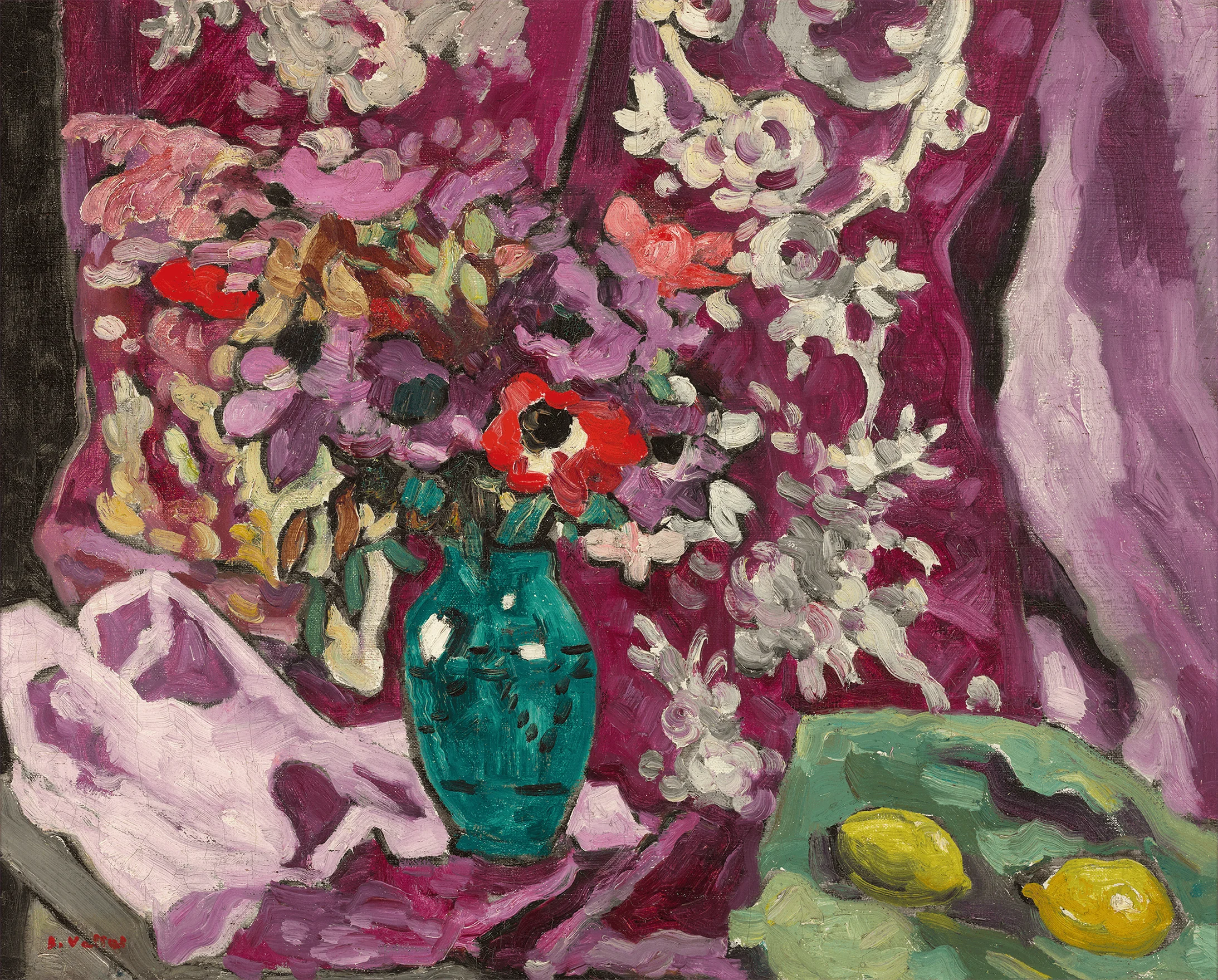
Vase anémones et citrons, draperie
(Vase with Anemones and Lemons, Drapery)
Signed "L. Valtat" (lower left)
Oil on canvas
Extraordinarily vibrant, this magnificent still life is an exceptional example of Louis Valtat's mesmerizing style. Valtat was celebrated for his refreshing take on this traditional genre, and his iconic depictions of flowers are among his most coveted works. Here, a bouquet springs to life in jewel-toned brilliance, with its blooms marvelously echoed in the drapery's elaborate pattern. Reminiscent in its boldness to the works of Vincent van Gogh and Paul Cézanne, Vase anémones et citrons, draperie displays the artist's virtuoso and visionary Post-Impressionist style.
Born in Normandy in 1869, Valtat enrolled at the École des Beaux-Arts at the age of 17, where he studied under the great French figure painters Gustave Boulanger and Jules Lefebvre. There, he began his association with several artists who would influence the trajectory of his career, including Henri Matisse, Édouard Vuillard, Pierre Bonnard, Paul Signac and Pierre-Auguste Renoir, with whom he remained lifelong friends.
Renoir introduced Valtat’s works to Ambroise Vollard, the renowned art dealer. Vollard identified Valtat as one of the most exciting painters working in Paris at the turn of the 20th century. On Renoir’s advice, Vollard made an agreement with Valtat to purchase almost all of the artist’s work for the first decade of the 20th century (1902 – 1912), becoming his dealer and agent.
The relationship was a fruitful one; Vollard went on to organize Valtat’s first solo exhibition at his gallery and submitted Valtat’s works to other exhibitions in Paris. Throughout his career, the artist remained true to his unique style. He was never completely associated with a particular art movement, but is remembered for his crucial influence on early Fauvism. Today, similar works by Valtat are found in important collections around the world, including the Art Institute of Chicago, the Musée d'Orsay and many others.
Painted 1934
Canvas: 25" high x 31" wide (63.50 x 78.74 cm)
Frame: 35" high x 41" wide x 3 1/2" deep (88.90 x 104.14 x 8.89 cm)
Provenance:
Private Collection, New York
M.S. Rau, New Orleans
Literature:
Jean Valtat, Louis Valtat: Catalogue de l'Oeuvre Peint, 1869-1952, vol. I, Paris, 1977, no. 2332, p. 260 (illustrated)
1869-1952 | French
Vase anémones et citrons, draperie
(Vase with Anemones and Lemons, Drapery)
Signed "L. Valtat" (lower left)
Oil on canvas
Extraordinarily vibrant, this magnificent still life is an exceptional example of Louis Valtat's mesmerizing style. Valtat was celebrated for his refreshing take on this traditional genre, and his iconic depictions of flowers are among his most coveted works. Here, a bouquet springs to life in jewel-toned brilliance, with its blooms marvelously echoed in the drapery's elaborate pattern. Reminiscent in its boldness to the works of Vincent van Gogh and Paul Cézanne, Vase anémones et citrons, draperie displays the artist's virtuoso and visionary Post-Impressionist style.
Born in Normandy in 1869, Valtat enrolled at the École des Beaux-Arts at the age of 17, where he studied under the great French figure painters Gustave Boulanger and Jules Lefebvre. There, he began his association with several artists who would influence the trajectory of his career, including Henri Matisse, Édouard Vuillard, Pierre Bonnard, Paul Signac and Pierre-Auguste Renoir, with whom he remained lifelong friends.
Renoir introduced Valtat’s works to Ambroise Vollard, the renowned art dealer. Vollard identified Valtat as one of the most exciting painters working in Paris at the turn of the 20th century. On Renoir’s advice, Vollard made an agreement with Valtat to purchase almost all of the artist’s work for the first decade of the 20th century (1902 – 1912), becoming his dealer and agent.
The relationship was a fruitful one; Vollard went on to organize Valtat’s first solo exhibition at his gallery and submitted Valtat’s works to other exhibitions in Paris. Throughout his career, the artist remained true to his unique style. He was never completely associated with a particular art movement, but is remembered for his crucial influence on early Fauvism. Today, similar works by Valtat are found in important collections around the world, including the Art Institute of Chicago, the Musée d'Orsay and many others.
Painted 1934
Canvas: 25" high x 31" wide (63.50 x 78.74 cm)
Frame: 35" high x 41" wide x 3 1/2" deep (88.90 x 104.14 x 8.89 cm)
Provenance:
Private Collection, New York
M.S. Rau, New Orleans
Literature:
Jean Valtat, Louis Valtat: Catalogue de l'Oeuvre Peint, 1869-1952, vol. I, Paris, 1977, no. 2332, p. 260 (illustrated)
Louis Valtat
1869-1952 | French
Vase anémones et citrons, draperie
(Vase with Anemones and Lemons, Drapery)
Signed "L. Valtat" (lower left)
Oil on canvas
Extraordinarily vibrant, this magnificent still life is an exceptional example of Louis Valtat's mesmerizing style. Valtat was celebrated for his refreshing take on this traditional genre, and his iconic depictions of flowers are among his most coveted works. Here, a bouquet springs to life in jewel-toned brilliance, with its blooms marvelously echoed in the drapery's elaborate pattern. Reminiscent in its boldness to the works of Vincent van Gogh and Paul Cézanne, Vase anémones et citrons, draperie displays the artist's virtuoso and visionary Post-Impressionist style.
Born in Normandy in 1869, Valtat enrolled at the École des Beaux-Arts at the age of 17, where he studied under the great French figure painters Gustave Boulanger and Jules Lefebvre. There, he began his association with several artists who would influence the trajectory of his career, including Henri Matisse, Édouard Vuillard, Pierre Bonnard, Paul Signac and Pierre-Auguste Renoir, with whom he remained lifelong friends.
Renoir introduced Valtat’s works to Ambroise Vollard, the renowned art dealer. Vollard identified Valtat as one of the most exciting painters working in Paris at the turn of the 20th century. On Renoir’s advice, Vollard made an agreement with Valtat to purchase almost all of the artist’s work for the first decade of the 20th century (1902 – 1912), becoming his dealer and agent.
The relationship was a fruitful one; Vollard went on to organize Valtat’s first solo exhibition at his gallery and submitted Valtat’s works to other exhibitions in Paris. Throughout his career, the artist remained true to his unique style. He was never completely associated with a particular art movement, but is remembered for his crucial influence on early Fauvism. Today, similar works by Valtat are found in important collections around the world, including the Art Institute of Chicago, the Musée d'Orsay and many others.
Painted 1934
Canvas: 25" high x 31" wide (63.50 x 78.74 cm)
Frame: 35" high x 41" wide x 3 1/2" deep (88.90 x 104.14 x 8.89 cm)
Provenance:
Private Collection, New York
M.S. Rau, New Orleans
Literature:
Jean Valtat, Louis Valtat: Catalogue de l'Oeuvre Peint, 1869-1952, vol. I, Paris, 1977, no. 2332, p. 260 (illustrated)
1869-1952 | French
Vase anémones et citrons, draperie
(Vase with Anemones and Lemons, Drapery)
Signed "L. Valtat" (lower left)
Oil on canvas
Extraordinarily vibrant, this magnificent still life is an exceptional example of Louis Valtat's mesmerizing style. Valtat was celebrated for his refreshing take on this traditional genre, and his iconic depictions of flowers are among his most coveted works. Here, a bouquet springs to life in jewel-toned brilliance, with its blooms marvelously echoed in the drapery's elaborate pattern. Reminiscent in its boldness to the works of Vincent van Gogh and Paul Cézanne, Vase anémones et citrons, draperie displays the artist's virtuoso and visionary Post-Impressionist style.
Born in Normandy in 1869, Valtat enrolled at the École des Beaux-Arts at the age of 17, where he studied under the great French figure painters Gustave Boulanger and Jules Lefebvre. There, he began his association with several artists who would influence the trajectory of his career, including Henri Matisse, Édouard Vuillard, Pierre Bonnard, Paul Signac and Pierre-Auguste Renoir, with whom he remained lifelong friends.
Renoir introduced Valtat’s works to Ambroise Vollard, the renowned art dealer. Vollard identified Valtat as one of the most exciting painters working in Paris at the turn of the 20th century. On Renoir’s advice, Vollard made an agreement with Valtat to purchase almost all of the artist’s work for the first decade of the 20th century (1902 – 1912), becoming his dealer and agent.
The relationship was a fruitful one; Vollard went on to organize Valtat’s first solo exhibition at his gallery and submitted Valtat’s works to other exhibitions in Paris. Throughout his career, the artist remained true to his unique style. He was never completely associated with a particular art movement, but is remembered for his crucial influence on early Fauvism. Today, similar works by Valtat are found in important collections around the world, including the Art Institute of Chicago, the Musée d'Orsay and many others.
Painted 1934
Canvas: 25" high x 31" wide (63.50 x 78.74 cm)
Frame: 35" high x 41" wide x 3 1/2" deep (88.90 x 104.14 x 8.89 cm)
Provenance:
Private Collection, New York
M.S. Rau, New Orleans
Literature:
Jean Valtat, Louis Valtat: Catalogue de l'Oeuvre Peint, 1869-1952, vol. I, Paris, 1977, no. 2332, p. 260 (illustrated)
$65,975.00
Original: $188,500.00
-65%Vase anémones et citrons, draperie by Louis Valtat—
$188,500.00
$65,975.00Description
Louis Valtat
1869-1952 | French
Vase anémones et citrons, draperie
(Vase with Anemones and Lemons, Drapery)
Signed "L. Valtat" (lower left)
Oil on canvas
Extraordinarily vibrant, this magnificent still life is an exceptional example of Louis Valtat's mesmerizing style. Valtat was celebrated for his refreshing take on this traditional genre, and his iconic depictions of flowers are among his most coveted works. Here, a bouquet springs to life in jewel-toned brilliance, with its blooms marvelously echoed in the drapery's elaborate pattern. Reminiscent in its boldness to the works of Vincent van Gogh and Paul Cézanne, Vase anémones et citrons, draperie displays the artist's virtuoso and visionary Post-Impressionist style.
Born in Normandy in 1869, Valtat enrolled at the École des Beaux-Arts at the age of 17, where he studied under the great French figure painters Gustave Boulanger and Jules Lefebvre. There, he began his association with several artists who would influence the trajectory of his career, including Henri Matisse, Édouard Vuillard, Pierre Bonnard, Paul Signac and Pierre-Auguste Renoir, with whom he remained lifelong friends.
Renoir introduced Valtat’s works to Ambroise Vollard, the renowned art dealer. Vollard identified Valtat as one of the most exciting painters working in Paris at the turn of the 20th century. On Renoir’s advice, Vollard made an agreement with Valtat to purchase almost all of the artist’s work for the first decade of the 20th century (1902 – 1912), becoming his dealer and agent.
The relationship was a fruitful one; Vollard went on to organize Valtat’s first solo exhibition at his gallery and submitted Valtat’s works to other exhibitions in Paris. Throughout his career, the artist remained true to his unique style. He was never completely associated with a particular art movement, but is remembered for his crucial influence on early Fauvism. Today, similar works by Valtat are found in important collections around the world, including the Art Institute of Chicago, the Musée d'Orsay and many others.
Painted 1934
Canvas: 25" high x 31" wide (63.50 x 78.74 cm)
Frame: 35" high x 41" wide x 3 1/2" deep (88.90 x 104.14 x 8.89 cm)
Provenance:
Private Collection, New York
M.S. Rau, New Orleans
Literature:
Jean Valtat, Louis Valtat: Catalogue de l'Oeuvre Peint, 1869-1952, vol. I, Paris, 1977, no. 2332, p. 260 (illustrated)
1869-1952 | French
Vase anémones et citrons, draperie
(Vase with Anemones and Lemons, Drapery)
Signed "L. Valtat" (lower left)
Oil on canvas
Extraordinarily vibrant, this magnificent still life is an exceptional example of Louis Valtat's mesmerizing style. Valtat was celebrated for his refreshing take on this traditional genre, and his iconic depictions of flowers are among his most coveted works. Here, a bouquet springs to life in jewel-toned brilliance, with its blooms marvelously echoed in the drapery's elaborate pattern. Reminiscent in its boldness to the works of Vincent van Gogh and Paul Cézanne, Vase anémones et citrons, draperie displays the artist's virtuoso and visionary Post-Impressionist style.
Born in Normandy in 1869, Valtat enrolled at the École des Beaux-Arts at the age of 17, where he studied under the great French figure painters Gustave Boulanger and Jules Lefebvre. There, he began his association with several artists who would influence the trajectory of his career, including Henri Matisse, Édouard Vuillard, Pierre Bonnard, Paul Signac and Pierre-Auguste Renoir, with whom he remained lifelong friends.
Renoir introduced Valtat’s works to Ambroise Vollard, the renowned art dealer. Vollard identified Valtat as one of the most exciting painters working in Paris at the turn of the 20th century. On Renoir’s advice, Vollard made an agreement with Valtat to purchase almost all of the artist’s work for the first decade of the 20th century (1902 – 1912), becoming his dealer and agent.
The relationship was a fruitful one; Vollard went on to organize Valtat’s first solo exhibition at his gallery and submitted Valtat’s works to other exhibitions in Paris. Throughout his career, the artist remained true to his unique style. He was never completely associated with a particular art movement, but is remembered for his crucial influence on early Fauvism. Today, similar works by Valtat are found in important collections around the world, including the Art Institute of Chicago, the Musée d'Orsay and many others.
Painted 1934
Canvas: 25" high x 31" wide (63.50 x 78.74 cm)
Frame: 35" high x 41" wide x 3 1/2" deep (88.90 x 104.14 x 8.89 cm)
Provenance:
Private Collection, New York
M.S. Rau, New Orleans
Literature:
Jean Valtat, Louis Valtat: Catalogue de l'Oeuvre Peint, 1869-1952, vol. I, Paris, 1977, no. 2332, p. 260 (illustrated)