1 / 6
+1
Venus of Philae by Henry Roderick Newman
Henry Roderick Newman
1843-1917 | American
Venus of Philae
Signed, dated and inscribed lower left
Watercolor on paper
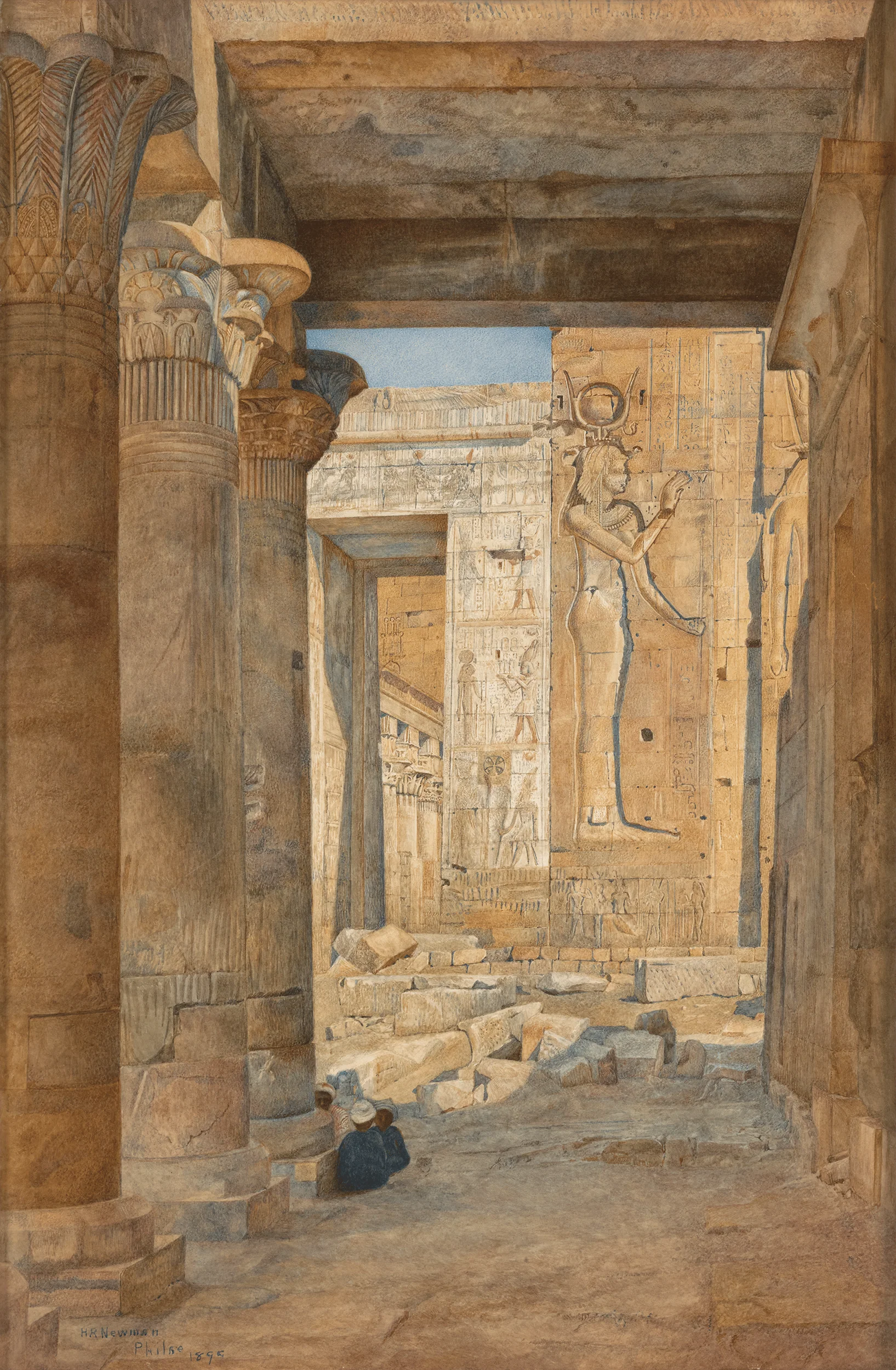
A masterwork of American Pre-Raphaelite painting, Venus of Philae captures Henry Roderick Newman's meticulous architectural rendering and profound understanding of ancient Egyptian sacred spaces. Painted during the artist's winter sojourn to Egypt in 1899, this luminous watercolor transports viewers into the hallowed hypostyle hall of the Temple of Isis at Philae, one of antiquity's most revered sanctuaries and a site that captivated 19th-century travelers and artists alike.
Newman's composition draws the eye through towering columns adorned with lotus and papyrus capitals, their surfaces bearing carved hieroglyphics and relief sculptures proclaiming Isis's divine power. The artist renders the temple interior with extraordinary precision, capturing shadow and light filtering through ancient stones. Warm ochres and tans dominate the palette, punctuated by deep blue Egyptian sky, while a small figure in dark robes provides scale and emphasizes the architecture's monumentality.
The "Venus" reference in the work's title is somewhat misleading, as this is actually the Temple of Isis, not Venus, the Roman goddess of love. However, during the 19th century, Isis was sometimes identified with Venus/Aphrodite due to their shared associations with femininity, beauty and divine power.
Henry Roderick Newman stands as one of the most accomplished self-taught artists of the American Pre-Raphaelite movement. Born in Easton, New York, Newman initially pursued medicine but devoted himself entirely to painting following his father's death in 1861. After establishing his reputation at the National Academy of Design, Newman relocated to Florence in 1872, developing his signature architectural style inspired by Giotto and Fra Angelico. Beginning in 1887, Newman spent each winter in Egypt, drawn to ancient monuments and crystalline light. His Egyptian watercolors combine archaeological precision with poetic sensibility. A closely related painting of the same subject is held in the collection of the Metropolitan Museum of Art, while other works by Newman reside in many of the world’s most esteemed institutions.
Dated 1899
Paper: 25 1/2" high x 16 5/8" wide (64.77 x 42.23 cm)
Frame: 34 1/2" high x 25 1/2" wide x x1 1/4" deep (87.63 x 64.77 x 3.18 cm)
1843-1917 | American
Venus of Philae
Signed, dated and inscribed lower left
Watercolor on paper
A masterwork of American Pre-Raphaelite painting, Venus of Philae captures Henry Roderick Newman's meticulous architectural rendering and profound understanding of ancient Egyptian sacred spaces. Painted during the artist's winter sojourn to Egypt in 1899, this luminous watercolor transports viewers into the hallowed hypostyle hall of the Temple of Isis at Philae, one of antiquity's most revered sanctuaries and a site that captivated 19th-century travelers and artists alike.
Newman's composition draws the eye through towering columns adorned with lotus and papyrus capitals, their surfaces bearing carved hieroglyphics and relief sculptures proclaiming Isis's divine power. The artist renders the temple interior with extraordinary precision, capturing shadow and light filtering through ancient stones. Warm ochres and tans dominate the palette, punctuated by deep blue Egyptian sky, while a small figure in dark robes provides scale and emphasizes the architecture's monumentality.
The "Venus" reference in the work's title is somewhat misleading, as this is actually the Temple of Isis, not Venus, the Roman goddess of love. However, during the 19th century, Isis was sometimes identified with Venus/Aphrodite due to their shared associations with femininity, beauty and divine power.
Henry Roderick Newman stands as one of the most accomplished self-taught artists of the American Pre-Raphaelite movement. Born in Easton, New York, Newman initially pursued medicine but devoted himself entirely to painting following his father's death in 1861. After establishing his reputation at the National Academy of Design, Newman relocated to Florence in 1872, developing his signature architectural style inspired by Giotto and Fra Angelico. Beginning in 1887, Newman spent each winter in Egypt, drawn to ancient monuments and crystalline light. His Egyptian watercolors combine archaeological precision with poetic sensibility. A closely related painting of the same subject is held in the collection of the Metropolitan Museum of Art, while other works by Newman reside in many of the world’s most esteemed institutions.
Dated 1899
Paper: 25 1/2" high x 16 5/8" wide (64.77 x 42.23 cm)
Frame: 34 1/2" high x 25 1/2" wide x x1 1/4" deep (87.63 x 64.77 x 3.18 cm)
Henry Roderick Newman
1843-1917 | American
Venus of Philae
Signed, dated and inscribed lower left
Watercolor on paper
A masterwork of American Pre-Raphaelite painting, Venus of Philae captures Henry Roderick Newman's meticulous architectural rendering and profound understanding of ancient Egyptian sacred spaces. Painted during the artist's winter sojourn to Egypt in 1899, this luminous watercolor transports viewers into the hallowed hypostyle hall of the Temple of Isis at Philae, one of antiquity's most revered sanctuaries and a site that captivated 19th-century travelers and artists alike.
Newman's composition draws the eye through towering columns adorned with lotus and papyrus capitals, their surfaces bearing carved hieroglyphics and relief sculptures proclaiming Isis's divine power. The artist renders the temple interior with extraordinary precision, capturing shadow and light filtering through ancient stones. Warm ochres and tans dominate the palette, punctuated by deep blue Egyptian sky, while a small figure in dark robes provides scale and emphasizes the architecture's monumentality.
The "Venus" reference in the work's title is somewhat misleading, as this is actually the Temple of Isis, not Venus, the Roman goddess of love. However, during the 19th century, Isis was sometimes identified with Venus/Aphrodite due to their shared associations with femininity, beauty and divine power.
Henry Roderick Newman stands as one of the most accomplished self-taught artists of the American Pre-Raphaelite movement. Born in Easton, New York, Newman initially pursued medicine but devoted himself entirely to painting following his father's death in 1861. After establishing his reputation at the National Academy of Design, Newman relocated to Florence in 1872, developing his signature architectural style inspired by Giotto and Fra Angelico. Beginning in 1887, Newman spent each winter in Egypt, drawn to ancient monuments and crystalline light. His Egyptian watercolors combine archaeological precision with poetic sensibility. A closely related painting of the same subject is held in the collection of the Metropolitan Museum of Art, while other works by Newman reside in many of the world’s most esteemed institutions.
Dated 1899
Paper: 25 1/2" high x 16 5/8" wide (64.77 x 42.23 cm)
Frame: 34 1/2" high x 25 1/2" wide x x1 1/4" deep (87.63 x 64.77 x 3.18 cm)
1843-1917 | American
Venus of Philae
Signed, dated and inscribed lower left
Watercolor on paper
A masterwork of American Pre-Raphaelite painting, Venus of Philae captures Henry Roderick Newman's meticulous architectural rendering and profound understanding of ancient Egyptian sacred spaces. Painted during the artist's winter sojourn to Egypt in 1899, this luminous watercolor transports viewers into the hallowed hypostyle hall of the Temple of Isis at Philae, one of antiquity's most revered sanctuaries and a site that captivated 19th-century travelers and artists alike.
Newman's composition draws the eye through towering columns adorned with lotus and papyrus capitals, their surfaces bearing carved hieroglyphics and relief sculptures proclaiming Isis's divine power. The artist renders the temple interior with extraordinary precision, capturing shadow and light filtering through ancient stones. Warm ochres and tans dominate the palette, punctuated by deep blue Egyptian sky, while a small figure in dark robes provides scale and emphasizes the architecture's monumentality.
The "Venus" reference in the work's title is somewhat misleading, as this is actually the Temple of Isis, not Venus, the Roman goddess of love. However, during the 19th century, Isis was sometimes identified with Venus/Aphrodite due to their shared associations with femininity, beauty and divine power.
Henry Roderick Newman stands as one of the most accomplished self-taught artists of the American Pre-Raphaelite movement. Born in Easton, New York, Newman initially pursued medicine but devoted himself entirely to painting following his father's death in 1861. After establishing his reputation at the National Academy of Design, Newman relocated to Florence in 1872, developing his signature architectural style inspired by Giotto and Fra Angelico. Beginning in 1887, Newman spent each winter in Egypt, drawn to ancient monuments and crystalline light. His Egyptian watercolors combine archaeological precision with poetic sensibility. A closely related painting of the same subject is held in the collection of the Metropolitan Museum of Art, while other works by Newman reside in many of the world’s most esteemed institutions.
Dated 1899
Paper: 25 1/2" high x 16 5/8" wide (64.77 x 42.23 cm)
Frame: 34 1/2" high x 25 1/2" wide x x1 1/4" deep (87.63 x 64.77 x 3.18 cm)
$13,947.50
Original: $39,850.00
-65%Venus of Philae by Henry Roderick Newman—
$39,850.00
$13,947.50Description
Henry Roderick Newman
1843-1917 | American
Venus of Philae
Signed, dated and inscribed lower left
Watercolor on paper
A masterwork of American Pre-Raphaelite painting, Venus of Philae captures Henry Roderick Newman's meticulous architectural rendering and profound understanding of ancient Egyptian sacred spaces. Painted during the artist's winter sojourn to Egypt in 1899, this luminous watercolor transports viewers into the hallowed hypostyle hall of the Temple of Isis at Philae, one of antiquity's most revered sanctuaries and a site that captivated 19th-century travelers and artists alike.
Newman's composition draws the eye through towering columns adorned with lotus and papyrus capitals, their surfaces bearing carved hieroglyphics and relief sculptures proclaiming Isis's divine power. The artist renders the temple interior with extraordinary precision, capturing shadow and light filtering through ancient stones. Warm ochres and tans dominate the palette, punctuated by deep blue Egyptian sky, while a small figure in dark robes provides scale and emphasizes the architecture's monumentality.
The "Venus" reference in the work's title is somewhat misleading, as this is actually the Temple of Isis, not Venus, the Roman goddess of love. However, during the 19th century, Isis was sometimes identified with Venus/Aphrodite due to their shared associations with femininity, beauty and divine power.
Henry Roderick Newman stands as one of the most accomplished self-taught artists of the American Pre-Raphaelite movement. Born in Easton, New York, Newman initially pursued medicine but devoted himself entirely to painting following his father's death in 1861. After establishing his reputation at the National Academy of Design, Newman relocated to Florence in 1872, developing his signature architectural style inspired by Giotto and Fra Angelico. Beginning in 1887, Newman spent each winter in Egypt, drawn to ancient monuments and crystalline light. His Egyptian watercolors combine archaeological precision with poetic sensibility. A closely related painting of the same subject is held in the collection of the Metropolitan Museum of Art, while other works by Newman reside in many of the world’s most esteemed institutions.
Dated 1899
Paper: 25 1/2" high x 16 5/8" wide (64.77 x 42.23 cm)
Frame: 34 1/2" high x 25 1/2" wide x x1 1/4" deep (87.63 x 64.77 x 3.18 cm)
1843-1917 | American
Venus of Philae
Signed, dated and inscribed lower left
Watercolor on paper
A masterwork of American Pre-Raphaelite painting, Venus of Philae captures Henry Roderick Newman's meticulous architectural rendering and profound understanding of ancient Egyptian sacred spaces. Painted during the artist's winter sojourn to Egypt in 1899, this luminous watercolor transports viewers into the hallowed hypostyle hall of the Temple of Isis at Philae, one of antiquity's most revered sanctuaries and a site that captivated 19th-century travelers and artists alike.
Newman's composition draws the eye through towering columns adorned with lotus and papyrus capitals, their surfaces bearing carved hieroglyphics and relief sculptures proclaiming Isis's divine power. The artist renders the temple interior with extraordinary precision, capturing shadow and light filtering through ancient stones. Warm ochres and tans dominate the palette, punctuated by deep blue Egyptian sky, while a small figure in dark robes provides scale and emphasizes the architecture's monumentality.
The "Venus" reference in the work's title is somewhat misleading, as this is actually the Temple of Isis, not Venus, the Roman goddess of love. However, during the 19th century, Isis was sometimes identified with Venus/Aphrodite due to their shared associations with femininity, beauty and divine power.
Henry Roderick Newman stands as one of the most accomplished self-taught artists of the American Pre-Raphaelite movement. Born in Easton, New York, Newman initially pursued medicine but devoted himself entirely to painting following his father's death in 1861. After establishing his reputation at the National Academy of Design, Newman relocated to Florence in 1872, developing his signature architectural style inspired by Giotto and Fra Angelico. Beginning in 1887, Newman spent each winter in Egypt, drawn to ancient monuments and crystalline light. His Egyptian watercolors combine archaeological precision with poetic sensibility. A closely related painting of the same subject is held in the collection of the Metropolitan Museum of Art, while other works by Newman reside in many of the world’s most esteemed institutions.
Dated 1899
Paper: 25 1/2" high x 16 5/8" wide (64.77 x 42.23 cm)
Frame: 34 1/2" high x 25 1/2" wide x x1 1/4" deep (87.63 x 64.77 x 3.18 cm)