1 / 7
+2
Wedgwood Black Basalt Pastille Burner
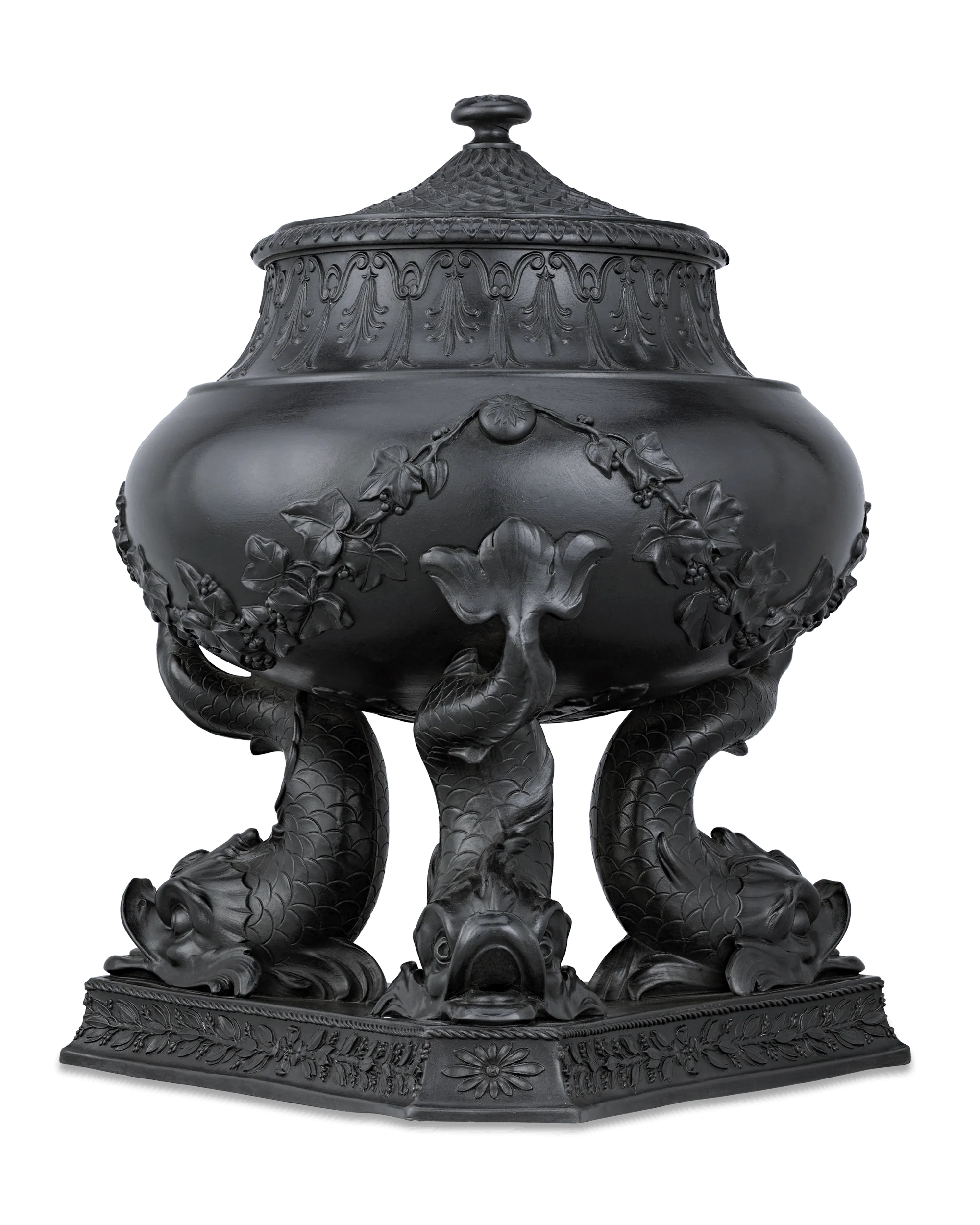
Wedgwood began crafting pastille burners in the early nineteenth century, and this stunning dolphin burner is a gorgeous example of his innovative design. The finely-pierced lid with trellis design, foliate swags and applied rosettes provide delicate, elegant texture and detail, in contrast to the solidity and stability of the black basalt. Pastille burners were used for burning cone-shaped “pastilles” of powdered willow-wood charcoal mixed with fragrant oils and gum arabic to overpower odors caused by poor ventilation and inadequate drains.
The graceful dolphin tripod shape was first introduced as an oil lamp and translated to the pastille burner around 1804. Earlier versions of the burner were crafted on a smaller scale, and this larger model was introduced at the request of the Bishop of Winchester, who wanted to burn many pastilles at once. The larger size serves to accentuate the dolphins’ graceful curves and intricately detailed decoration. A similar large pastille burner appears on page 452 of Wedgwood Vol. 2 by Robin Reilly.
Early 19th Century
Impressed uppercase mark
12 1/2” high x 9 4/5“ wide x 9 4/5" deep
Provenance: Muriel Polikoff, Philadelphia, PA, 1988.
The graceful dolphin tripod shape was first introduced as an oil lamp and translated to the pastille burner around 1804. Earlier versions of the burner were crafted on a smaller scale, and this larger model was introduced at the request of the Bishop of Winchester, who wanted to burn many pastilles at once. The larger size serves to accentuate the dolphins’ graceful curves and intricately detailed decoration. A similar large pastille burner appears on page 452 of Wedgwood Vol. 2 by Robin Reilly.
Early 19th Century
Impressed uppercase mark
12 1/2” high x 9 4/5“ wide x 9 4/5" deep
Provenance: Muriel Polikoff, Philadelphia, PA, 1988.
Wedgwood began crafting pastille burners in the early nineteenth century, and this stunning dolphin burner is a gorgeous example of his innovative design. The finely-pierced lid with trellis design, foliate swags and applied rosettes provide delicate, elegant texture and detail, in contrast to the solidity and stability of the black basalt. Pastille burners were used for burning cone-shaped “pastilles” of powdered willow-wood charcoal mixed with fragrant oils and gum arabic to overpower odors caused by poor ventilation and inadequate drains.
The graceful dolphin tripod shape was first introduced as an oil lamp and translated to the pastille burner around 1804. Earlier versions of the burner were crafted on a smaller scale, and this larger model was introduced at the request of the Bishop of Winchester, who wanted to burn many pastilles at once. The larger size serves to accentuate the dolphins’ graceful curves and intricately detailed decoration. A similar large pastille burner appears on page 452 of Wedgwood Vol. 2 by Robin Reilly.
Early 19th Century
Impressed uppercase mark
12 1/2” high x 9 4/5“ wide x 9 4/5" deep
Provenance: Muriel Polikoff, Philadelphia, PA, 1988.
The graceful dolphin tripod shape was first introduced as an oil lamp and translated to the pastille burner around 1804. Earlier versions of the burner were crafted on a smaller scale, and this larger model was introduced at the request of the Bishop of Winchester, who wanted to burn many pastilles at once. The larger size serves to accentuate the dolphins’ graceful curves and intricately detailed decoration. A similar large pastille burner appears on page 452 of Wedgwood Vol. 2 by Robin Reilly.
Early 19th Century
Impressed uppercase mark
12 1/2” high x 9 4/5“ wide x 9 4/5" deep
Provenance: Muriel Polikoff, Philadelphia, PA, 1988.
$12,850.00
Wedgwood Black Basalt Pastille Burner—
$12,850.00
Description
Wedgwood began crafting pastille burners in the early nineteenth century, and this stunning dolphin burner is a gorgeous example of his innovative design. The finely-pierced lid with trellis design, foliate swags and applied rosettes provide delicate, elegant texture and detail, in contrast to the solidity and stability of the black basalt. Pastille burners were used for burning cone-shaped “pastilles” of powdered willow-wood charcoal mixed with fragrant oils and gum arabic to overpower odors caused by poor ventilation and inadequate drains.
The graceful dolphin tripod shape was first introduced as an oil lamp and translated to the pastille burner around 1804. Earlier versions of the burner were crafted on a smaller scale, and this larger model was introduced at the request of the Bishop of Winchester, who wanted to burn many pastilles at once. The larger size serves to accentuate the dolphins’ graceful curves and intricately detailed decoration. A similar large pastille burner appears on page 452 of Wedgwood Vol. 2 by Robin Reilly.
Early 19th Century
Impressed uppercase mark
12 1/2” high x 9 4/5“ wide x 9 4/5" deep
Provenance: Muriel Polikoff, Philadelphia, PA, 1988.
The graceful dolphin tripod shape was first introduced as an oil lamp and translated to the pastille burner around 1804. Earlier versions of the burner were crafted on a smaller scale, and this larger model was introduced at the request of the Bishop of Winchester, who wanted to burn many pastilles at once. The larger size serves to accentuate the dolphins’ graceful curves and intricately detailed decoration. A similar large pastille burner appears on page 452 of Wedgwood Vol. 2 by Robin Reilly.
Early 19th Century
Impressed uppercase mark
12 1/2” high x 9 4/5“ wide x 9 4/5" deep
Provenance: Muriel Polikoff, Philadelphia, PA, 1988.