
1 / 6
+1
Pietre Dure Plaque of Village Children
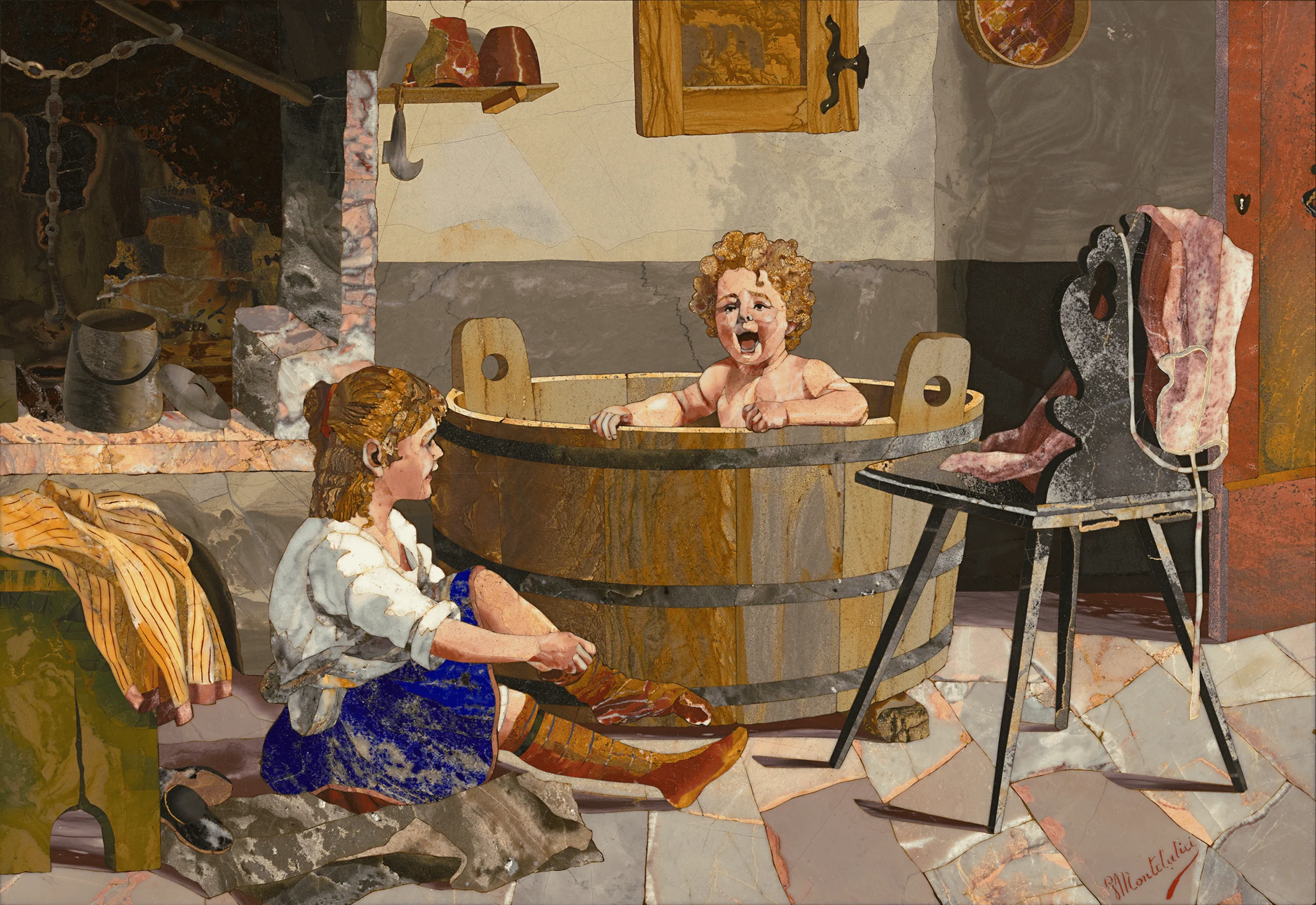
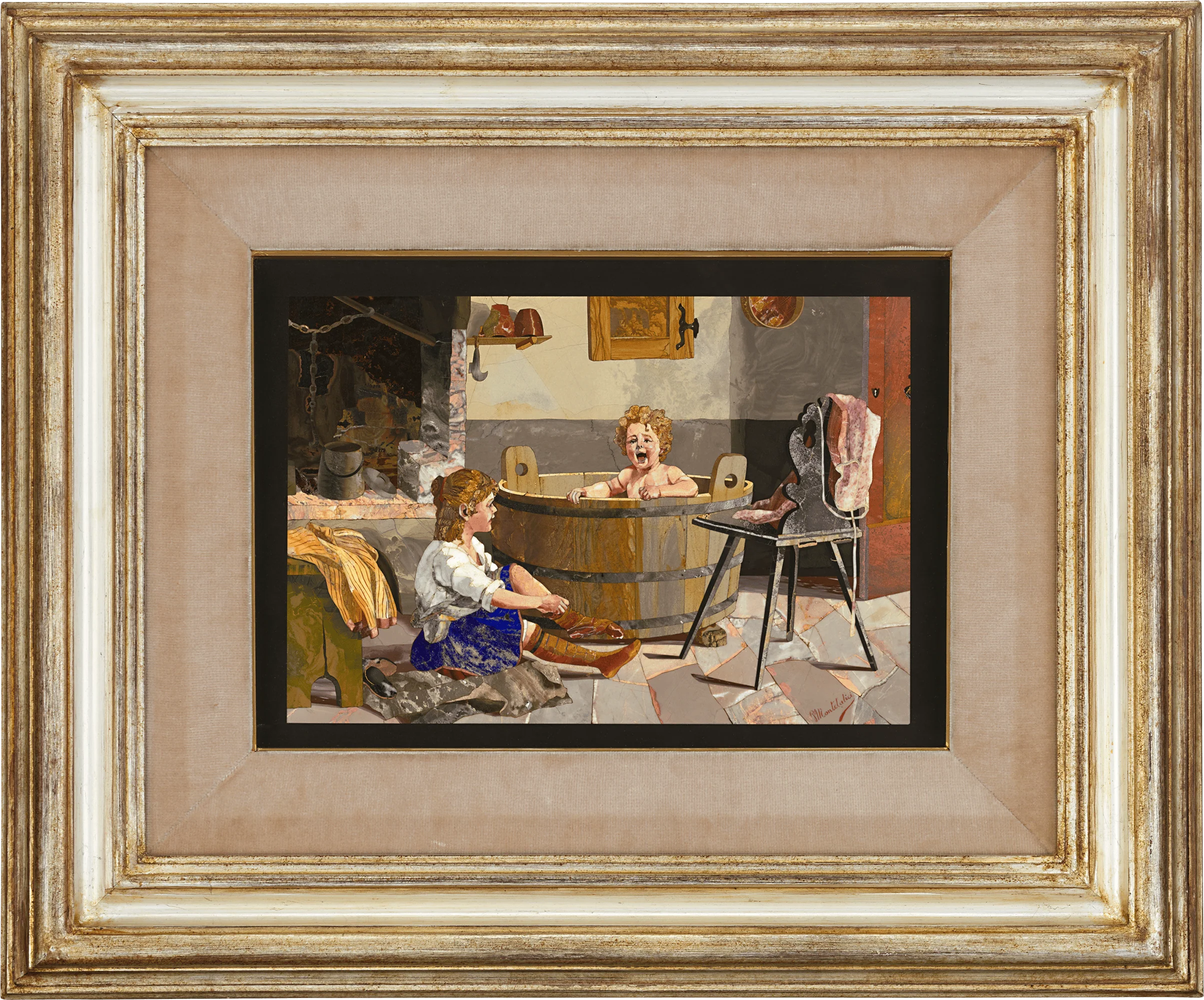
Magnificent and colorful, this enchanting Florentine work of art is not a painting, but upon closer inspection is revealed to be a superb example of the intensive art of pietre dure. Depicting a charming scene of a mother catching her children in the act of a mischievous prank. Rather than paint, this sumptuous piece uses hundreds of different kinds of polished marble and minerals to make this playful scene come to life. Each piece is carefully chosen for color and pattern, cut with the utmost precision and precisely inlaid onto a stone base, thereby creating an image of such beauty and skill as to have the perfect trompe l'oeil effect.
Pietre dure, also known as pietra dura, first developed in antiquity, and originally consisted of shaping stones with small saws, wires and other metal instruments and adding them to decorative objects such as vases or small sculptures. The art was revived during the Renaissance by Italian craftsmen, and the first hard-stone workshop was established by the Medici family in Florence in 1588. The art was also practiced at the courts of Naples, Madrid, Prague, Paris and elsewhere. The Italians were particularly fond of pietre dure and used the technique on everything from monumental cabinets to tiny boxes. From the late 16th century, the colorful stones were arranged on furniture as landscapes and flower scenes. These items were also popular with wealthy aristocrats making their Grand Tour through Italy in the 18th and 19th centuries, who bought them in droves and even sent larger pieces home.
The technique requires that fine marbles and stones be inlaid into a stone base. By using materials of varying colors, artisans were able to create patterns and pictures in much the same manner as a mosaic. The technique was expensive, requiring not only precious materials but also highly skilled craftsmen. As a result, many works were completed using imitation marble and are known as scagliola. True marble and stone pietre dure works such as this are very rare and highly collectible.
Signed "M Zaccagnini" (lower right)
Circa 1880
Plaque: 17" high x 22 1/4" wide (43.18 x 56.52 cm)
Frame: 22" high x 27 1/8" wide (55.88 x 68.9 cm)
Pietre dure, also known as pietra dura, first developed in antiquity, and originally consisted of shaping stones with small saws, wires and other metal instruments and adding them to decorative objects such as vases or small sculptures. The art was revived during the Renaissance by Italian craftsmen, and the first hard-stone workshop was established by the Medici family in Florence in 1588. The art was also practiced at the courts of Naples, Madrid, Prague, Paris and elsewhere. The Italians were particularly fond of pietre dure and used the technique on everything from monumental cabinets to tiny boxes. From the late 16th century, the colorful stones were arranged on furniture as landscapes and flower scenes. These items were also popular with wealthy aristocrats making their Grand Tour through Italy in the 18th and 19th centuries, who bought them in droves and even sent larger pieces home.
The technique requires that fine marbles and stones be inlaid into a stone base. By using materials of varying colors, artisans were able to create patterns and pictures in much the same manner as a mosaic. The technique was expensive, requiring not only precious materials but also highly skilled craftsmen. As a result, many works were completed using imitation marble and are known as scagliola. True marble and stone pietre dure works such as this are very rare and highly collectible.
Signed "M Zaccagnini" (lower right)
Circa 1880
Plaque: 17" high x 22 1/4" wide (43.18 x 56.52 cm)
Frame: 22" high x 27 1/8" wide (55.88 x 68.9 cm)
Magnificent and colorful, this enchanting Florentine work of art is not a painting, but upon closer inspection is revealed to be a superb example of the intensive art of pietre dure. Depicting a charming scene of a mother catching her children in the act of a mischievous prank. Rather than paint, this sumptuous piece uses hundreds of different kinds of polished marble and minerals to make this playful scene come to life. Each piece is carefully chosen for color and pattern, cut with the utmost precision and precisely inlaid onto a stone base, thereby creating an image of such beauty and skill as to have the perfect trompe l'oeil effect.
Pietre dure, also known as pietra dura, first developed in antiquity, and originally consisted of shaping stones with small saws, wires and other metal instruments and adding them to decorative objects such as vases or small sculptures. The art was revived during the Renaissance by Italian craftsmen, and the first hard-stone workshop was established by the Medici family in Florence in 1588. The art was also practiced at the courts of Naples, Madrid, Prague, Paris and elsewhere. The Italians were particularly fond of pietre dure and used the technique on everything from monumental cabinets to tiny boxes. From the late 16th century, the colorful stones were arranged on furniture as landscapes and flower scenes. These items were also popular with wealthy aristocrats making their Grand Tour through Italy in the 18th and 19th centuries, who bought them in droves and even sent larger pieces home.
The technique requires that fine marbles and stones be inlaid into a stone base. By using materials of varying colors, artisans were able to create patterns and pictures in much the same manner as a mosaic. The technique was expensive, requiring not only precious materials but also highly skilled craftsmen. As a result, many works were completed using imitation marble and are known as scagliola. True marble and stone pietre dure works such as this are very rare and highly collectible.
Signed "M Zaccagnini" (lower right)
Circa 1880
Plaque: 17" high x 22 1/4" wide (43.18 x 56.52 cm)
Frame: 22" high x 27 1/8" wide (55.88 x 68.9 cm)
Pietre dure, also known as pietra dura, first developed in antiquity, and originally consisted of shaping stones with small saws, wires and other metal instruments and adding them to decorative objects such as vases or small sculptures. The art was revived during the Renaissance by Italian craftsmen, and the first hard-stone workshop was established by the Medici family in Florence in 1588. The art was also practiced at the courts of Naples, Madrid, Prague, Paris and elsewhere. The Italians were particularly fond of pietre dure and used the technique on everything from monumental cabinets to tiny boxes. From the late 16th century, the colorful stones were arranged on furniture as landscapes and flower scenes. These items were also popular with wealthy aristocrats making their Grand Tour through Italy in the 18th and 19th centuries, who bought them in droves and even sent larger pieces home.
The technique requires that fine marbles and stones be inlaid into a stone base. By using materials of varying colors, artisans were able to create patterns and pictures in much the same manner as a mosaic. The technique was expensive, requiring not only precious materials but also highly skilled craftsmen. As a result, many works were completed using imitation marble and are known as scagliola. True marble and stone pietre dure works such as this are very rare and highly collectible.
Signed "M Zaccagnini" (lower right)
Circa 1880
Plaque: 17" high x 22 1/4" wide (43.18 x 56.52 cm)
Frame: 22" high x 27 1/8" wide (55.88 x 68.9 cm)
$98,500.00
Pietre Dure Plaque of Village Children—
$98,500.00
Description
Magnificent and colorful, this enchanting Florentine work of art is not a painting, but upon closer inspection is revealed to be a superb example of the intensive art of pietre dure. Depicting a charming scene of a mother catching her children in the act of a mischievous prank. Rather than paint, this sumptuous piece uses hundreds of different kinds of polished marble and minerals to make this playful scene come to life. Each piece is carefully chosen for color and pattern, cut with the utmost precision and precisely inlaid onto a stone base, thereby creating an image of such beauty and skill as to have the perfect trompe l'oeil effect.
Pietre dure, also known as pietra dura, first developed in antiquity, and originally consisted of shaping stones with small saws, wires and other metal instruments and adding them to decorative objects such as vases or small sculptures. The art was revived during the Renaissance by Italian craftsmen, and the first hard-stone workshop was established by the Medici family in Florence in 1588. The art was also practiced at the courts of Naples, Madrid, Prague, Paris and elsewhere. The Italians were particularly fond of pietre dure and used the technique on everything from monumental cabinets to tiny boxes. From the late 16th century, the colorful stones were arranged on furniture as landscapes and flower scenes. These items were also popular with wealthy aristocrats making their Grand Tour through Italy in the 18th and 19th centuries, who bought them in droves and even sent larger pieces home.
The technique requires that fine marbles and stones be inlaid into a stone base. By using materials of varying colors, artisans were able to create patterns and pictures in much the same manner as a mosaic. The technique was expensive, requiring not only precious materials but also highly skilled craftsmen. As a result, many works were completed using imitation marble and are known as scagliola. True marble and stone pietre dure works such as this are very rare and highly collectible.
Signed "M Zaccagnini" (lower right)
Circa 1880
Plaque: 17" high x 22 1/4" wide (43.18 x 56.52 cm)
Frame: 22" high x 27 1/8" wide (55.88 x 68.9 cm)
Pietre dure, also known as pietra dura, first developed in antiquity, and originally consisted of shaping stones with small saws, wires and other metal instruments and adding them to decorative objects such as vases or small sculptures. The art was revived during the Renaissance by Italian craftsmen, and the first hard-stone workshop was established by the Medici family in Florence in 1588. The art was also practiced at the courts of Naples, Madrid, Prague, Paris and elsewhere. The Italians were particularly fond of pietre dure and used the technique on everything from monumental cabinets to tiny boxes. From the late 16th century, the colorful stones were arranged on furniture as landscapes and flower scenes. These items were also popular with wealthy aristocrats making their Grand Tour through Italy in the 18th and 19th centuries, who bought them in droves and even sent larger pieces home.
The technique requires that fine marbles and stones be inlaid into a stone base. By using materials of varying colors, artisans were able to create patterns and pictures in much the same manner as a mosaic. The technique was expensive, requiring not only precious materials but also highly skilled craftsmen. As a result, many works were completed using imitation marble and are known as scagliola. True marble and stone pietre dure works such as this are very rare and highly collectible.
Signed "M Zaccagnini" (lower right)
Circa 1880
Plaque: 17" high x 22 1/4" wide (43.18 x 56.52 cm)
Frame: 22" high x 27 1/8" wide (55.88 x 68.9 cm)