
1 / 2
Georgian Silver Lemon Strainer by Patrick Robertson
Silver Lemon Strainer
Patrick Robertson
Hallmarked Edinburgh, 1780
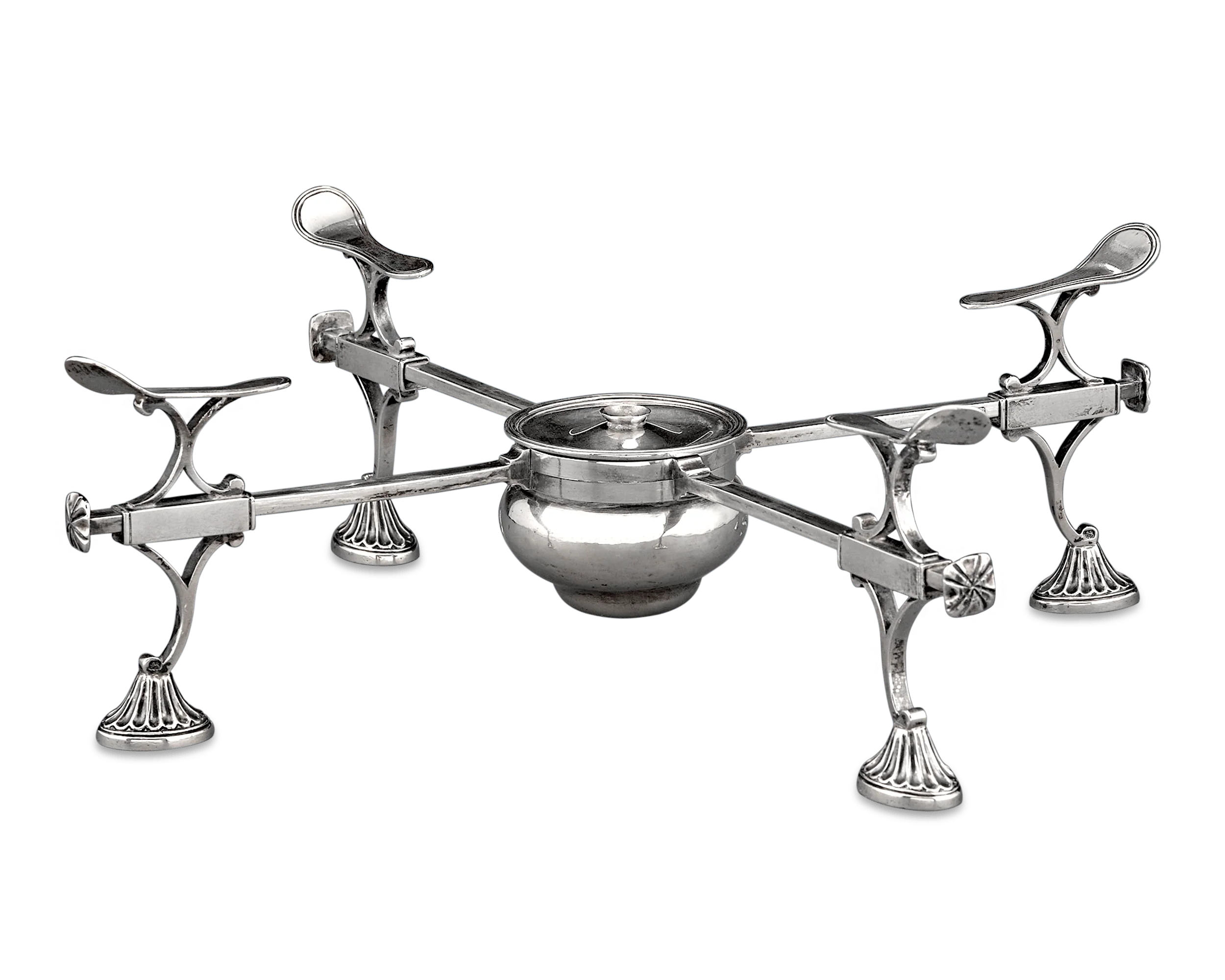
This exceptional silver lemon strainer, crafted by the renowned Edinburgh silversmith Patrick Robertson, was an essential companion to the punch bowl. In 18th-century Britain and Scotland, punch made with spirits had become a social staple, its name likely derived from the Hindi word for “five,” representing the five essential ingredients, including lemons. These strainers, with their elegantly shaped and extended handles, are wide enough to rest securely on the edges of a punch bowl, while the lemon juice passes through the delicately pierced holes, arranged in a striking blossom pattern.
Visually, the strainer’s refined design is a testament to both form and function. The handles’ graceful curves provide not only aesthetic appeal but also practical balance, allowing the strainer to sit comfortably over a punch bowl. The pierced blossom motif on the bowl surface adds an extra layer of artistry, turning a simple kitchen tool into a decorative item that enhances the serving experience.
Patrick Robertson, an esteemed Edinburgh silversmith born in 1729, apprenticed to Edward Lothian in 1743. He was a Deacon in 1755 and 1765, and a member of the Royal Company of Archers. Robertson’s craftsmanship reflects the highest standards of Georgian silversmithing, and his works are highly regarded for their beauty and precision. He was also related to the famous architect Robert Adam, further establishing his connection to Britain’s elite cultural circles.
1" high x 11" wide x 4" deep
Patrick Robertson
Hallmarked Edinburgh, 1780
This exceptional silver lemon strainer, crafted by the renowned Edinburgh silversmith Patrick Robertson, was an essential companion to the punch bowl. In 18th-century Britain and Scotland, punch made with spirits had become a social staple, its name likely derived from the Hindi word for “five,” representing the five essential ingredients, including lemons. These strainers, with their elegantly shaped and extended handles, are wide enough to rest securely on the edges of a punch bowl, while the lemon juice passes through the delicately pierced holes, arranged in a striking blossom pattern.
Visually, the strainer’s refined design is a testament to both form and function. The handles’ graceful curves provide not only aesthetic appeal but also practical balance, allowing the strainer to sit comfortably over a punch bowl. The pierced blossom motif on the bowl surface adds an extra layer of artistry, turning a simple kitchen tool into a decorative item that enhances the serving experience.
Patrick Robertson, an esteemed Edinburgh silversmith born in 1729, apprenticed to Edward Lothian in 1743. He was a Deacon in 1755 and 1765, and a member of the Royal Company of Archers. Robertson’s craftsmanship reflects the highest standards of Georgian silversmithing, and his works are highly regarded for their beauty and precision. He was also related to the famous architect Robert Adam, further establishing his connection to Britain’s elite cultural circles.
1" high x 11" wide x 4" deep
Silver Lemon Strainer
Patrick Robertson
Hallmarked Edinburgh, 1780
This exceptional silver lemon strainer, crafted by the renowned Edinburgh silversmith Patrick Robertson, was an essential companion to the punch bowl. In 18th-century Britain and Scotland, punch made with spirits had become a social staple, its name likely derived from the Hindi word for “five,” representing the five essential ingredients, including lemons. These strainers, with their elegantly shaped and extended handles, are wide enough to rest securely on the edges of a punch bowl, while the lemon juice passes through the delicately pierced holes, arranged in a striking blossom pattern.
Visually, the strainer’s refined design is a testament to both form and function. The handles’ graceful curves provide not only aesthetic appeal but also practical balance, allowing the strainer to sit comfortably over a punch bowl. The pierced blossom motif on the bowl surface adds an extra layer of artistry, turning a simple kitchen tool into a decorative item that enhances the serving experience.
Patrick Robertson, an esteemed Edinburgh silversmith born in 1729, apprenticed to Edward Lothian in 1743. He was a Deacon in 1755 and 1765, and a member of the Royal Company of Archers. Robertson’s craftsmanship reflects the highest standards of Georgian silversmithing, and his works are highly regarded for their beauty and precision. He was also related to the famous architect Robert Adam, further establishing his connection to Britain’s elite cultural circles.
1" high x 11" wide x 4" deep
Patrick Robertson
Hallmarked Edinburgh, 1780
This exceptional silver lemon strainer, crafted by the renowned Edinburgh silversmith Patrick Robertson, was an essential companion to the punch bowl. In 18th-century Britain and Scotland, punch made with spirits had become a social staple, its name likely derived from the Hindi word for “five,” representing the five essential ingredients, including lemons. These strainers, with their elegantly shaped and extended handles, are wide enough to rest securely on the edges of a punch bowl, while the lemon juice passes through the delicately pierced holes, arranged in a striking blossom pattern.
Visually, the strainer’s refined design is a testament to both form and function. The handles’ graceful curves provide not only aesthetic appeal but also practical balance, allowing the strainer to sit comfortably over a punch bowl. The pierced blossom motif on the bowl surface adds an extra layer of artistry, turning a simple kitchen tool into a decorative item that enhances the serving experience.
Patrick Robertson, an esteemed Edinburgh silversmith born in 1729, apprenticed to Edward Lothian in 1743. He was a Deacon in 1755 and 1765, and a member of the Royal Company of Archers. Robertson’s craftsmanship reflects the highest standards of Georgian silversmithing, and his works are highly regarded for their beauty and precision. He was also related to the famous architect Robert Adam, further establishing his connection to Britain’s elite cultural circles.
1" high x 11" wide x 4" deep
$659.75
Original: $1,885.00
-65%Georgian Silver Lemon Strainer by Patrick Robertson—
$1,885.00
$659.75Description
Silver Lemon Strainer
Patrick Robertson
Hallmarked Edinburgh, 1780
This exceptional silver lemon strainer, crafted by the renowned Edinburgh silversmith Patrick Robertson, was an essential companion to the punch bowl. In 18th-century Britain and Scotland, punch made with spirits had become a social staple, its name likely derived from the Hindi word for “five,” representing the five essential ingredients, including lemons. These strainers, with their elegantly shaped and extended handles, are wide enough to rest securely on the edges of a punch bowl, while the lemon juice passes through the delicately pierced holes, arranged in a striking blossom pattern.
Visually, the strainer’s refined design is a testament to both form and function. The handles’ graceful curves provide not only aesthetic appeal but also practical balance, allowing the strainer to sit comfortably over a punch bowl. The pierced blossom motif on the bowl surface adds an extra layer of artistry, turning a simple kitchen tool into a decorative item that enhances the serving experience.
Patrick Robertson, an esteemed Edinburgh silversmith born in 1729, apprenticed to Edward Lothian in 1743. He was a Deacon in 1755 and 1765, and a member of the Royal Company of Archers. Robertson’s craftsmanship reflects the highest standards of Georgian silversmithing, and his works are highly regarded for their beauty and precision. He was also related to the famous architect Robert Adam, further establishing his connection to Britain’s elite cultural circles.
1" high x 11" wide x 4" deep
Patrick Robertson
Hallmarked Edinburgh, 1780
This exceptional silver lemon strainer, crafted by the renowned Edinburgh silversmith Patrick Robertson, was an essential companion to the punch bowl. In 18th-century Britain and Scotland, punch made with spirits had become a social staple, its name likely derived from the Hindi word for “five,” representing the five essential ingredients, including lemons. These strainers, with their elegantly shaped and extended handles, are wide enough to rest securely on the edges of a punch bowl, while the lemon juice passes through the delicately pierced holes, arranged in a striking blossom pattern.
Visually, the strainer’s refined design is a testament to both form and function. The handles’ graceful curves provide not only aesthetic appeal but also practical balance, allowing the strainer to sit comfortably over a punch bowl. The pierced blossom motif on the bowl surface adds an extra layer of artistry, turning a simple kitchen tool into a decorative item that enhances the serving experience.
Patrick Robertson, an esteemed Edinburgh silversmith born in 1729, apprenticed to Edward Lothian in 1743. He was a Deacon in 1755 and 1765, and a member of the Royal Company of Archers. Robertson’s craftsmanship reflects the highest standards of Georgian silversmithing, and his works are highly regarded for their beauty and precision. He was also related to the famous architect Robert Adam, further establishing his connection to Britain’s elite cultural circles.
1" high x 11" wide x 4" deep