1 / 6
+1
Gold Étui in Original Case
Gold Étui in Original Case
Jacques Martin Petitjean
Circa 1777
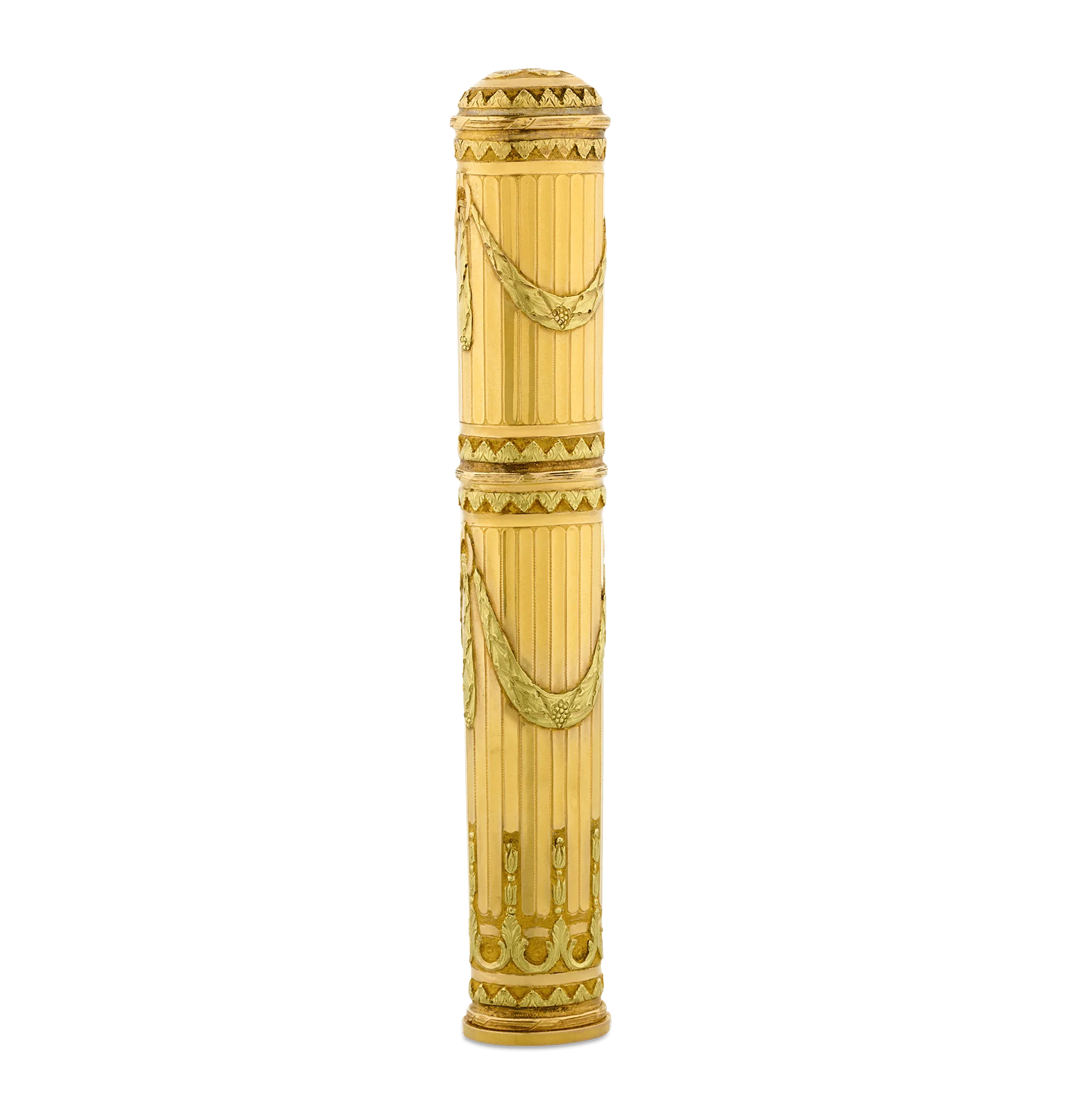
Expertly engraved entirely of yellow gold, this remarkably rare Louis XVI-era étui is a work of art. Resplendent columns and garlands adorn the stunning neoclassical design, which would once have been used to carry diminutive objects, such as secret correspondence between lovers or pieces of wax to melt down and use when sealing documents. At the étui's base is an intricately carved wax seal, allowing one to conveniently seal their letter with their coat-of-arms before depositing it inside the étui for delivery. Stunning in its artistry and beauty, and perfectly preserved in its original green leather case this étui flawlessly reflects the 18th-century taste for classical refinement and delicate, intricate ornamentation.
Derived from the Old French word “estuier,” meaning “to keep or hold,” the étui was a remarkably versatile accessory. While some were employed for discreet exchanges, others held essential tools such as scissors, thimbles, bodkins, needles, makeup pencils or even a doctor’s lancet. This particular example bears the inscription "ROLLAND," likely indicating its original owner.
Features French gold marks for Jacques Martin Petitjean, circa 1777
Étui: 4 3/4" high x 3/4" wide x 5/8" deep
Case: 5" high x 1 1/8" wide x 7/8" deep
Jacques Martin Petitjean
Circa 1777
Expertly engraved entirely of yellow gold, this remarkably rare Louis XVI-era étui is a work of art. Resplendent columns and garlands adorn the stunning neoclassical design, which would once have been used to carry diminutive objects, such as secret correspondence between lovers or pieces of wax to melt down and use when sealing documents. At the étui's base is an intricately carved wax seal, allowing one to conveniently seal their letter with their coat-of-arms before depositing it inside the étui for delivery. Stunning in its artistry and beauty, and perfectly preserved in its original green leather case this étui flawlessly reflects the 18th-century taste for classical refinement and delicate, intricate ornamentation.
Derived from the Old French word “estuier,” meaning “to keep or hold,” the étui was a remarkably versatile accessory. While some were employed for discreet exchanges, others held essential tools such as scissors, thimbles, bodkins, needles, makeup pencils or even a doctor’s lancet. This particular example bears the inscription "ROLLAND," likely indicating its original owner.
Features French gold marks for Jacques Martin Petitjean, circa 1777
Étui: 4 3/4" high x 3/4" wide x 5/8" deep
Case: 5" high x 1 1/8" wide x 7/8" deep
Gold Étui in Original Case
Jacques Martin Petitjean
Circa 1777
Expertly engraved entirely of yellow gold, this remarkably rare Louis XVI-era étui is a work of art. Resplendent columns and garlands adorn the stunning neoclassical design, which would once have been used to carry diminutive objects, such as secret correspondence between lovers or pieces of wax to melt down and use when sealing documents. At the étui's base is an intricately carved wax seal, allowing one to conveniently seal their letter with their coat-of-arms before depositing it inside the étui for delivery. Stunning in its artistry and beauty, and perfectly preserved in its original green leather case this étui flawlessly reflects the 18th-century taste for classical refinement and delicate, intricate ornamentation.
Derived from the Old French word “estuier,” meaning “to keep or hold,” the étui was a remarkably versatile accessory. While some were employed for discreet exchanges, others held essential tools such as scissors, thimbles, bodkins, needles, makeup pencils or even a doctor’s lancet. This particular example bears the inscription "ROLLAND," likely indicating its original owner.
Features French gold marks for Jacques Martin Petitjean, circa 1777
Étui: 4 3/4" high x 3/4" wide x 5/8" deep
Case: 5" high x 1 1/8" wide x 7/8" deep
Jacques Martin Petitjean
Circa 1777
Expertly engraved entirely of yellow gold, this remarkably rare Louis XVI-era étui is a work of art. Resplendent columns and garlands adorn the stunning neoclassical design, which would once have been used to carry diminutive objects, such as secret correspondence between lovers or pieces of wax to melt down and use when sealing documents. At the étui's base is an intricately carved wax seal, allowing one to conveniently seal their letter with their coat-of-arms before depositing it inside the étui for delivery. Stunning in its artistry and beauty, and perfectly preserved in its original green leather case this étui flawlessly reflects the 18th-century taste for classical refinement and delicate, intricate ornamentation.
Derived from the Old French word “estuier,” meaning “to keep or hold,” the étui was a remarkably versatile accessory. While some were employed for discreet exchanges, others held essential tools such as scissors, thimbles, bodkins, needles, makeup pencils or even a doctor’s lancet. This particular example bears the inscription "ROLLAND," likely indicating its original owner.
Features French gold marks for Jacques Martin Petitjean, circa 1777
Étui: 4 3/4" high x 3/4" wide x 5/8" deep
Case: 5" high x 1 1/8" wide x 7/8" deep
$7,077.00
Original: $20,220.00
-65%Gold Étui in Original Case—
$20,220.00
$7,077.00Description
Gold Étui in Original Case
Jacques Martin Petitjean
Circa 1777
Expertly engraved entirely of yellow gold, this remarkably rare Louis XVI-era étui is a work of art. Resplendent columns and garlands adorn the stunning neoclassical design, which would once have been used to carry diminutive objects, such as secret correspondence between lovers or pieces of wax to melt down and use when sealing documents. At the étui's base is an intricately carved wax seal, allowing one to conveniently seal their letter with their coat-of-arms before depositing it inside the étui for delivery. Stunning in its artistry and beauty, and perfectly preserved in its original green leather case this étui flawlessly reflects the 18th-century taste for classical refinement and delicate, intricate ornamentation.
Derived from the Old French word “estuier,” meaning “to keep or hold,” the étui was a remarkably versatile accessory. While some were employed for discreet exchanges, others held essential tools such as scissors, thimbles, bodkins, needles, makeup pencils or even a doctor’s lancet. This particular example bears the inscription "ROLLAND," likely indicating its original owner.
Features French gold marks for Jacques Martin Petitjean, circa 1777
Étui: 4 3/4" high x 3/4" wide x 5/8" deep
Case: 5" high x 1 1/8" wide x 7/8" deep
Jacques Martin Petitjean
Circa 1777
Expertly engraved entirely of yellow gold, this remarkably rare Louis XVI-era étui is a work of art. Resplendent columns and garlands adorn the stunning neoclassical design, which would once have been used to carry diminutive objects, such as secret correspondence between lovers or pieces of wax to melt down and use when sealing documents. At the étui's base is an intricately carved wax seal, allowing one to conveniently seal their letter with their coat-of-arms before depositing it inside the étui for delivery. Stunning in its artistry and beauty, and perfectly preserved in its original green leather case this étui flawlessly reflects the 18th-century taste for classical refinement and delicate, intricate ornamentation.
Derived from the Old French word “estuier,” meaning “to keep or hold,” the étui was a remarkably versatile accessory. While some were employed for discreet exchanges, others held essential tools such as scissors, thimbles, bodkins, needles, makeup pencils or even a doctor’s lancet. This particular example bears the inscription "ROLLAND," likely indicating its original owner.
Features French gold marks for Jacques Martin Petitjean, circa 1777
Étui: 4 3/4" high x 3/4" wide x 5/8" deep
Case: 5" high x 1 1/8" wide x 7/8" deep