1 / 7
+2
Meissen Gilt Traveling Tea Service
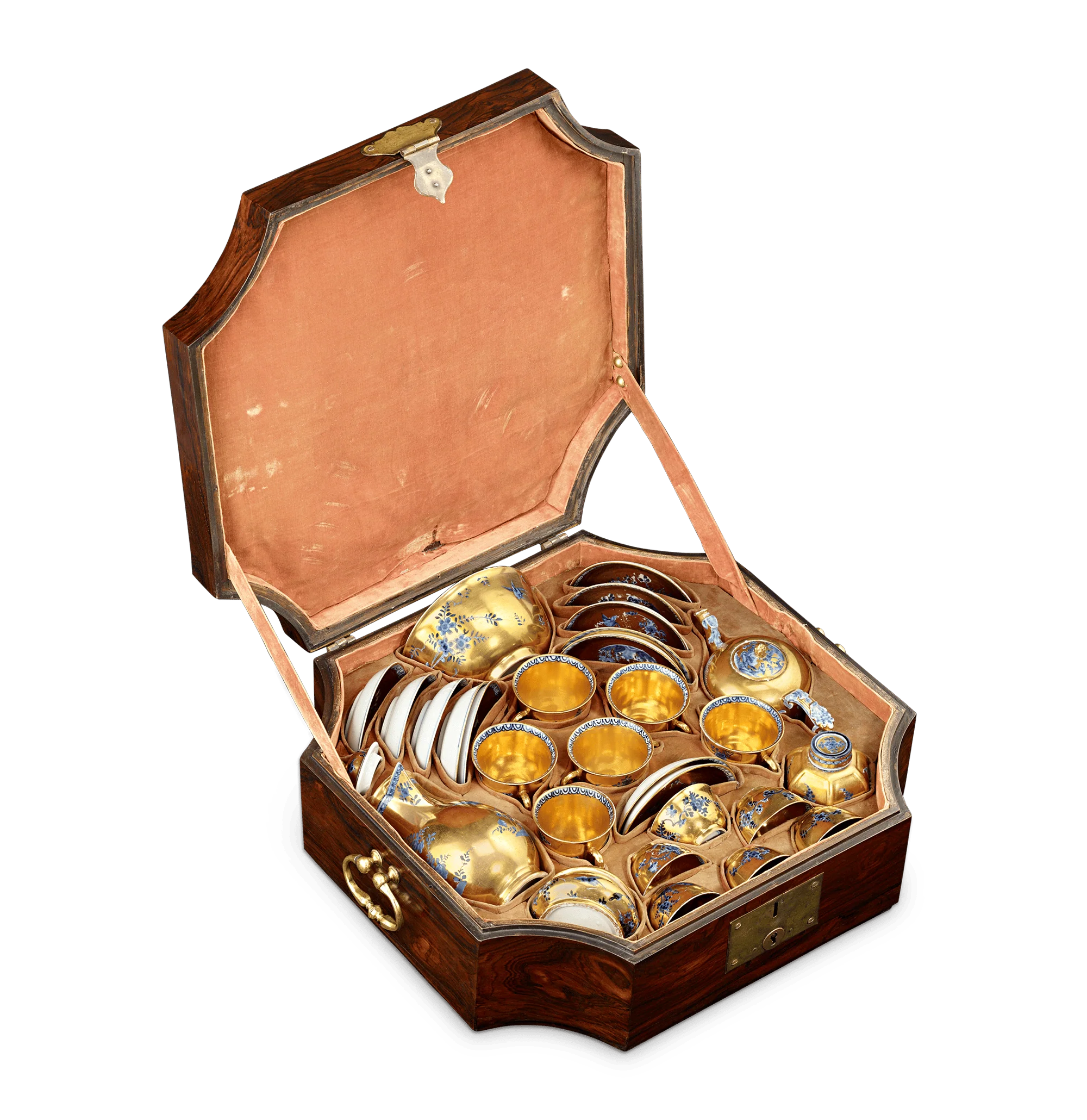
Meissen Gilt Traveling Tea Service, 29 pieces
Circa 1735-40
This magnificent Meissen traveling tea service is extraordinary in so many ways. To find such a stunningly gilt, complete Meissen set from the first half of the 18th century, preserved in exceptional condition in its original fitted case, is a rarity beyond compare.
For centuries, porcelain was the ultimate luxury in Europe. It could only be obtained with great difficulty from China and Japan, and it was so coveted that it became known as “white gold.” When the Meissen manufactory created the first true hard-paste porcelain outside of Asia in 1710, they became the supreme artisans of Europe.
This opulent 29-piece tea service would only have been afforded by an elite patron. The set's original solid mahogany and rosewood veneered box features an ormolu noble coat of arms emblazoned on its lid, confirming its status as a royal commission. Furthermore, after the porcelain was crafted to perfection at the Meissen manufactory, it was then transported to Augsburg, the center for specialist gilders and engravers. These costly collaborative productions were reserved almost exclusively for commissions intended for kings, queens and the highest-ranking diplomats.
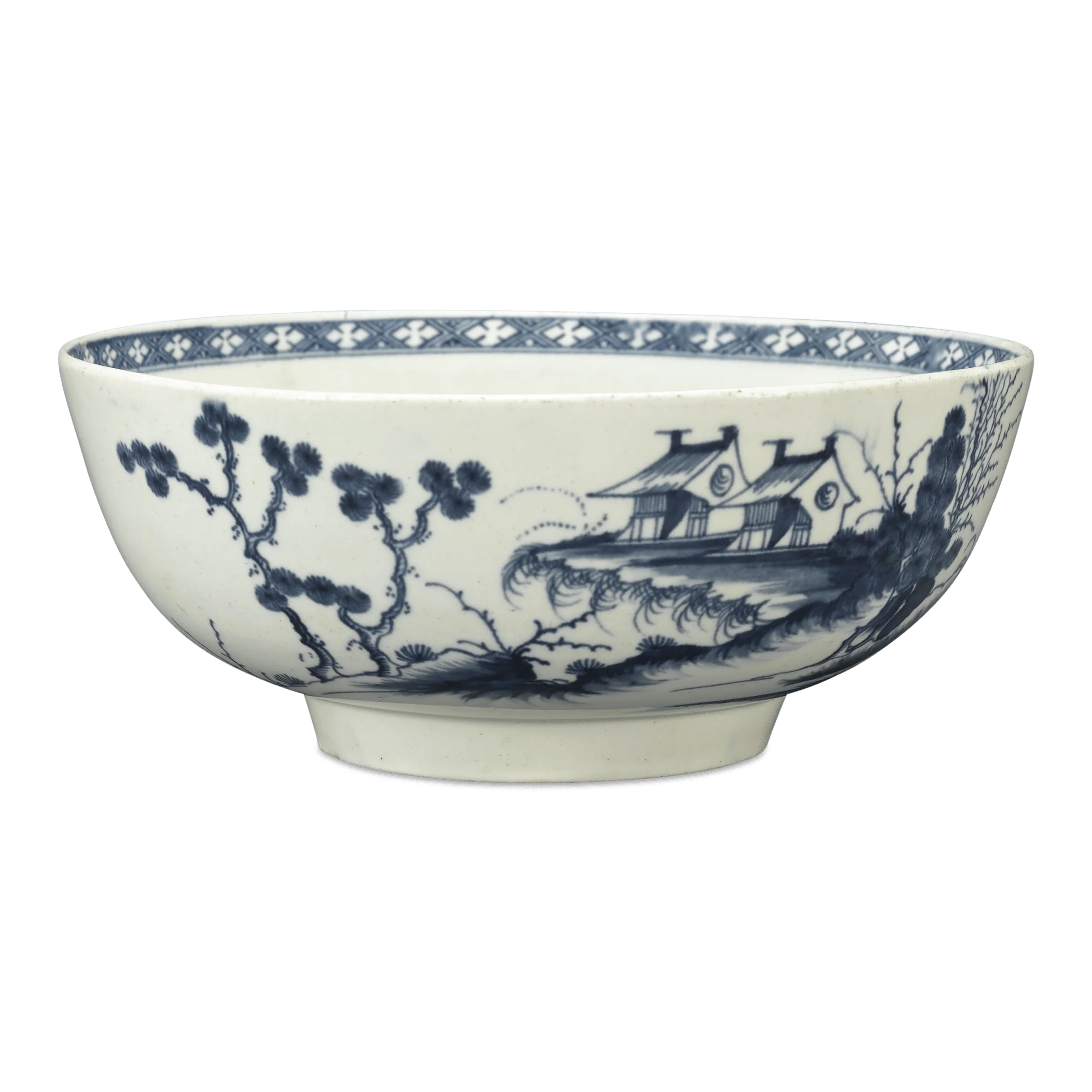
Compared to the few examples surviving today in museums and royal collections, this set's gilding is in remarkable condition, its original brilliance perfectly preserved for nearly three centuries. The 24-carat gilding complements the rich blue decoration on the porcelain. The motif was inspired by oriental design and known as "Fels und Vogeldekor," which often showed plum bushes, insects and hummingbirds emerging from a rocky ground.
That both this extraordinary gilt porcelain set and its fitted case survive together, in such condition, is simply astonishing. Meissen of this caliber resides in the world's foremost museums, including a related, but smaller set held by Russia’s Hermitage Museum, one currently on view at the Brooklyn Museum and another related service presented to the King of Sardinia.
Each piece bears the Meissen crossed swords mark
In case: 6 1/4" high x 20 1/2" wide x 18 1/2" deep
This complete tea service includes:
1 tea pot
1 chocolate pot
1 tea caddy
1 covered sugar bowl
1 round bowl
6 double-handled chocolate pots
6 tea cups
12 saucers
Circa 1735-40
This magnificent Meissen traveling tea service is extraordinary in so many ways. To find such a stunningly gilt, complete Meissen set from the first half of the 18th century, preserved in exceptional condition in its original fitted case, is a rarity beyond compare.
For centuries, porcelain was the ultimate luxury in Europe. It could only be obtained with great difficulty from China and Japan, and it was so coveted that it became known as “white gold.” When the Meissen manufactory created the first true hard-paste porcelain outside of Asia in 1710, they became the supreme artisans of Europe.
This opulent 29-piece tea service would only have been afforded by an elite patron. The set's original solid mahogany and rosewood veneered box features an ormolu noble coat of arms emblazoned on its lid, confirming its status as a royal commission. Furthermore, after the porcelain was crafted to perfection at the Meissen manufactory, it was then transported to Augsburg, the center for specialist gilders and engravers. These costly collaborative productions were reserved almost exclusively for commissions intended for kings, queens and the highest-ranking diplomats.
Compared to the few examples surviving today in museums and royal collections, this set's gilding is in remarkable condition, its original brilliance perfectly preserved for nearly three centuries. The 24-carat gilding complements the rich blue decoration on the porcelain. The motif was inspired by oriental design and known as "Fels und Vogeldekor," which often showed plum bushes, insects and hummingbirds emerging from a rocky ground.
That both this extraordinary gilt porcelain set and its fitted case survive together, in such condition, is simply astonishing. Meissen of this caliber resides in the world's foremost museums, including a related, but smaller set held by Russia’s Hermitage Museum, one currently on view at the Brooklyn Museum and another related service presented to the King of Sardinia.
Each piece bears the Meissen crossed swords mark
In case: 6 1/4" high x 20 1/2" wide x 18 1/2" deep
This complete tea service includes:
1 tea pot
1 chocolate pot
1 tea caddy
1 covered sugar bowl
1 round bowl
6 double-handled chocolate pots
6 tea cups
12 saucers
Meissen Gilt Traveling Tea Service, 29 pieces
Circa 1735-40
This magnificent Meissen traveling tea service is extraordinary in so many ways. To find such a stunningly gilt, complete Meissen set from the first half of the 18th century, preserved in exceptional condition in its original fitted case, is a rarity beyond compare.
For centuries, porcelain was the ultimate luxury in Europe. It could only be obtained with great difficulty from China and Japan, and it was so coveted that it became known as “white gold.” When the Meissen manufactory created the first true hard-paste porcelain outside of Asia in 1710, they became the supreme artisans of Europe.
This opulent 29-piece tea service would only have been afforded by an elite patron. The set's original solid mahogany and rosewood veneered box features an ormolu noble coat of arms emblazoned on its lid, confirming its status as a royal commission. Furthermore, after the porcelain was crafted to perfection at the Meissen manufactory, it was then transported to Augsburg, the center for specialist gilders and engravers. These costly collaborative productions were reserved almost exclusively for commissions intended for kings, queens and the highest-ranking diplomats.
Compared to the few examples surviving today in museums and royal collections, this set's gilding is in remarkable condition, its original brilliance perfectly preserved for nearly three centuries. The 24-carat gilding complements the rich blue decoration on the porcelain. The motif was inspired by oriental design and known as "Fels und Vogeldekor," which often showed plum bushes, insects and hummingbirds emerging from a rocky ground.
That both this extraordinary gilt porcelain set and its fitted case survive together, in such condition, is simply astonishing. Meissen of this caliber resides in the world's foremost museums, including a related, but smaller set held by Russia’s Hermitage Museum, one currently on view at the Brooklyn Museum and another related service presented to the King of Sardinia.
Each piece bears the Meissen crossed swords mark
In case: 6 1/4" high x 20 1/2" wide x 18 1/2" deep
This complete tea service includes:
1 tea pot
1 chocolate pot
1 tea caddy
1 covered sugar bowl
1 round bowl
6 double-handled chocolate pots
6 tea cups
12 saucers
Circa 1735-40
This magnificent Meissen traveling tea service is extraordinary in so many ways. To find such a stunningly gilt, complete Meissen set from the first half of the 18th century, preserved in exceptional condition in its original fitted case, is a rarity beyond compare.
For centuries, porcelain was the ultimate luxury in Europe. It could only be obtained with great difficulty from China and Japan, and it was so coveted that it became known as “white gold.” When the Meissen manufactory created the first true hard-paste porcelain outside of Asia in 1710, they became the supreme artisans of Europe.
This opulent 29-piece tea service would only have been afforded by an elite patron. The set's original solid mahogany and rosewood veneered box features an ormolu noble coat of arms emblazoned on its lid, confirming its status as a royal commission. Furthermore, after the porcelain was crafted to perfection at the Meissen manufactory, it was then transported to Augsburg, the center for specialist gilders and engravers. These costly collaborative productions were reserved almost exclusively for commissions intended for kings, queens and the highest-ranking diplomats.
Compared to the few examples surviving today in museums and royal collections, this set's gilding is in remarkable condition, its original brilliance perfectly preserved for nearly three centuries. The 24-carat gilding complements the rich blue decoration on the porcelain. The motif was inspired by oriental design and known as "Fels und Vogeldekor," which often showed plum bushes, insects and hummingbirds emerging from a rocky ground.
That both this extraordinary gilt porcelain set and its fitted case survive together, in such condition, is simply astonishing. Meissen of this caliber resides in the world's foremost museums, including a related, but smaller set held by Russia’s Hermitage Museum, one currently on view at the Brooklyn Museum and another related service presented to the King of Sardinia.
Each piece bears the Meissen crossed swords mark
In case: 6 1/4" high x 20 1/2" wide x 18 1/2" deep
This complete tea service includes:
1 tea pot
1 chocolate pot
1 tea caddy
1 covered sugar bowl
1 round bowl
6 double-handled chocolate pots
6 tea cups
12 saucers
$98,500.00
Meissen Gilt Traveling Tea Service—
$98,500.00
Description
Meissen Gilt Traveling Tea Service, 29 pieces
Circa 1735-40
This magnificent Meissen traveling tea service is extraordinary in so many ways. To find such a stunningly gilt, complete Meissen set from the first half of the 18th century, preserved in exceptional condition in its original fitted case, is a rarity beyond compare.
For centuries, porcelain was the ultimate luxury in Europe. It could only be obtained with great difficulty from China and Japan, and it was so coveted that it became known as “white gold.” When the Meissen manufactory created the first true hard-paste porcelain outside of Asia in 1710, they became the supreme artisans of Europe.
This opulent 29-piece tea service would only have been afforded by an elite patron. The set's original solid mahogany and rosewood veneered box features an ormolu noble coat of arms emblazoned on its lid, confirming its status as a royal commission. Furthermore, after the porcelain was crafted to perfection at the Meissen manufactory, it was then transported to Augsburg, the center for specialist gilders and engravers. These costly collaborative productions were reserved almost exclusively for commissions intended for kings, queens and the highest-ranking diplomats.
Compared to the few examples surviving today in museums and royal collections, this set's gilding is in remarkable condition, its original brilliance perfectly preserved for nearly three centuries. The 24-carat gilding complements the rich blue decoration on the porcelain. The motif was inspired by oriental design and known as "Fels und Vogeldekor," which often showed plum bushes, insects and hummingbirds emerging from a rocky ground.
That both this extraordinary gilt porcelain set and its fitted case survive together, in such condition, is simply astonishing. Meissen of this caliber resides in the world's foremost museums, including a related, but smaller set held by Russia’s Hermitage Museum, one currently on view at the Brooklyn Museum and another related service presented to the King of Sardinia.
Each piece bears the Meissen crossed swords mark
In case: 6 1/4" high x 20 1/2" wide x 18 1/2" deep
This complete tea service includes:
1 tea pot
1 chocolate pot
1 tea caddy
1 covered sugar bowl
1 round bowl
6 double-handled chocolate pots
6 tea cups
12 saucers
Circa 1735-40
This magnificent Meissen traveling tea service is extraordinary in so many ways. To find such a stunningly gilt, complete Meissen set from the first half of the 18th century, preserved in exceptional condition in its original fitted case, is a rarity beyond compare.
For centuries, porcelain was the ultimate luxury in Europe. It could only be obtained with great difficulty from China and Japan, and it was so coveted that it became known as “white gold.” When the Meissen manufactory created the first true hard-paste porcelain outside of Asia in 1710, they became the supreme artisans of Europe.
This opulent 29-piece tea service would only have been afforded by an elite patron. The set's original solid mahogany and rosewood veneered box features an ormolu noble coat of arms emblazoned on its lid, confirming its status as a royal commission. Furthermore, after the porcelain was crafted to perfection at the Meissen manufactory, it was then transported to Augsburg, the center for specialist gilders and engravers. These costly collaborative productions were reserved almost exclusively for commissions intended for kings, queens and the highest-ranking diplomats.
Compared to the few examples surviving today in museums and royal collections, this set's gilding is in remarkable condition, its original brilliance perfectly preserved for nearly three centuries. The 24-carat gilding complements the rich blue decoration on the porcelain. The motif was inspired by oriental design and known as "Fels und Vogeldekor," which often showed plum bushes, insects and hummingbirds emerging from a rocky ground.
That both this extraordinary gilt porcelain set and its fitted case survive together, in such condition, is simply astonishing. Meissen of this caliber resides in the world's foremost museums, including a related, but smaller set held by Russia’s Hermitage Museum, one currently on view at the Brooklyn Museum and another related service presented to the King of Sardinia.
Each piece bears the Meissen crossed swords mark
In case: 6 1/4" high x 20 1/2" wide x 18 1/2" deep
This complete tea service includes:
1 tea pot
1 chocolate pot
1 tea caddy
1 covered sugar bowl
1 round bowl
6 double-handled chocolate pots
6 tea cups
12 saucers