1 / 6
+1
Royal Silver Gilt Tazze by Digby Scott and Benjamin Smith
Silver-Gilt Tazze
Digby Scott and Benjamin Smith
Hallmarked London, 1803
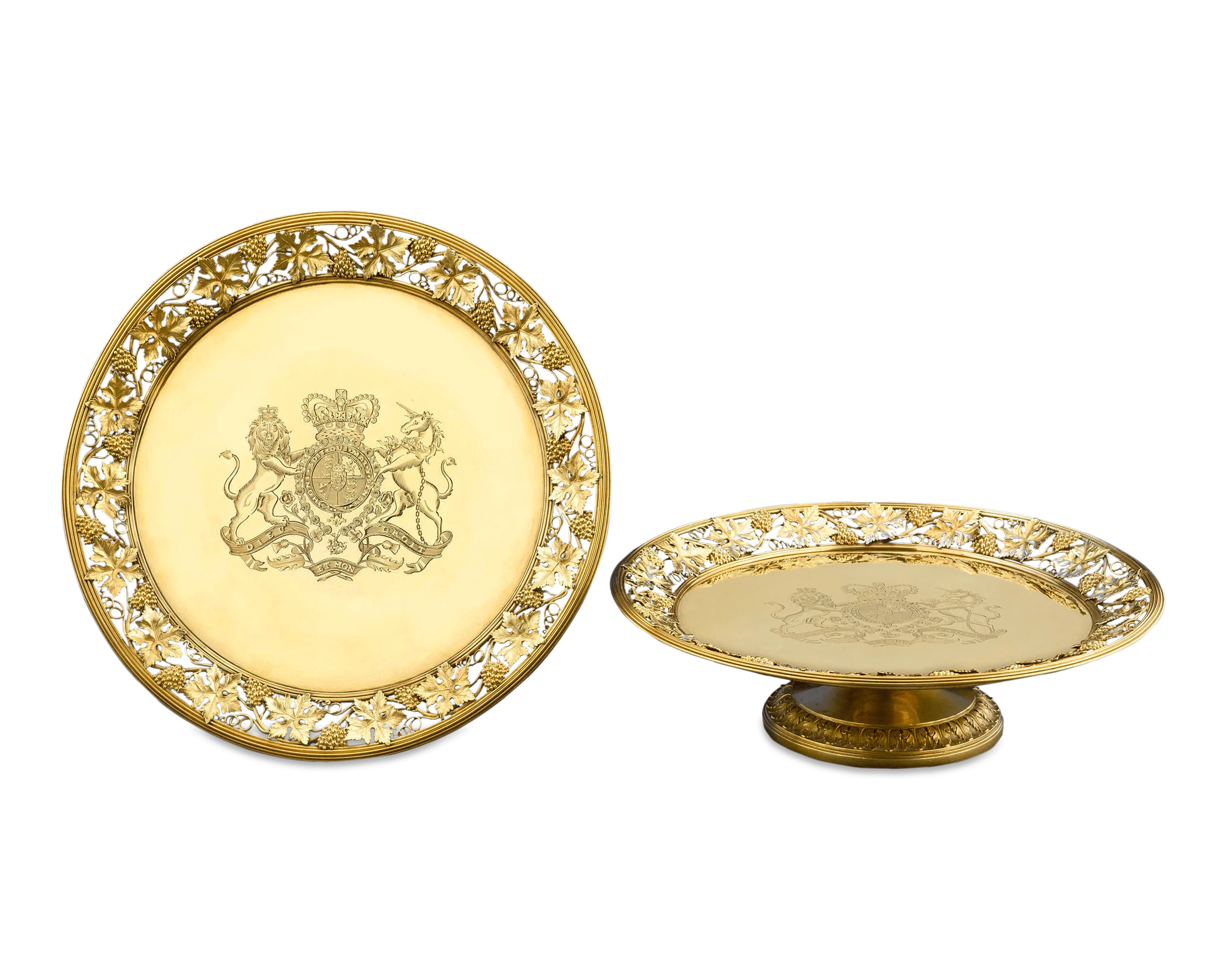
This extraordinary pair of silver gilt tazze was crafted by the famed partnership of Digby Scott and Benjamin Smith. The tazze are exemplary of the superior work produced by Scott and Smith, the most prominent silversmiths of the Georgian era. Each piece boasts an intricately pierced and chased Bacchanalian motif of grapevines around their edges. At the center of each tazza is etched the coat of arms of the Duke of Cumberland, meaning that the pair was specially made for Prince Ernest Augustus (later King of Hanover), the fifth son of King George III and Queen Charlotte of the United Kingdom. A very similar silver gilt tray by Scott and Smith is currently in the collection of the Metropolitan Museum of Art (New York), while a candelabrum made by the firm for the duke is in the collection of Colonial Williamsburg.
The partnership of Digby Scott and Benjamin Smith produced some of the greatest silver works of the Regency period, and their repertoire often included royal commissions such as these tazze. Scott and Smith jointly ran workshops located in Greenwich from 1802 to 1807, and during their brief partnership they were the principal suppliers of silver masterpieces to Rundell, Bridge & Rundell, the official “Jeweller, Gold and Silversmiths to the Crown.” Working on the cusp of the late Georgian and early Regency periods, the works of Scott and Smith often feature elements of the Neoclassical style, such as the pierced grapevines in these tazze, all crafted in exquisite, sumptuous detail. The firm’s royal commissions also include the Duke of York baskets, created for King George III's second son, Frederick Augustus (1763-1827), which are currently on display at the Powerhouse Museum (Sydney).
12” diameter x 3 1/4” high
Digby Scott and Benjamin Smith
Hallmarked London, 1803
This extraordinary pair of silver gilt tazze was crafted by the famed partnership of Digby Scott and Benjamin Smith. The tazze are exemplary of the superior work produced by Scott and Smith, the most prominent silversmiths of the Georgian era. Each piece boasts an intricately pierced and chased Bacchanalian motif of grapevines around their edges. At the center of each tazza is etched the coat of arms of the Duke of Cumberland, meaning that the pair was specially made for Prince Ernest Augustus (later King of Hanover), the fifth son of King George III and Queen Charlotte of the United Kingdom. A very similar silver gilt tray by Scott and Smith is currently in the collection of the Metropolitan Museum of Art (New York), while a candelabrum made by the firm for the duke is in the collection of Colonial Williamsburg.
The partnership of Digby Scott and Benjamin Smith produced some of the greatest silver works of the Regency period, and their repertoire often included royal commissions such as these tazze. Scott and Smith jointly ran workshops located in Greenwich from 1802 to 1807, and during their brief partnership they were the principal suppliers of silver masterpieces to Rundell, Bridge & Rundell, the official “Jeweller, Gold and Silversmiths to the Crown.” Working on the cusp of the late Georgian and early Regency periods, the works of Scott and Smith often feature elements of the Neoclassical style, such as the pierced grapevines in these tazze, all crafted in exquisite, sumptuous detail. The firm’s royal commissions also include the Duke of York baskets, created for King George III's second son, Frederick Augustus (1763-1827), which are currently on display at the Powerhouse Museum (Sydney).
12” diameter x 3 1/4” high
Silver-Gilt Tazze
Digby Scott and Benjamin Smith
Hallmarked London, 1803
This extraordinary pair of silver gilt tazze was crafted by the famed partnership of Digby Scott and Benjamin Smith. The tazze are exemplary of the superior work produced by Scott and Smith, the most prominent silversmiths of the Georgian era. Each piece boasts an intricately pierced and chased Bacchanalian motif of grapevines around their edges. At the center of each tazza is etched the coat of arms of the Duke of Cumberland, meaning that the pair was specially made for Prince Ernest Augustus (later King of Hanover), the fifth son of King George III and Queen Charlotte of the United Kingdom. A very similar silver gilt tray by Scott and Smith is currently in the collection of the Metropolitan Museum of Art (New York), while a candelabrum made by the firm for the duke is in the collection of Colonial Williamsburg.
The partnership of Digby Scott and Benjamin Smith produced some of the greatest silver works of the Regency period, and their repertoire often included royal commissions such as these tazze. Scott and Smith jointly ran workshops located in Greenwich from 1802 to 1807, and during their brief partnership they were the principal suppliers of silver masterpieces to Rundell, Bridge & Rundell, the official “Jeweller, Gold and Silversmiths to the Crown.” Working on the cusp of the late Georgian and early Regency periods, the works of Scott and Smith often feature elements of the Neoclassical style, such as the pierced grapevines in these tazze, all crafted in exquisite, sumptuous detail. The firm’s royal commissions also include the Duke of York baskets, created for King George III's second son, Frederick Augustus (1763-1827), which are currently on display at the Powerhouse Museum (Sydney).
12” diameter x 3 1/4” high
Digby Scott and Benjamin Smith
Hallmarked London, 1803
This extraordinary pair of silver gilt tazze was crafted by the famed partnership of Digby Scott and Benjamin Smith. The tazze are exemplary of the superior work produced by Scott and Smith, the most prominent silversmiths of the Georgian era. Each piece boasts an intricately pierced and chased Bacchanalian motif of grapevines around their edges. At the center of each tazza is etched the coat of arms of the Duke of Cumberland, meaning that the pair was specially made for Prince Ernest Augustus (later King of Hanover), the fifth son of King George III and Queen Charlotte of the United Kingdom. A very similar silver gilt tray by Scott and Smith is currently in the collection of the Metropolitan Museum of Art (New York), while a candelabrum made by the firm for the duke is in the collection of Colonial Williamsburg.
The partnership of Digby Scott and Benjamin Smith produced some of the greatest silver works of the Regency period, and their repertoire often included royal commissions such as these tazze. Scott and Smith jointly ran workshops located in Greenwich from 1802 to 1807, and during their brief partnership they were the principal suppliers of silver masterpieces to Rundell, Bridge & Rundell, the official “Jeweller, Gold and Silversmiths to the Crown.” Working on the cusp of the late Georgian and early Regency periods, the works of Scott and Smith often feature elements of the Neoclassical style, such as the pierced grapevines in these tazze, all crafted in exquisite, sumptuous detail. The firm’s royal commissions also include the Duke of York baskets, created for King George III's second son, Frederick Augustus (1763-1827), which are currently on display at the Powerhouse Museum (Sydney).
12” diameter x 3 1/4” high
$398,500.00
Royal Silver Gilt Tazze by Digby Scott and Benjamin Smith—
$398,500.00
Description
Silver-Gilt Tazze
Digby Scott and Benjamin Smith
Hallmarked London, 1803
This extraordinary pair of silver gilt tazze was crafted by the famed partnership of Digby Scott and Benjamin Smith. The tazze are exemplary of the superior work produced by Scott and Smith, the most prominent silversmiths of the Georgian era. Each piece boasts an intricately pierced and chased Bacchanalian motif of grapevines around their edges. At the center of each tazza is etched the coat of arms of the Duke of Cumberland, meaning that the pair was specially made for Prince Ernest Augustus (later King of Hanover), the fifth son of King George III and Queen Charlotte of the United Kingdom. A very similar silver gilt tray by Scott and Smith is currently in the collection of the Metropolitan Museum of Art (New York), while a candelabrum made by the firm for the duke is in the collection of Colonial Williamsburg.
The partnership of Digby Scott and Benjamin Smith produced some of the greatest silver works of the Regency period, and their repertoire often included royal commissions such as these tazze. Scott and Smith jointly ran workshops located in Greenwich from 1802 to 1807, and during their brief partnership they were the principal suppliers of silver masterpieces to Rundell, Bridge & Rundell, the official “Jeweller, Gold and Silversmiths to the Crown.” Working on the cusp of the late Georgian and early Regency periods, the works of Scott and Smith often feature elements of the Neoclassical style, such as the pierced grapevines in these tazze, all crafted in exquisite, sumptuous detail. The firm’s royal commissions also include the Duke of York baskets, created for King George III's second son, Frederick Augustus (1763-1827), which are currently on display at the Powerhouse Museum (Sydney).
12” diameter x 3 1/4” high
Digby Scott and Benjamin Smith
Hallmarked London, 1803
This extraordinary pair of silver gilt tazze was crafted by the famed partnership of Digby Scott and Benjamin Smith. The tazze are exemplary of the superior work produced by Scott and Smith, the most prominent silversmiths of the Georgian era. Each piece boasts an intricately pierced and chased Bacchanalian motif of grapevines around their edges. At the center of each tazza is etched the coat of arms of the Duke of Cumberland, meaning that the pair was specially made for Prince Ernest Augustus (later King of Hanover), the fifth son of King George III and Queen Charlotte of the United Kingdom. A very similar silver gilt tray by Scott and Smith is currently in the collection of the Metropolitan Museum of Art (New York), while a candelabrum made by the firm for the duke is in the collection of Colonial Williamsburg.
The partnership of Digby Scott and Benjamin Smith produced some of the greatest silver works of the Regency period, and their repertoire often included royal commissions such as these tazze. Scott and Smith jointly ran workshops located in Greenwich from 1802 to 1807, and during their brief partnership they were the principal suppliers of silver masterpieces to Rundell, Bridge & Rundell, the official “Jeweller, Gold and Silversmiths to the Crown.” Working on the cusp of the late Georgian and early Regency periods, the works of Scott and Smith often feature elements of the Neoclassical style, such as the pierced grapevines in these tazze, all crafted in exquisite, sumptuous detail. The firm’s royal commissions also include the Duke of York baskets, created for King George III's second son, Frederick Augustus (1763-1827), which are currently on display at the Powerhouse Museum (Sydney).
12” diameter x 3 1/4” high