1 / 5
Silver Chamberstick by Hester Bateman
Silver chamberstick
Hester Bateman
Hallmarked London, 1778
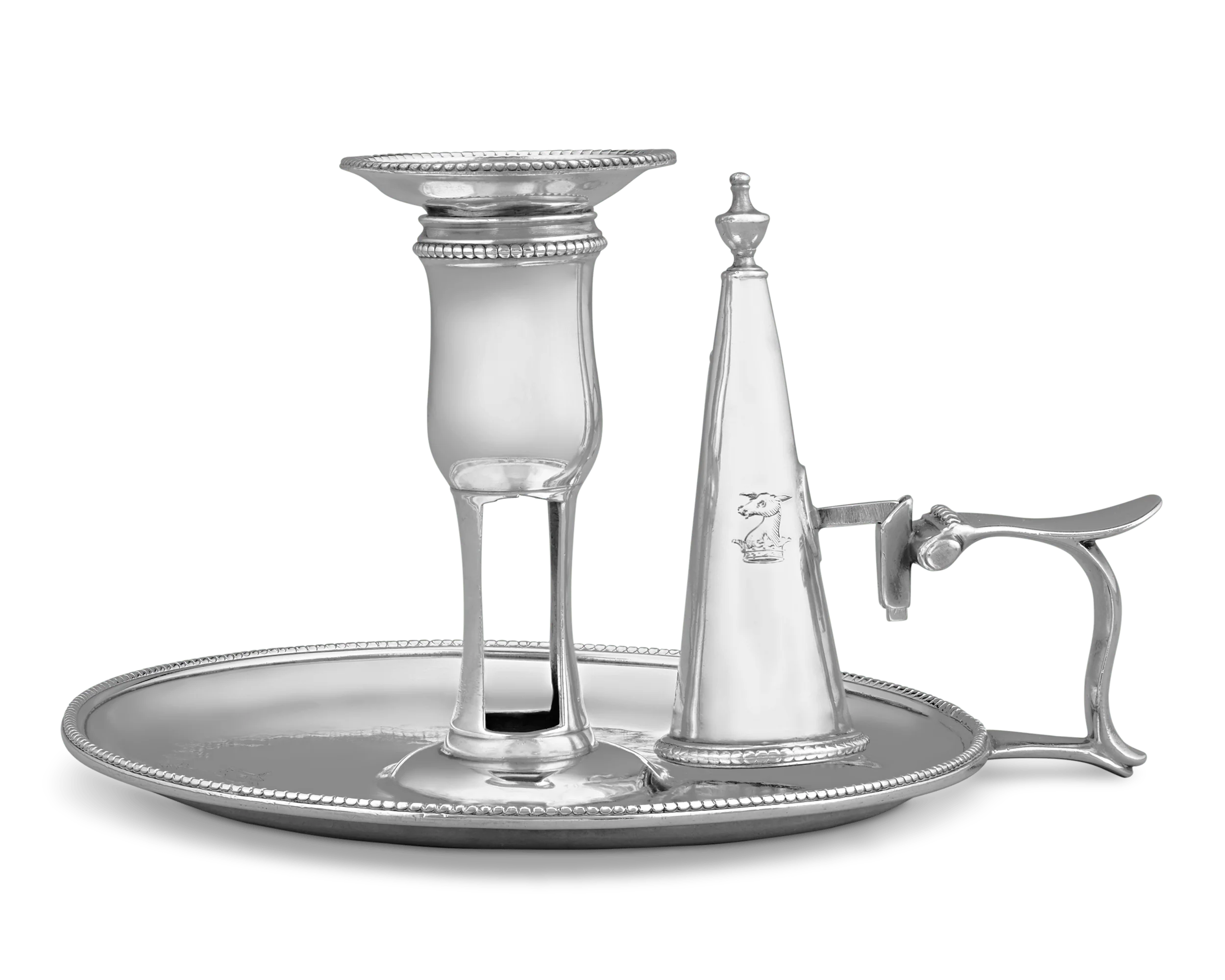
In 18th-century England, after completing one’s evening routine, the final act before sleep would be extinguishing the light. This elegant Georgian chamberstick by the renowned silversmith Hester Bateman exemplifies the refined craftsmanship of the 18th century, which facilitated this bedtime ritual. The chamberstick features a neatly designed snuffer, which hangs just above the tray to prevent any wax or soot from marring the surface. The snuffer, adorned with a tiny vase-shaped finial and an S-curve handle, embodies both form and function. There is a crest on the wax pan, a calf’s head over a crown symbolizing this item’s connection with English nobility.
Additionally, the opening below the candle cup likely served as a convenient holder for a wick trimmer, emphasizing the practical yet sophisticated design. Chambersticks like this played a crucial role in Georgian society, providing essential light for the journey from the main living quarters to the bedchamber. Beyond their practicality, they were also symbols of the era's elegance and sophistication.
Hester Bateman, known as the "Queen of Silver," took over her family's silversmithing business in 1760 after the death of her husband. Her pioneering leadership and innovative techniques, such as the use of workable sheet silver, led to the flourishing of the business until her retirement in 1790. This chamberstick, a stunning example of Bateman’s work, was once part of the esteemed Red McCombs Collection, a collection that has garnered significant attention.
3 3/4” high x 6” wide x 5” deep
Provenance:
M.S. Rau, New Orleans
Red McCombs Collection, Texas
M.S. Rau, New Orleans
Hester Bateman
Hallmarked London, 1778
In 18th-century England, after completing one’s evening routine, the final act before sleep would be extinguishing the light. This elegant Georgian chamberstick by the renowned silversmith Hester Bateman exemplifies the refined craftsmanship of the 18th century, which facilitated this bedtime ritual. The chamberstick features a neatly designed snuffer, which hangs just above the tray to prevent any wax or soot from marring the surface. The snuffer, adorned with a tiny vase-shaped finial and an S-curve handle, embodies both form and function. There is a crest on the wax pan, a calf’s head over a crown symbolizing this item’s connection with English nobility.
Additionally, the opening below the candle cup likely served as a convenient holder for a wick trimmer, emphasizing the practical yet sophisticated design. Chambersticks like this played a crucial role in Georgian society, providing essential light for the journey from the main living quarters to the bedchamber. Beyond their practicality, they were also symbols of the era's elegance and sophistication.
Hester Bateman, known as the "Queen of Silver," took over her family's silversmithing business in 1760 after the death of her husband. Her pioneering leadership and innovative techniques, such as the use of workable sheet silver, led to the flourishing of the business until her retirement in 1790. This chamberstick, a stunning example of Bateman’s work, was once part of the esteemed Red McCombs Collection, a collection that has garnered significant attention.
3 3/4” high x 6” wide x 5” deep
Provenance:
M.S. Rau, New Orleans
Red McCombs Collection, Texas
M.S. Rau, New Orleans
Silver chamberstick
Hester Bateman
Hallmarked London, 1778
In 18th-century England, after completing one’s evening routine, the final act before sleep would be extinguishing the light. This elegant Georgian chamberstick by the renowned silversmith Hester Bateman exemplifies the refined craftsmanship of the 18th century, which facilitated this bedtime ritual. The chamberstick features a neatly designed snuffer, which hangs just above the tray to prevent any wax or soot from marring the surface. The snuffer, adorned with a tiny vase-shaped finial and an S-curve handle, embodies both form and function. There is a crest on the wax pan, a calf’s head over a crown symbolizing this item’s connection with English nobility.
Additionally, the opening below the candle cup likely served as a convenient holder for a wick trimmer, emphasizing the practical yet sophisticated design. Chambersticks like this played a crucial role in Georgian society, providing essential light for the journey from the main living quarters to the bedchamber. Beyond their practicality, they were also symbols of the era's elegance and sophistication.
Hester Bateman, known as the "Queen of Silver," took over her family's silversmithing business in 1760 after the death of her husband. Her pioneering leadership and innovative techniques, such as the use of workable sheet silver, led to the flourishing of the business until her retirement in 1790. This chamberstick, a stunning example of Bateman’s work, was once part of the esteemed Red McCombs Collection, a collection that has garnered significant attention.
3 3/4” high x 6” wide x 5” deep
Provenance:
M.S. Rau, New Orleans
Red McCombs Collection, Texas
M.S. Rau, New Orleans
Hester Bateman
Hallmarked London, 1778
In 18th-century England, after completing one’s evening routine, the final act before sleep would be extinguishing the light. This elegant Georgian chamberstick by the renowned silversmith Hester Bateman exemplifies the refined craftsmanship of the 18th century, which facilitated this bedtime ritual. The chamberstick features a neatly designed snuffer, which hangs just above the tray to prevent any wax or soot from marring the surface. The snuffer, adorned with a tiny vase-shaped finial and an S-curve handle, embodies both form and function. There is a crest on the wax pan, a calf’s head over a crown symbolizing this item’s connection with English nobility.
Additionally, the opening below the candle cup likely served as a convenient holder for a wick trimmer, emphasizing the practical yet sophisticated design. Chambersticks like this played a crucial role in Georgian society, providing essential light for the journey from the main living quarters to the bedchamber. Beyond their practicality, they were also symbols of the era's elegance and sophistication.
Hester Bateman, known as the "Queen of Silver," took over her family's silversmithing business in 1760 after the death of her husband. Her pioneering leadership and innovative techniques, such as the use of workable sheet silver, led to the flourishing of the business until her retirement in 1790. This chamberstick, a stunning example of Bateman’s work, was once part of the esteemed Red McCombs Collection, a collection that has garnered significant attention.
3 3/4” high x 6” wide x 5” deep
Provenance:
M.S. Rau, New Orleans
Red McCombs Collection, Texas
M.S. Rau, New Orleans
$2,607.50
Original: $7,450.00
-65%Silver Chamberstick by Hester Bateman—
$7,450.00
$2,607.50Description
Silver chamberstick
Hester Bateman
Hallmarked London, 1778
In 18th-century England, after completing one’s evening routine, the final act before sleep would be extinguishing the light. This elegant Georgian chamberstick by the renowned silversmith Hester Bateman exemplifies the refined craftsmanship of the 18th century, which facilitated this bedtime ritual. The chamberstick features a neatly designed snuffer, which hangs just above the tray to prevent any wax or soot from marring the surface. The snuffer, adorned with a tiny vase-shaped finial and an S-curve handle, embodies both form and function. There is a crest on the wax pan, a calf’s head over a crown symbolizing this item’s connection with English nobility.
Additionally, the opening below the candle cup likely served as a convenient holder for a wick trimmer, emphasizing the practical yet sophisticated design. Chambersticks like this played a crucial role in Georgian society, providing essential light for the journey from the main living quarters to the bedchamber. Beyond their practicality, they were also symbols of the era's elegance and sophistication.
Hester Bateman, known as the "Queen of Silver," took over her family's silversmithing business in 1760 after the death of her husband. Her pioneering leadership and innovative techniques, such as the use of workable sheet silver, led to the flourishing of the business until her retirement in 1790. This chamberstick, a stunning example of Bateman’s work, was once part of the esteemed Red McCombs Collection, a collection that has garnered significant attention.
3 3/4” high x 6” wide x 5” deep
Provenance:
M.S. Rau, New Orleans
Red McCombs Collection, Texas
M.S. Rau, New Orleans
Hester Bateman
Hallmarked London, 1778
In 18th-century England, after completing one’s evening routine, the final act before sleep would be extinguishing the light. This elegant Georgian chamberstick by the renowned silversmith Hester Bateman exemplifies the refined craftsmanship of the 18th century, which facilitated this bedtime ritual. The chamberstick features a neatly designed snuffer, which hangs just above the tray to prevent any wax or soot from marring the surface. The snuffer, adorned with a tiny vase-shaped finial and an S-curve handle, embodies both form and function. There is a crest on the wax pan, a calf’s head over a crown symbolizing this item’s connection with English nobility.
Additionally, the opening below the candle cup likely served as a convenient holder for a wick trimmer, emphasizing the practical yet sophisticated design. Chambersticks like this played a crucial role in Georgian society, providing essential light for the journey from the main living quarters to the bedchamber. Beyond their practicality, they were also symbols of the era's elegance and sophistication.
Hester Bateman, known as the "Queen of Silver," took over her family's silversmithing business in 1760 after the death of her husband. Her pioneering leadership and innovative techniques, such as the use of workable sheet silver, led to the flourishing of the business until her retirement in 1790. This chamberstick, a stunning example of Bateman’s work, was once part of the esteemed Red McCombs Collection, a collection that has garnered significant attention.
3 3/4” high x 6” wide x 5” deep
Provenance:
M.S. Rau, New Orleans
Red McCombs Collection, Texas
M.S. Rau, New Orleans