1 / 9
+4
Silver-Mounted Italian Snaphaunce Blunderbuss
Silver-Mounted Snaphaunce Blunderbuss
Acqua Fresca & Gironimo Mutti
Circa 1730
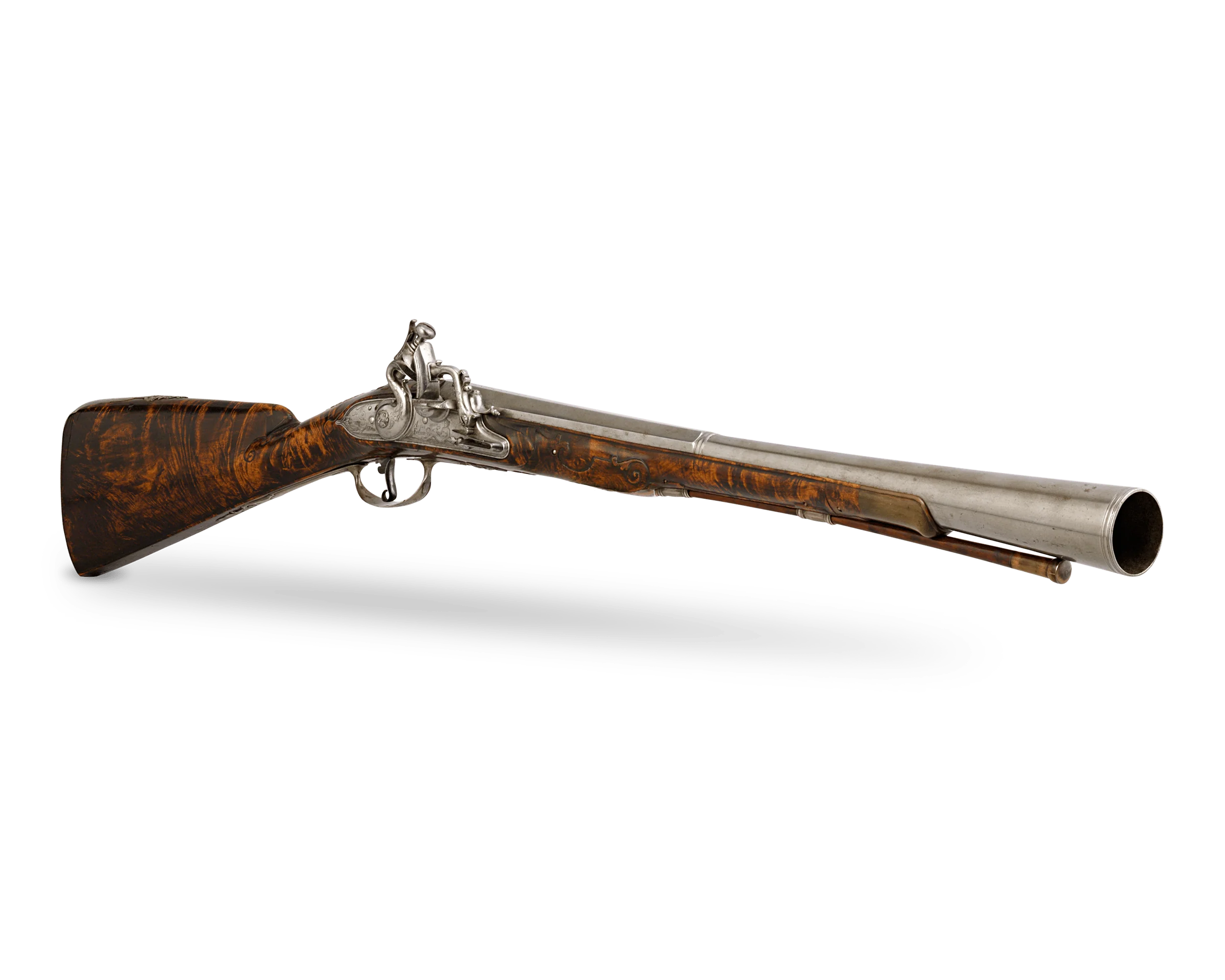
This exceptional Italian blunderbuss represents the pinnacle of early 18th-century firearms artistry, created circa 1730 as a collaboration between two of Italy's most distinguished gunsmiths. The weapon features a sophisticated snaphaunce lock mechanism, an advanced flint-and-steel ignition system that preceded the later flintlock design, showcasing the cutting-edge military technology of its era.
The hefty two-stage smoothbore barrel transitions from octagonal at the breech to round toward the dramatically flared muzzle. Blunderbusses proved ideal for close-range defense during an era plagued by highway robbery and constant warfare, offering quick reloading capabilities whether on horseback, in coaches or aboard ships, while delivering a devastating, scattered shot at close range.
The firearm displays extraordinary Baroque artistry throughout. The lock plate presents an engraved nude female figure with a hound and a bird amid floral scrollwork, signed "Acqua Fresca," while the breech bears Mutti's engraved signature amid shamrock motifs. Functional elements become sculptural: the hammer forms a bearded face and the jaw screw hides beneath a carved mask. The briarwood stock showcases engraved silver furniture, including a hunting trophy sideplate, decorated butt plate and trigger guard with crowned shield, plus practical elements like a saddle ring and original ramrod.
Gironimo Mutti ranked among the premier barrel-makers working at Gardone, near Brescia, whose expertly forged barrels were highly sought after for deluxe firearms. "Acqua Fresca" is the pseudonym of Matteo Cecchi of Bargi, a master gunsmith celebrated for his unparalleled skill in relief-chiseled steel engraving. Working from his remote hamlet near Bologna yet serving an elite clientele—including the Medici rulers of Florence—Cecchi exemplified the extraordinary artistry that defined Italian firearms of this golden age.
4 1/2“ high x 3 1/2” wide x 35 1/2“ long
Acqua Fresca & Gironimo Mutti
Circa 1730
This exceptional Italian blunderbuss represents the pinnacle of early 18th-century firearms artistry, created circa 1730 as a collaboration between two of Italy's most distinguished gunsmiths. The weapon features a sophisticated snaphaunce lock mechanism, an advanced flint-and-steel ignition system that preceded the later flintlock design, showcasing the cutting-edge military technology of its era.
The hefty two-stage smoothbore barrel transitions from octagonal at the breech to round toward the dramatically flared muzzle. Blunderbusses proved ideal for close-range defense during an era plagued by highway robbery and constant warfare, offering quick reloading capabilities whether on horseback, in coaches or aboard ships, while delivering a devastating, scattered shot at close range.
The firearm displays extraordinary Baroque artistry throughout. The lock plate presents an engraved nude female figure with a hound and a bird amid floral scrollwork, signed "Acqua Fresca," while the breech bears Mutti's engraved signature amid shamrock motifs. Functional elements become sculptural: the hammer forms a bearded face and the jaw screw hides beneath a carved mask. The briarwood stock showcases engraved silver furniture, including a hunting trophy sideplate, decorated butt plate and trigger guard with crowned shield, plus practical elements like a saddle ring and original ramrod.
Gironimo Mutti ranked among the premier barrel-makers working at Gardone, near Brescia, whose expertly forged barrels were highly sought after for deluxe firearms. "Acqua Fresca" is the pseudonym of Matteo Cecchi of Bargi, a master gunsmith celebrated for his unparalleled skill in relief-chiseled steel engraving. Working from his remote hamlet near Bologna yet serving an elite clientele—including the Medici rulers of Florence—Cecchi exemplified the extraordinary artistry that defined Italian firearms of this golden age.
4 1/2“ high x 3 1/2” wide x 35 1/2“ long
Silver-Mounted Snaphaunce Blunderbuss
Acqua Fresca & Gironimo Mutti
Circa 1730
This exceptional Italian blunderbuss represents the pinnacle of early 18th-century firearms artistry, created circa 1730 as a collaboration between two of Italy's most distinguished gunsmiths. The weapon features a sophisticated snaphaunce lock mechanism, an advanced flint-and-steel ignition system that preceded the later flintlock design, showcasing the cutting-edge military technology of its era.
The hefty two-stage smoothbore barrel transitions from octagonal at the breech to round toward the dramatically flared muzzle. Blunderbusses proved ideal for close-range defense during an era plagued by highway robbery and constant warfare, offering quick reloading capabilities whether on horseback, in coaches or aboard ships, while delivering a devastating, scattered shot at close range.
The firearm displays extraordinary Baroque artistry throughout. The lock plate presents an engraved nude female figure with a hound and a bird amid floral scrollwork, signed "Acqua Fresca," while the breech bears Mutti's engraved signature amid shamrock motifs. Functional elements become sculptural: the hammer forms a bearded face and the jaw screw hides beneath a carved mask. The briarwood stock showcases engraved silver furniture, including a hunting trophy sideplate, decorated butt plate and trigger guard with crowned shield, plus practical elements like a saddle ring and original ramrod.
Gironimo Mutti ranked among the premier barrel-makers working at Gardone, near Brescia, whose expertly forged barrels were highly sought after for deluxe firearms. "Acqua Fresca" is the pseudonym of Matteo Cecchi of Bargi, a master gunsmith celebrated for his unparalleled skill in relief-chiseled steel engraving. Working from his remote hamlet near Bologna yet serving an elite clientele—including the Medici rulers of Florence—Cecchi exemplified the extraordinary artistry that defined Italian firearms of this golden age.
4 1/2“ high x 3 1/2” wide x 35 1/2“ long
Acqua Fresca & Gironimo Mutti
Circa 1730
This exceptional Italian blunderbuss represents the pinnacle of early 18th-century firearms artistry, created circa 1730 as a collaboration between two of Italy's most distinguished gunsmiths. The weapon features a sophisticated snaphaunce lock mechanism, an advanced flint-and-steel ignition system that preceded the later flintlock design, showcasing the cutting-edge military technology of its era.
The hefty two-stage smoothbore barrel transitions from octagonal at the breech to round toward the dramatically flared muzzle. Blunderbusses proved ideal for close-range defense during an era plagued by highway robbery and constant warfare, offering quick reloading capabilities whether on horseback, in coaches or aboard ships, while delivering a devastating, scattered shot at close range.
The firearm displays extraordinary Baroque artistry throughout. The lock plate presents an engraved nude female figure with a hound and a bird amid floral scrollwork, signed "Acqua Fresca," while the breech bears Mutti's engraved signature amid shamrock motifs. Functional elements become sculptural: the hammer forms a bearded face and the jaw screw hides beneath a carved mask. The briarwood stock showcases engraved silver furniture, including a hunting trophy sideplate, decorated butt plate and trigger guard with crowned shield, plus practical elements like a saddle ring and original ramrod.
Gironimo Mutti ranked among the premier barrel-makers working at Gardone, near Brescia, whose expertly forged barrels were highly sought after for deluxe firearms. "Acqua Fresca" is the pseudonym of Matteo Cecchi of Bargi, a master gunsmith celebrated for his unparalleled skill in relief-chiseled steel engraving. Working from his remote hamlet near Bologna yet serving an elite clientele—including the Medici rulers of Florence—Cecchi exemplified the extraordinary artistry that defined Italian firearms of this golden age.
4 1/2“ high x 3 1/2” wide x 35 1/2“ long
$14,997.50
Original: $42,850.00
-65%Silver-Mounted Italian Snaphaunce Blunderbuss—
$42,850.00
$14,997.50Description
Silver-Mounted Snaphaunce Blunderbuss
Acqua Fresca & Gironimo Mutti
Circa 1730
This exceptional Italian blunderbuss represents the pinnacle of early 18th-century firearms artistry, created circa 1730 as a collaboration between two of Italy's most distinguished gunsmiths. The weapon features a sophisticated snaphaunce lock mechanism, an advanced flint-and-steel ignition system that preceded the later flintlock design, showcasing the cutting-edge military technology of its era.
The hefty two-stage smoothbore barrel transitions from octagonal at the breech to round toward the dramatically flared muzzle. Blunderbusses proved ideal for close-range defense during an era plagued by highway robbery and constant warfare, offering quick reloading capabilities whether on horseback, in coaches or aboard ships, while delivering a devastating, scattered shot at close range.
The firearm displays extraordinary Baroque artistry throughout. The lock plate presents an engraved nude female figure with a hound and a bird amid floral scrollwork, signed "Acqua Fresca," while the breech bears Mutti's engraved signature amid shamrock motifs. Functional elements become sculptural: the hammer forms a bearded face and the jaw screw hides beneath a carved mask. The briarwood stock showcases engraved silver furniture, including a hunting trophy sideplate, decorated butt plate and trigger guard with crowned shield, plus practical elements like a saddle ring and original ramrod.
Gironimo Mutti ranked among the premier barrel-makers working at Gardone, near Brescia, whose expertly forged barrels were highly sought after for deluxe firearms. "Acqua Fresca" is the pseudonym of Matteo Cecchi of Bargi, a master gunsmith celebrated for his unparalleled skill in relief-chiseled steel engraving. Working from his remote hamlet near Bologna yet serving an elite clientele—including the Medici rulers of Florence—Cecchi exemplified the extraordinary artistry that defined Italian firearms of this golden age.
4 1/2“ high x 3 1/2” wide x 35 1/2“ long
Acqua Fresca & Gironimo Mutti
Circa 1730
This exceptional Italian blunderbuss represents the pinnacle of early 18th-century firearms artistry, created circa 1730 as a collaboration between two of Italy's most distinguished gunsmiths. The weapon features a sophisticated snaphaunce lock mechanism, an advanced flint-and-steel ignition system that preceded the later flintlock design, showcasing the cutting-edge military technology of its era.
The hefty two-stage smoothbore barrel transitions from octagonal at the breech to round toward the dramatically flared muzzle. Blunderbusses proved ideal for close-range defense during an era plagued by highway robbery and constant warfare, offering quick reloading capabilities whether on horseback, in coaches or aboard ships, while delivering a devastating, scattered shot at close range.
The firearm displays extraordinary Baroque artistry throughout. The lock plate presents an engraved nude female figure with a hound and a bird amid floral scrollwork, signed "Acqua Fresca," while the breech bears Mutti's engraved signature amid shamrock motifs. Functional elements become sculptural: the hammer forms a bearded face and the jaw screw hides beneath a carved mask. The briarwood stock showcases engraved silver furniture, including a hunting trophy sideplate, decorated butt plate and trigger guard with crowned shield, plus practical elements like a saddle ring and original ramrod.
Gironimo Mutti ranked among the premier barrel-makers working at Gardone, near Brescia, whose expertly forged barrels were highly sought after for deluxe firearms. "Acqua Fresca" is the pseudonym of Matteo Cecchi of Bargi, a master gunsmith celebrated for his unparalleled skill in relief-chiseled steel engraving. Working from his remote hamlet near Bologna yet serving an elite clientele—including the Medici rulers of Florence—Cecchi exemplified the extraordinary artistry that defined Italian firearms of this golden age.
4 1/2“ high x 3 1/2” wide x 35 1/2“ long